Students enjoy working on Class 2 English Mridang Worksheet Chapter 2 Picture Reading as they make learning fun and interactive.
Picture Reading Class 2 Worksheet
Picture Reading Worksheet Class 2
Let’s Picture Read

(i) What do you see?
_______________________________________
(ii) How many children are there in the picture?
_______________________________________
(iii) What are the children doing?
_______________________________________
(iv) How are children having fun?
_______________________________________
(v) What games do you play?
_______________________________________
![]()
Let’s Revise
Out! Out!
- Jeet and Babli enjoy their holiday by playing different games.
- As they play bat and ball, Babli hits the ball hard and it goes straight into Mohit’s garden.
- The house is locked so Babli decides to make a ball out of few rags, paper and wool.
- Now, Jeet decides to bat and as he hits the ball hard, it opens up in the air and Babli catches a piece of rag and shouts “Out! Out!”.

Word Meanings
- skipped – stepping from one foot to the other with a hop or bounce
- threw – sent something through air by arm (past tense of throw)
- courtyard – an open area of ground surrounded by buildings or wall
- gathered – came together or assembled (past tense of gather)
- brought – took something to a place (past tense of bring)
- picked – took something from somewhere (past tense of pick)
Worksheet – 4
Answer the following questions.
1. What games do you like to play with your friends?
_______________________________________
_______________________________________
2. Have you played ‘bat and ball’?
_______________________________________
_______________________________________
3. Babli made a ball using a few rags, paper, wool and string. Have you tried to play a game using the things around you? What did you play? Name the things that you use to play. Talk about it in the class.
_______________________________________
_______________________________________
4. Read pages 10— 11 of the story again and number the following sentences in their correct order.
- Babli hit the ball. ___________
- Jeet threw the ball. ___________
- The ball went into Mohit’s garden. ___________
- Jeet got ready to throw the ball. ___________
- They lost the ball. ___________
W0rksheet-5
Let’s write
A. Read the story ‘OUT! OUT!’ again and fill in the blanks.
1. Write the names of the children in the story.
___________ ___________ ___________
2. Write the items that the children used to make a ball.
_______________________________________
B. Write the opposites of the following words. One has been done for you.

C. Join the sentences using ‘and’. Write it in the given space. One has been done for you.
1. Suresh went to school.
Gopal went to school.
Example: Suresh and Gopal went to school.
![]()
2. I like to eat mangoes.
I like to eat grapes.
_______________________________________
_______________________________________
3. The cat sat on the mat.
The dog sat on the mat.
_______________________________________
_______________________________________
4. This ball has yellow dots on it.
This ball also has green dots on it.
_______________________________________
_______________________________________
5. There are tables in my classroom.
There are chairs in my classroom.
_______________________________________
_______________________________________
Worksheet-6
Let’s do
A. Choose a partner. Imagine you both are Babli and Jeet. Enact the story. You may use some words from the story for dialogues.

___________________________________________________________________
B. Ask your grandparents or parents to tell you about a game that they had played in their childhood. Find out about it in detail. The next day speak about it in the class.

Class 2 English Picture Reading Worksheet
Observe the picture carefully and answer the following questions
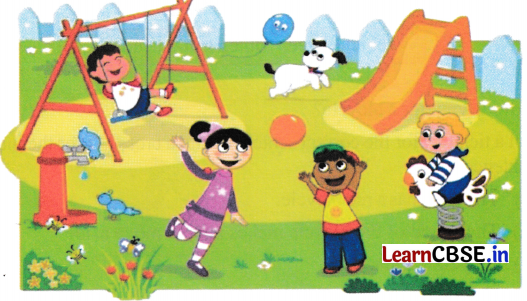
1. What is this place?
2. How many children arc there in the picture?
3. Who are playing?

![]()
Out!
One day Jeet and Babli were playing. They played many games. Both of them skipped the rope. Then they played hide and seek. After that they played bat and ball.
Jeet threw the ball. Babli swung the bat hard. They could not find the ball. Babli rolled rags, paper and wool to make a new ball. Babli threw the ball. Jeet hit the ball hard. Babli caught the new ball. She shouted out! out!
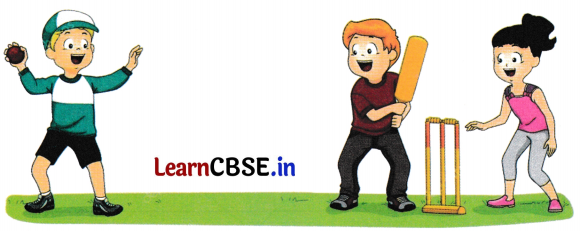
Complete the following sentences.
1. Babli _______the ball.
2. Jeet threw the __________
3. The ball went into _____ garden.
4. They lost the_____
5. Cricket is played with a bat and _____
![]()
Let us Speak
Cricket is a game played with bat and ball. The person who hits the ball is called Batsman another person who bowls is called Bowler. A batsman can be dismissed in a number of ways, the most common being bowled, caught. leg before wicket (LBW). run out and stumped.
A. Answer the following questions:
1. Name the things that you use to play.
2. What games do you like to play?
3. How do you play bat and ball?
4. Which game is played with bat and ball’?
B. Put a Tick (✓) for the correct sentences and a Cross (✗) for the incorrect sentences.
(a) Jeet threw the ball.
(b) Bablihittheball.
(c) The ball went into Ajay’s garden.
(d) They lost the ball.
![]()
Let us
The article ‘an’ is used before a singular noun beginning with a vowel (a, e, i, o and u). A or An is called an indefinite article.
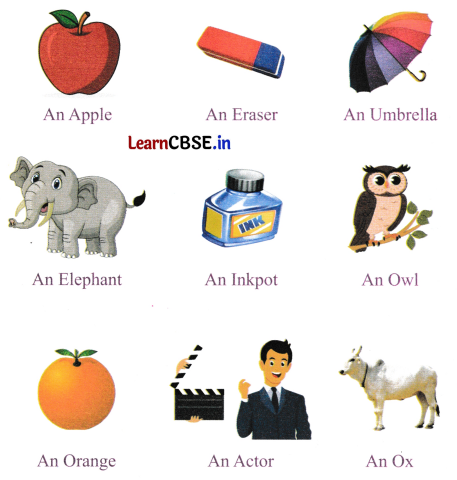
Let us Write
Conjunctions join words and phrases to make complete sentences. One of the most common conjunctions is ‘and’.
Join the following sentences by using ‘and’. One has been done for you.
1. Pooja is sitting. Pooja is eating.
Answer:
Pooja is sitting and eating.
2. He hit the ball. He dropped the bat.
3. The girls went to the mall. They went to the store.
4. I had dinner. I went to sleep.
5. Rudra is tired. He want to sleep.
6. Ajay packed his bag. He went to school.
7. Ram packed his lunch. He went to the office.
8. Kiran went to market. She purchased chocolate.
![]()
Let us Write
Opposite words: The words having the opposite meaning are called antonyms or opposite words.
Word —- Opposite Word
1. On — Off
2. Short —-
3. Big —-
4. Low —-
5. In —-
6. Cold —-
7. Dry —-
8. Near —-
9. All —-
1o. Down —-