Students must start practicing the questions from CBSE Sample Papers for class 9 Social Science with Solutions Set 5 are designed as per the revised syllabus.
CBSE Sample Papers for Class 9 Social Science Set 5 with Solutions
Time Allowed: 3 hours
Maximum Marks: 80
General instructions:
- Question paper comprises five Sections – A, B, C, D, and E. There are 37 questions in the question paper. All questions are compulsory.
- Section A – From questions to 20 are MCQs of 1 mark each.
- Section B – Questions no. 21 to 24 are Venj Short Answer Type Questions, carrying 2 marks each. The answer to each question should not exceed 40 words.
- Section C – Questions no.25 to 29 are Short Answer Type Questions, carrying 3 marks each. The answer to each question should not exceed 60 words.
- Section D – Questions no. 30 to 33 are Long Answer Type Questions, carrying 5 marks each. Answer to each question should not exceed 120 words.
- Section E – Questions no. from 34 to 36 are Case Based Questions with three sub-questions and are of 4 marks each.
- Section F – Question no. .37 is Map-based, carrying 5 marks with two parts, 37a from History (2 marks) and 37b from Geography (3 marks).
- There is no overall choice in the question paper. However, an internal choice has been provided in a few questions. Only one of the choices in such questions has to be attempted.
- In addition to this, separate instructions are given with each section and question, wherever necessary.
Section-A
MCQs
(1 × 20 = 20 Marks)
Question 1.
………………….. period is referred to as the Reign of Terror? [1]
(A) 1789 to 1790
(B) 1791 to 1800
(C) 1793 to 1794
(D) 1794 to 1795
Answer:
Option (C) is correct.
Explanation: Robes Pierre followed a policy of control and punishment. All those whom he saw as being enemies of the republic who did not agree with his methods – were arrested, imprisoned, and then tried by a revolutionary tribunal. If the court found them guilty’ they were guillotined.
Question 2.
Which industry suffered the most during the colonial period? [1]
(A) Agriculture
(B) Textiles
(C) Raw Materials
(D) Manufacturing
Answer:
Option (B) is correct.
Explanation: The policies of the Colonial Government ruined traditional handicrafts and discouraged the development of industries like textiles.
Question 3.
On which of the following dates France declared itself as a Republic? [1]
(A) On 5th November 1791
(B) On 31st December 1789
(C) On 21st September 1792
(D) On 1st November 1792
Answer:
Option (C) is correct.
Explanations The policies of the Colonial Government ruined traditional handicrafts and discouraged development of industries like textiles.
Question 4.
Study the given picture carefully
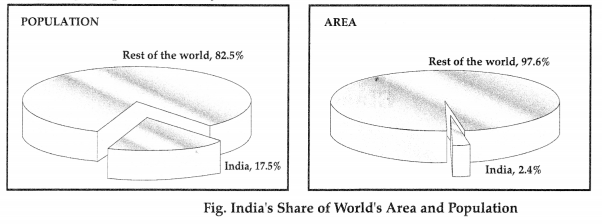
What is India’s share of World’s Area and Population? [1]
(A) 2.4% and 17.5%
(B) 17.5% and 2.4%
(C) 2.4% and 17.5%
(D) 97.6% and 82.5%
Answer:
(C) 2.4% and 17.5%
Question 5.
Which of the following port city/cities owed it! their economic prosperity to the flourishing slave trade? [1]
(A) Bordeaux
(B) Paris
(C) Nantes
(D) Both (A) and (C)
Answer:
Option (D) is correct.
Explanation: French merchants sailed from the ports of Bordeaux or Nantes to the African coast, where they bought slaves from local chieftains.
Question 6.
What was meant by New Harmony? [1]
(A) Abank
(B) A cooperative community
(C) A capitalist
(D) Common man
Answer:
Option (B) is correct.
Explanation: New Harmony was the name given to the cooperative community established b’ the British socialist thinker Robert Owen in Indiana, USA.
Question 7.
Study the picture carefully: [1]
This picture is related to which of the following:
(A) Monarchy
(B) Democracy
(C) Oligarchy
(D) Totalitarianism
Answer:
Option (B) is correct.
Explanation: Titled ‘Electoral Campaigns. this cartoon was drawn in the Latin American context.
Question 8.
The western coastal strip, south of Goa is referred to as: [1]
(A) Coromandel
(B) Konkan
(C) Kannada
(D) Northern Circar
Answer:
Option (C) is correct.
Explanation: Titled Electoral Campaigns’, this cartoon was drawn in the Latin American context
Question 9.
Which plan endeavored to raise the country’s GER? [1]
(A) Tenth
(B) Eleventh
(C) Twelfth
(D) Eighth
Answer:
Option (C) is correct.
Explanation: The twelfth plan endeavored to raise the country’s gross enrolment ratio GER in higher education in the age group of 18 to 23 years.
Question 1o.
The river Narmada has its source at: [1]
(A) Satpura
(B) Brahmagiri
(C) Amarkantak
(D) Slopes of the Western Chats
Answer:
Option (C) is correct.
Explanation: The source of the Narmada is a small reservoir, known as the Narmada Kund. It is located at Amarkantak on the Amarkantak Plateau in the Anuppur District on Shahdol zone of eastern Madhya Pradesh.
Question 11.
In which state of India, the famous cooperative Antul is situated? [1]
(A) Delhi
(B) Gujarat
(C) Karnataka
(D) Punjab
Answer:
Option (B) is correct
Explanation: Amul cooperative is situated in Anand in Gujarat.
Question 12.
The activities of the Ganga Action Plan (GAP) phase-I, were initiated in: [1]
(A) 1985
(B) 1984
(C) 1986
(D) 1989
Answer:
Option (A) is correct.
Explanation: Ganga Action Plan (GAP) is an initiative taken by the Government of India to control the pollution level of River Ganga. Ganga Action Plan (GAP) phase I initiated in 1985.
Question 13.
Which part of India experiences the highest range of temperature in a day? [1]
(A) Gujarat
(B) Madhya Pradesh
(C) Uttar Pradesh
(D) Thar Desert in Rajasthan
Answer:
Option (D) is correct.
Explanation: Ganga Action Plan (GAP) is an initiative taken by the Government of India to control the pollution level of River Ganga. Ganga Action Plan (GAP) phase I initiated in 1985.
Question 14.
Mango showers occur in which group of two states? [1]
(A) Kerala and Karnataka
(B) Kerala and 1mil adu
(C) Karnataka and Andhra Pradesh
(D) Tamil Nadu and Kerala
Answer:
Option (A) is correct.
Explanation: Pre-monsoon showers are common in Kerala and Karnataka and arc often referred as ‘Mango Showers’ as they help in the early ripening of mangoes.
Question 15.
There are two statements marked as Assertion (A) and Reason (R). [1]
Assertion (A): For Lok Sabha elections, the country is divided into 543 constituencies.
Reason (R): The representative elected from each constituency is called a Member of Parliament or an MP.
(A) Both Assertion (A) and Reason (R) are true and Reason (R) is the correct explanation of Assertion (A).
(B) Both Assertion (A) and Reason (R) are true and Reason (R) is not the correct explanation of Assertion (A).
(C) Assertion (A) is correct but Reason (R) is wrong.
(D) Assertion (A) is wrong but Reason (R) is correct.
Answer:
(B) Both Assertion (A) and Reason (R) are true and Reason (R) is not the correct explanation of Assertion (A).
Question 16.
Who implements the Code of Conduct during the elections? [1]
(A) The Election Commission
(B) General Public
(C) Prime Minister
(D) Supreme Court
Answer:
Option (A) is correct.
Explanation: Election Commission of India has established certain code of conduct that to he followed by the political parties and their candidates during the election campaign.
Question 17.
Why is India called a republic? [1]
(A) Because the head of the state is elected
(B) Because it has many cultures
(C) Because it has many religions
(D) Because it has a multi-party system
Answer:
Option (A) is correct.
Explanation: India is called a republic as the head of the country is elected by people, not a monarch.
Question 18.
Which among these concepts describes the greater probability of certain communities remaining poor in the coming years? [1]
(A) Social exclusion
(B) Vulnerability
(C) Poverty line
(D) None of these.
Answer:
Option (B) is correct.
Explanation: Vulnerability to poverty is a measure, which describes the greater probability of certain communities of individuals of becoming or remaining poor in the coming years.
Question 19.
Which among these is the inclusion in the determination of the poverty line for subsistence? [1]
(A) Minimum level of food requirement
(B) Fuel and light
(C) Clothing
(D) All of these.
Answer:
Option (D) is correct.
Exp1antion: Minimum level of food requirement, fuel, and light, clothing are included in the determination of the poverty line for subsistence.
Question 20.
Which among these is the plank on which the anti-poverty strategy of the government is based? [1]
(A) Promotion of economic growth
(B) Targeted anti-poverty programs
(C) Both (a) and (b)
(D) None of these.
Answer:
Option (C) is correct.
Explanation: The anti-poverty strategy of the government is based on two planks-Promotion of economic growth and targeted anti-poverty programs.
Section-B
Very Short Answer Questions
(2 x 4 = 8 Marks)
Question 21.
How were the ideas of the liberals different from that of the radicals in Europe? [2]
Answer:
(i) Liberals argued for a representative, elected parliamentary government, subject to laws interpreted by a well-trained judiciary that was independent of rulers and officials, whereas radicals were in favour of having a government based on the majority of the country‘s population.
(ii) Liberals did not believe in the universal adult franchise, that is, the right of every citizen to vote. They felt men of property mainly should have the vote. They also did not want the vote for women. The radicals on the other hand supported women’s suffragette movements.
Question 22.
Why was every election held in Mexico won by the party called PRI? Explain any two reasons. [2]
Answer:
Every election was won by PRE because:
- Opposition did not contest and never managed to win.
- All those who were employed in the government office had to attend party meetings.
- Teachers of government schools used to force parents to vote for PRI.
- Media did not support the opposition.
Question 23.
What were the main features of the National Food for Work Programme? [2]
Answer:
- NFWP was launched in 2004 in 150 backward districts of the country.
- The programme is open to all the rural poor who are in need of wage employment and desire to do manual unskilled work.
- Implemented on a 100% centrally sponsored scheme and food grains are provided free of cost to the states.
Question 24.
What factors helped the Indian leaders to develop the Indian Constitution? Explain any two. How is the dignity of citizens enhanced in democracy? [2]
Answer:
Factors:
- Ideals of the French Revolution.
- Parliamentary democracy in Britain.
- Bill of Rights in the U.S.
Section-C
Short Answer-Based Questions
(3 x 5 = 15 Marks)
Question 25.
Describe the political conditions in Russia before the Revolution. [3]
Answer:
- Automatic rule of the Tsar was not subject to Parliament’s control.
- Political parties were considered illegal.
- A vast empire consisted of various nationalities, but the Tsar was insensitive to their demands
- Democracy enhances the dignity of citizens in the following ways:
- Democracy is based on the principle of political equality, on recognizing that the poorest and the least educated have the same status as the rich and the educated.
- people are not subjects of a ruler, they are the rulers themselves.
- Even when they make mistakes, they are responsible for their conduct. All the citizens are equal before the law.
Question 26.
Describe the climatic conditions of India during Retreating Monsoon.
OR
How is monsoon known for its uncertainties? [3]
Answer:
Climatic conditions during retreating Monsoons:
- This is the transition period during the months of October and November.
- The season changes from hot and rainy to dry winter conditions. The retreat of the monsoon is marked by clear skies and rise in temperature. Day temperatures are high and nights are cool and pleasant.
- Low-pressure conditions get transferred to the Bay of Bengal by early November
- Cyclonic depressions in the Andaman Sea cause heavy rainfall and are destructive
tropical cyclones
- The alternation of dry and wet spells ‘varies in intensity, frequency, and duration.
- It may cause heavy floods in one part and drought in the other part.
- It is often irregular in its arrival and retreat. Hence, monsoons affect the farming schedule of millions of farmers all over the country.
Question 27.
Explain any three characteristics of the South African Constitution. [3]
Answer:
Characteristics:
- The emergence of the new democratic South Africa under black leaders.
- Based on equality of all races, men and women.
- Extensive rights were given to all the citizens
- Everybody becomes the part of the solution.
- Determination of the people to work together.
Question 28.
How does social composition play an important role in the food security of the country? [3]
Answer:
- The SCs, STs, and sub-sections of the OBCs (lower caste among them) who have either poor land base or very low land productivity are prone to food insecurity.
- The people affected by natural disasters, who have to migrate to other areas in search of work, are also among the most food insecure people.
- High incidence of malnutrition prevails among women.
Question 29.
List any three objectives of the Swarna Jayanti Gram Swarozgar Yojana. [3]
Answer:
- It was started in 1999.
- The programme aims at bringing the assisted poor families above the poverty line.
- It helps the rural people to organise themselves into self-help groups through a mix of bank credit and government subsidy.
Section-D
Long Answer Based Questions
(5 × 4 = 20 Marks)
Question 30.
NREGA 2005 is an important anti-poverty programme. Explain.
OR
Describe the detrimental effect of increasing unemployment on economic growth. [5]
Answer:
- NREGA stands for National Rural Employment Guarantee Act, 2005.
- It aims at providing 100 days assured employment every year to every rural household. If an applicant is not provided employment within 15 days he/she will be entitled to a daily unemployment allowance.
- It initially started for 625 districts, but later on it was extended to all districts of India.
- One-third of the proposed jobs were reserved for women.
- The Central Government established National Employment Guarantee Funds and State Government established State Employment Guarantee Funds for the implementation of the scheme.
OR
- Because of unemployment, people who are an asset turn into a liability.
- There is a feeling of hopelessness and despair among youth.
- People don’t have money to support their family.
- Quality of life of an individual as well as society is adversely affected.
- When the family has to live in bare subsistence level, there is decline in health.
- Wastage of natural resources is another factor which emerges due to unemployment.
Question 31.
How far was the Communist Government responsible for the famine that occurred in China in 1958-1961? Explain.
OR
What weaknesses of democracy do you observe in India? [5]
Answer:
(i) China’s famine 0 1958-1961 was the worst recorded famine in the world history. Nearly three crore people died in this famine. During those days, India’s economic condition was not much better than China’s. Yet, India did not have a famine of the kind in China.
(ii) The Communist Government of China did shut down the gates for international business (import primarily) so, when they had poor food production and also they were not accepting international imports, it led to problems which promoted the famine of 1958.
(iii) The government wanted to revolutionise farming by discarding existing knowledge in favour of new techniques. Farmers were ordered to ‘close plant’ (sowing millions of seeds of different species together in a small area) and ‘deep-plough’ (digging the ground much deeper to encourage deep root growth). Both these experiments failed and entire plantings yielded next to nothing. Farmers were forbidden to use chemical fertilisers and large amounts of land were left fallow with poor results.
(iv) A more tangible cause of famine was grain procurement by the state. From 1953, all Chinese farmers were required to sell grains to the government, at prices and levels decided by the government. Some of these grains were redistributed back to the farmers.
(v) Most, however, was either sent to the cities (the so-called ‘urban food bias’), sold as export grains or distributed as foreign aid, to create the illusion of a booming economy. By the summer of 1959, however, food shortages had reached a critical point. Mao Zedong’s response was to attack his critics rather than relax his policies.
OR
Although democracy has been accepted as the best form of government in the modern world, yet it has its own problems. They are:
- Growing economic and social in equalities among the people: Although all the citizens have the right to vote and fight elections, vet only rich people have a chance to win the election.
- Role of anti-social elements: Voters are forced to vote for a particular candidate or party. Rigging also takes place during the elections.
- Corruption and inefficiency: In many democratic countries of the world, political leaders and government officials are corrupt, dishonest, and inefficient. This affects the working of democracy very badly.
- Casteism and communalism: There are other big challenges in many democratic countries like India. During elections, a large number of voters vote based on the caste and religion of the candidate.
- Political parties also keep in mind the caste or religion of a person while distributing the tickets of the election.
Question 32.
“There has been a sudden abrupt rise in the population of India since 1951.” Support the statement with reasons.
OR
What is growth of population? Explain the three ways by which we can express population change. [5]
Answer:
- India’s population has been steadily increasing from 361 million in 1951 to 1210 million in 2011.
- It reveals that from 1951 to 1981, the annual rate of population growth was steadily increasing, which explains the rapid increase in population from 361 million in 1951 to 683 million in 1981.
- Despite the decline in growth ratio, the number of people being added every decade was steadily increasing.
- Since 1981, however, the rate of growth started declining gradually. During this period, birth rates declined rapidly.
- Still 182 million people were added to the total population in the 1990s alone (an annual addition larger than ever before).
OR
Growth of population: It refers to the change in the number of inhabitants of a country/territory during a specific period of time, say during the last 10 years.
Population change can be expressed in the following ways:
- In terms of absolute numbers, and
- In terms of percentage change per year.
- The absolute numbers added each year or decade is the magnitude of the increase. It is obtained by simply subtracting the earlier population from the later population. It is referred to as the absolute increase.
- The rate or the pace of population increase is the other important aspect. it is studied in percent per annum. This is referred to as the annual growth rate.
Question 33.
How did the First World War affect the Soviets?
OR
Highlight the social and political conditions that led to the Russian Revolution. [5]
Answer:
- In Russia, the war was initially popular and people rallied around Tsar Nicholas II.
- Russia’s armies lost badly in Germany and Austria between 1914 and 1916.
- The var also had a severe impact on industry. Russia’s own industries were few in number and the country was cut off from other suppliers of industrial goods by German control of the Baltic Sea.
- Industrial equipment disintegrated more rapidly in Russia than elsewhere in Europe.
- By 1916, railway lines began to break down. Able-bodied men were called up to the war. As a result, there were labour shortages, and small workshops producing essentials were shut down.
OR
- Autocratic rule of 1ars.
- Conditions of peasants, who earned their living through agriculture.
- Status of industry – factory workers and craftsmen were almost in equal numbers.
- Condition of workers-their working hours were sometimes up to 15 hours,
- Status of nobles-got their power by serving Tsar. Peasants wanted land of nobles.
Section-E
Case-Based Questions
(4 × 3 = 12 Marks)
Question 34.
Read the source given below and answer the questions that follow: (1+1+2=4)
The percentage of the population that is economically active is an important index development. The distribution of the population according to different types of occupation is referred to as the occupational structure. An enormous variety of occupations are found in any country Occupations are, generally classified as primary, secondary, and tertiary. Primary,’ activities include agriculture, animal husbandry, forestry, and fishing. mining and quarrying, etc.
Secondary activities include the manufacturing industry building and construction work, etc. Tertiary activities include transport. communications1 commerce, administration, and other services. The proportion of people working in different activities varies in developed and developing countries. Developed nations have a high proportion of people in secondary and tertiary activities. Developing countries tend to have a higher proportion of their workforce engaged in primary activities.
In India, about 64 percent of the population is engaged only in agriculture. The proportion of the population dependent on secondary and tertiary sectors is about 13 and 20 percent respectively. There has been an occupational shift in favour of secondary and tertiary sectors because of growing industrialisation and urbanisation in recent times.
1. What is an important index of development?
2. How are occupations classified?
3. Why has there been an occupational shift in favour of secondary and tertiary sectors?
Answer:
- The percentage of population that is economically active is an important index of development.
- Occupations are classified as primary secondary and tertiary.
- There has been an occupational shift in favour of secondary and tertiary sectors because of growing md industrialisation and urbanisation in recent times.
Question 35.
Read the source given below and answer the questions that follow: (1+1+2=4)
When the Bolsheviks ordered land redistribution, the Russian army began to break up. Soldiers, mostly peasants, wished to go home for the redistribution and deserted. Non-Bolshevik socialists, liberals, and supporters of autocracy condemned the Bolshevik uprising. Their leaders moved to South Russia and organised troops to fight the Bolsheviks (the ‘reds). During 1918 and 1919, the ‘greens’ (Socialist Revolutionaries) and ‘whites’ (pro-Tsarists) controlled most of the Russian empire.
They were backed by French, American, British, and Japanese troops-all those forces who were worried about the growth of socialism in Russia. As these troops and the Bolsheviks fought a civil war, looting, banditry, and famine became common. Supporters of private property among ‘whites’ took harsh steps with peasants who had seized land. Such actions led to the loss of popular support for the non-Bolsheviks. By January 1920, the Bolsheviks controlled most of the former Russian empire.
They succeeded due to cooperation with non-Russian nationalities and Muslim adidists, Cooperation did not work where Russian colonists themselves turned Bolshevik. In Khiva, in Central Asia, Bolshevik colonists brutally massacred local nationalists in the name of defending socialism. In this situation, many were confused about what the Bolshevik government represented.
1. Why did the Russian army begin to break up when the Bolsheviks ordered land redistribution?
2. Who were the Reds’?
3. Who condemned the Bolshevik uprising? What did the Bolsheviks do in Khiva?
Answer:
- when the Bolsheviks ordered land redistribution, the Russian army began to break up because the soldiers, mostly peasants, wished to go home for the redistribution.
- The Bolsheviks
- Non-Bolshevik socialists, liberals, and supporters of autocracy condemned the Bolshevik uprising. In Khiva, in Central Asia, Bolshevik colonists brutally massacred local nationalists in the name of defending socialism.
Question 36.
Read the source given below and answer the questions that follow: (1+1+2=4)
In Pakistan, General Pervez Musharraf led a military coup in October 1999. He overthrew a democratically elected government and declared himself the ‘Chief Executive’ of the country. Later he changed his designation to President and in 2002 held a referendum in the country that granted him a five-year extension. Pakistani media, human rights organisations, and democracy activists said that the referendum was based on malpractices and fraud. In August 2002, he issued a ‘Legal Framework Order’ that amended the Constitution of Pakistan.
According to this Order, the President can dismiss the national and provincial assemblies. The work of the civilian cabinet is supervised by a National Security Council which is dominated by military officers. After passing this law, elections were held in the national and provincial assemblies. So, Pakistan has had elections, and elected representatives have sorne powers. But the final power rested with military officers and General Musharraf himself.
1. What was the outcome of the military coup led by General Pervez Musharraf in October 1999?
2. The Referendum of Z002 granted him what?
3. According to the ‘Legal Framework Order’, who could dismiss the national and provincial assemblies?
Answer:
- General Pervez Musharraf overthrew a democratically elected government and declared himself the Chief Executive of the country.
- The referendum allowed Pervez Musharraf to continue as the President of Pakistan for five years
- A referendum is a process of voting used to measure public opinion on a particular issue. It is a direct democratic process that allows citizens to participate in decision-making by voting for or against a proposed law or policy.
- According to the legal Framework Order, the President could dismiss the national and provincial assemblies.
Section-F
Map Skill-Based Questions
Question 37.
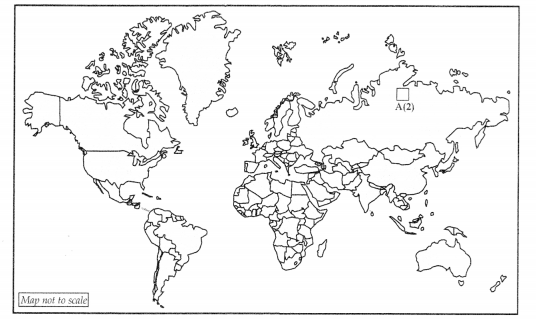
(A)
(1) On the given political map of the world, locate and label: Austria Hungary
(2) Identify the nation that was a member of the Allied Powers during World War II.
Answer:
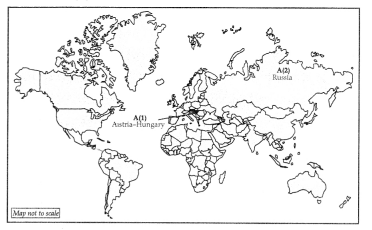
(A)
- Austria-Hungary
- Russia
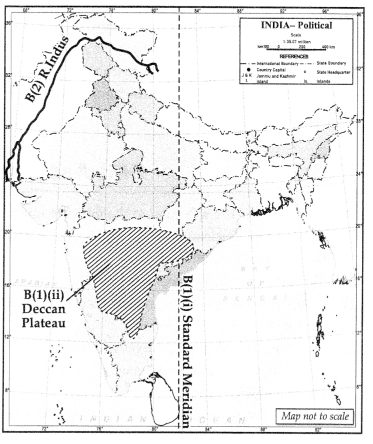
(B) (1) On the given political map of India, locate and label the following:
(i) Standard Meridian
(ii) Deccan Plateau
(2) Identify the river in the map
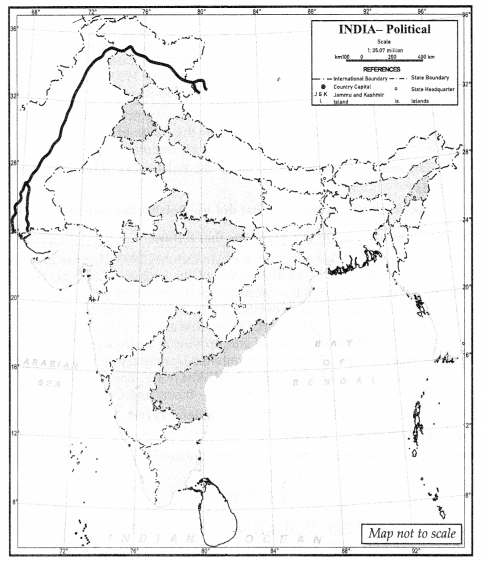
Answer:
(B)
1.
- Standard Meridian
- Deccan Plateau
2. River Indus