Students must start practicing the questions from CBSE Sample Papers for class 9 Social Science with Solutions Set 3 are designed as per the revised syllabus.
CBSE Sample Papers for Class 9 Social Science Set 3 with Solutions
Time Allowed: 3 hours
Maximum Marks: 80
General Instructions
- There are 38 questions in the Question paper. All questions are compulsory.
- The question paper has Four Sections – A-History, B-Geography C-Political Science, and D- Economics.
- Each Section is of 20 Marks and has MCQs, VSA, SA, LAs and CBQ.
- Very Short Answer Type Questions (VSA), carry 2 marks each. Answers to each question should not exceed 40 words.
- Short Answer Type Questions (SA), carry 3 marks each. Answers to each question should not exceed 60 words.
- Long answer type questions (LA), carry 5 marks each. Answers to each question should not exceed 120 words.
- There are case based questions (CBQ) with three sub questions and are of 4 marks each. Answers to each question should not exceed 100 words.
- The map-based questions, carry 5 marks with two parts- Q9. In Section A-History (2 marks) and Q19. In Section B -Geography (3 marks)
- There is no overall choice in the question paper. However, an internal choice has been provided in few questions. Only one of the choices in such questions must be attempted.
Section A (History)
Question 1.
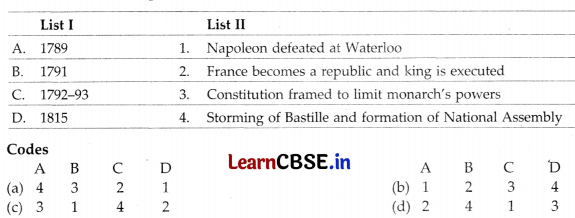
Match the following. (1)
Answer:
(a) 4 3 2 1
Question 2.
Identify and name the leader shown addressing workers in the picture given below. (1)

(a) Vladimir Lenin
(b) Joseph Stalin
(c) Adolf Hitler
(d) Leon Trotsky
Answer:
(a) Vladimir Lenin

Question 3.
Thousands of workers in early 20th-century Russia experienced hardship due to:(1)
(a) lack of agricultural jobs and poor grain production
(b) extremely long working hours and poor factory conditions
(c) absence of railway networks and foreign investment
(d) overregulation of factories by government inspectors
Answer:
(b) extremely long working hours and poor factory conditions
Question 4.
“The Third Estate is the whole. What has it been heretofore in the political order? Nothing. What does it desire to be? Something.” – What was the Third Estate demanding? (1)
(a) More taxes on the First Estate
(b) End of monarchy
(c) Equal political rights and voice in government
(d) More land for nobles
Answer:
(c) Equal political rights and voice in government
Question 5.
“The French government faced a serious economic crisis under Louis XVI.” Explain with two examples. (2)
Or
“The burden of financing the state fell on the Third Estate.” Justify the statement with two examples.
Answer:
The statement can be explained by the following examples
- France’s debt rose to over 2 billion livres and lenders began charging 10% interest on loans.
- To cover expenses like running the army and universities, the government increased taxes, which burdened only the Third Estate, worsening the financial crisis.
Or
The burden of financing the state fell on the Third Estate in the following ways
- Despite being the majority, the Third Estate was solely responsible for paying taxes.
- Meanwhile, the clergy and nobility, who owned most of the land and enjoyed privileges, were exempt from taxation, making the system deeply unfair and exploitative.
Question 6.
“Karl Marx presented a revolutionary form of socialism.” Explain the statement with examples. (3)
Or
“Industrial development in Russia was uneven and limited to certain areas.” Support the statement with examples.
Answer:
The given statement can be explained by the following
- Karl Marx believed that workers were exploited under capitalism, where profits went to factory owners.
- He argued that workers must overthrow capitalism and establish a classless society where property was socially owned.
- Marx, along with Friedrich Engels, proposed that only through revolution could workers end exploitation and create a communist society focused on equality and collective welfare.
Or
The given statement can be supported by the following examples:-
- Industry in Russia was concentrated in pockets like St. Petersburg and Moscow.
- Although coal production doubled and steel output quadrupled in the 1890s due to foreign investment and railway expansion, much of the production was still carried out by craftsmen.
- Small workshops and factories operated side by side, indicating limited and uneven industrial growth.
Question 7.
“Hitler’s rise to power in Germany was not accidental but rooted in deep economic, political and social turmoil.” Critically analyse this statement with suitable examples from the period.
Or
‘The rise of Hitler to the position of Chancellor in 1933 marked the beginning of a totalitarian regime in Germany.’ Examine the key steps taken by Hitler to establish a complete dictatorship after coming in power.
Answer:
Hitler’s rise to power was deeply influenced by the crisis that Germany faced after World War I. The harsh terms of the Treaty of Versailles humiliated the nation, creating widespread resentment. Economic hardship worsened during the Great Depression as banks collapsed, factories closed and unemployment soared. In this environment of desperation, Hitler’s promises of national revival, economic stability and pride found mass appeal.
His powerful speeches and propaganda gave hope to the disillusioned middle and working classes. Furthermore, Hitler’s ability to use mass rallies, symbols like the Swastika and dramatic political rituals helped him mobilise widespread support. His leadership of the Nazi Party transformed it from a fringe group into the largest political party in the Reichstag by 1932. Thus, his rise was a response to Germany’s national crisis, not a mere political accident.
Or
The key steps taken by Hitler to establish a complete dictatorship after coming in power are as follows
- Chancellorship & Fire Decree After becoming Chancellor in January 1933, Hitler used the Reichstag fire to pass the Fire Decree, suspending civil rights like freedom of speech and assembly.
- Eliminating Opposition Communists were arrested in large numbers and sent to concentration camps. Other political parties and trade unions were banned.
- Enabling Act (March 1933) This Act gave Hitler full powers to pass laws without parliament, establishing legal dictatorship.
- Control Over Institutions Hitler brought the judiciary, army, media and economy under Nazi control.
- Police Surveillance State Special forces like the Gestapo and SS were created, with unchecked power to arrest, torture or kill, spreading fear across society.
Question 8.
Read the given source and answer the following questions.
What is liberty? Two conflicting views
The revolutionary journalist Camille Desmoulins wrote the following in 1793. He was executed shortly after, during the Reign of Terror. Some people believe that Liberty is like a child, which needs to go through a phase of being disciplined before it attains maturity. Quite the opposite. Liberty is Happiness, Reason, Equality, Justice, it is the declaration of rights. I would like to finish off all your enemies by guillotining them. Has anyone heard of something more senseless? Would it be possible to bring a single person to the scaffold without making ten more enemies among his relations and friends?
(i) How does Camille Desmoulins define liberty in contrast to others’ beliefs? (1)
(ii) Why does Desmoulins criticize the use of violence in the name of liberty? (1)
(iii) How did revolutionary ideas during the French Revolution shape public opinion about liberty and justice? (2)
Answer:
(i) Camille Desmoulins defines liberty not as something that needs discipline or force to mature, but as a state of Happiness, Reason, Equality and Justice. Instead of supporting the brutal methods of the Reign of Terror, he argues that such violence only breeds more enemies, as executing one person leads to resentment from many others connected to the victim.
(ii) Desmoulins criticizes violence-especially mass executions-as an irrational and counterproductive way to establish liberty. He believes that killing people in the name of freedom contradicts the values liberty stands for. According to him, each execution during the Reign of Terror creates more hostility, as it angers the relatives and friends of those who are killed. This approach, he implies, leads to more division and undermines the very goal of achieving justice and unity.
(iii) Revolutionary ideas during the French Revolution inspired people to think critically about liberty, justice and equality. Intellectuals and journalists like Camille Desmoulins helped shape public opinion by voicing strong critiques of unjust practices, including violence by the state. Public debates, writings, and speeches encouraged the masses to demand rights and participate in political life. However, as the revolution progressed, these ideals were often challenged by violent phases like the Reign of Terror, which led to differing views on how liberty should be achieved and defended.
Map Based Question
Question 9.
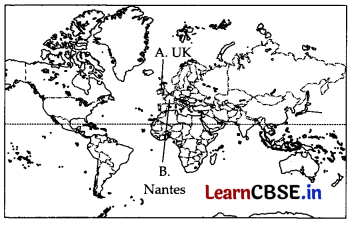
Two places A and B have been marked on the given outline map. Identify them and write their correct names on the lines marked on the map.
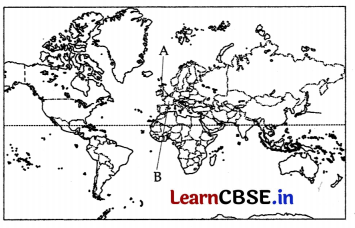
(A) One of the major Allied Powers during World War II which were fighting against the Axis Powers (1)
(B) French port city that thrived economically due to transatlantic slave trade (1)
Answer:
Question 10.
What makes the monsoon a unifying force in the Indian subcontinent? (1)
(a) Its presence is limited only to northern and coastal regions.
(b) It brings predictable and equal rainfall throughout the year.
(c) It provides seasonal rhythm and supports agricultural and cultural life.
(d) It separates the country into distinct climatic zones.
Answer:
(c) It provides seasonal rhythm and supports agricultural and cultural life.
Question 11.
Identify the appropriate option to fill in the empty boxes. (1)
| Population Density Classification | Below 250 persons/km2 | Moderate Density | High to Very High Density |
| Sparse due to rugged terrain and harsh climate | ? | ? | Flat plains, fertile soil and rainfall |
(a) Rajasthan, Assam, Uttar Pradesh
(b) Arunachal Pradesh, Andhra Pradesh, Punjab
(c) Himachal Pradesh, Assam, Bihar
(d) Jammu & Kashmir, Maharashtra, Kerala
Answer:
(d) Jammu & Kashmir, Maharashtra, Kerala
Question 12.
Which of the following is the most important reason why the adolescent population is considered a crucial resource for India’s future? (1)
(a) They require less nutrition compared to adults.
(b) They form a large part of the population with high growth potential.
(c) They contribute to immediate economic growth.
(d) They have limited influence on demographic changes.
Answer:
(b) They form a large part of the population with high growth potential.
Question 13.
Which of the following is the most important role of rivers in the economic development of India? (1)
(a) Rivers provide water essential for irrigation, navigation and hydro-power generation.
(b) Rivers primarily serve as boundaries between states and countries.
(c) Rivers are mainly used for recreational activities and tourism.
(d) Rivers only support urban settlements and have little impact on agriculture.
Answer:
(a) Rivers provide water essential for irrigation, navigation and hydro-power generation.
Question 14.
The Brahmaputra River enters India through which state? (1)
(a) Assam
(b) Arunachal Pradesh
(c) West Bengal
(d) Bihar
Answer:
(b) Arunachal Pradesh
Question 15.
Which of the following statements best evaluates the overall goal of the National Population Policy (NPP) 2000? (1)
(a) To enforce strict population control laws across the country.
(b) To encourage migration from rural to urban areas for better healthcare.
(c) To promote responsible parenthood through education, health and voluntary participation.
(d) To reduce the number of elderly dependents in the population by focusing on youth.
Answer:
(c) To promote responsible parenthood through education, health and voluntary participation.
Question16.
Why do the northern plains of India experience a more distinct winter season compared to the peninsular region? Support your answer with geographical reasons. (3)
Answer:
The northern plains experience colder winters due to their inland location and lack of moderating influence from the sea, unlike the peninsular region. Additionally, western disturbances bring rain and snowfall, further intensifying winter conditions in the north.
Question 17.
Person Q is planning to start a farming-based business in the Northern plains of India. A geographer advised him to choose areas near the Ganga and its Himalayan tributaries. Analyse the possible reasons behind this suggestion. (5)
Or
‘The rivers of the Peninsular plateau play a crucial role in shaping the geography and economy of Southern India.’ Justify this statement by highlighting their features and significance.
Answer:
The reasons behind the advice given to Person Q is based on the rich alluvial soil and fertile plains formed by the Ganga and its Himalayan tributaries like the Yamuna, Ghaghara, Gandak and Kosi. These rivers flood the plains annually, which, despite causing damage, also deposit nutrient-rich silt that enriches the soil, making it ideal for agriculture.
The wide and flat plains, along with the perennial flow of these rivers, ensure a reliable source of water for irrigation. Additionally, the dense population and well-developed transport networks in the Ganga basin provide a strong market for agricultural produce. Therefore, setting up a farming venture in this region offers both natural fertility and economic advantage, making it a wise and profitable choice for agricultural activities.
Or
The Peninsular rivers of India, like the Godavari, Krishna, Mahanadi and Kaveri, play a crucial role in shaping the geography and economy of southern India. These rivers mainly flow eastward due to the slope of the land and drain into the Bay of Bengal, forming fertile deltas that support extensive agriculture. The Godavari, often called the ‘Dakshin Ganga’, is the longest Peninsular river with a vast drainage basin supporting irrigation, drinking water and hydroelectric projects across Maharashtra, Madhya Pradesh and Andhra Pradesh.
In contrast, rivers like the Narmada and Tapi flow westward through rift valleys, creating scenic landscapes and supporting local economies. Their estuaries are important for fishing and minor ports. Thus, Peninsular rivers not only shape the landforms but also provide vital resources that support livelihoods, agriculture, transport and power generation in southern India.
Question 18.
Read the given source and answer the following questions.
Barren Island holds the distinction of being the sole confirmed active volcano in not just India but all of South Asia. This volcanic island sits in the Indian Ocean, roughly 135 kilometers northeast of Port Blair, the capital of Andaman and Nicobar Islands.
Barren Island’s volcanic activity has a long and fiery history. The first recorded eruption occurred in 1787 and the island has since erupted over 10 times. The most recent eruption activity vas reported in 2022, showcasing the volcano’s continued presence as a geological force. Volcanologists and researchers keep a close eye on Barren Island. Studying the island’s activity helps scientists understand volcanic processes better and develop methods for prediction and mitigation of volcanic hazards.
(i) Why do you think the Lakshadweep Islands need special environmental attention? (1)
(ii) How do the Andaman and Nicobar Islands contribute to India’s strategic and ecological importance?Explain with examples. (2)
(ii) Is it right to say that island groups like Lakshadweep and Andaman & Nicobar play a dual role in India’s geography ana security? Justify. (1)
Answer:
(i) Lakshadweep Islands need special environmental attention as they are small coral islands covering only 32 sq km , making them highly sensitive to ecological changes. Their biodiversity and presence of bird sanctuaries make them important but vulnerable. Climate change, rising sea levels and human interference can easily disrupt their fragile ecosystems.
(ii) These islands are located near key international sea routes in the Bay of Bengal, giving them immense strategic value for national security and maritime trade. Ecologically, they host India’s only active volcano on Barren Island and support rich biodiversity due to their equatorial climate and dense forests.
(iii) Yes, these islands are crucial both geographically and strategically. While Lakshadweep supports marine biodiversity and tourism, the Andaman & Nicobar Islands act as sentinels in the Indian Ocean, housing defense installations.
Map Based Question
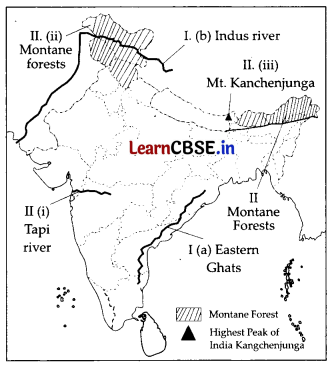
Question 19.
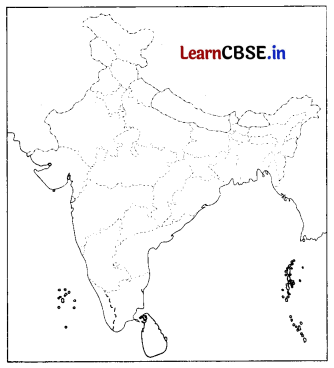
On the outline map of India locate and label the following with suitable symbols (1)
I. (a) A discontinuous mountain range along India’s Eastern coast
Or (b) This river rises in Tibet, near Lake Mansarowar
II. Any two of the following. (2)
(i) This river rises in the Satpura ranges, in the Betul district of Madhya Pradesh
(ii) Silver fir, junipers, pines and birches are the common trees of these forests.
(iii) Highest peak of India
Answer:
Section C (Political Science)
Question 20
Which of the following statements about the South African Constitution-making process are correct? (1)
I. Both black and white leaders agreed to share power and respect each other’s rights.
II. The blacks accepted that majority rule would be absolute and could change rules freely.
III. The constitution was written to guarantee that no future government could easily alter fundamental rules.
IV. Constitution-making in South Africa shows that only countries with past conflict need a constitution.
Choose the correct option.
(a) I and II
(b) I and III
(c) II and IV
(d) III and IV
Answer:
(b) I and III
Question 21.
What does the cartoon illustrate about the relationship between politicians and voters? (1)
(a) Politicians are consistently attentive to the needs of the voters both before and after elections.
(b) Voters are neglected by politicians after the election is over.
(c) Politicians always fulfil their promises to the voters.
(d) Voters are satisfied with the actions of politicians after the elections.
Answer:
(b) Voters are neglected by politicians after the election is over.
Question 22.
Suppose the Prime Minister decides to bypass Cabinet discussions and announces a major policy directly to the media. What does this violate in the functioning of institutions? (1)
(a) The principle of collective responsibility.
(b) The right to freedom of speech.
(c) The authority of the judiciary.
(d) The financial autonomy of the government.
Answer:
(a) The principle of collective responsibility.
Question 23.
Two statements are given as Assertion (A) and Reason(R). Read the statements carefully and choose the suitable option. (1)
Assertion (A) Saudi Arabia is considered an undemocratic country.
Reason (R) Citizens are denied basic democratic rights like political participation, freedom of speech and equality.
Codes
(a) Both A and R are true and R is the correct explanation of A.
(b) Both A and R are true, but R is not the correct explanation of A.
(c) A is true, but R is false.
(d) A is false, but R is true.
Answer:
(a) Both A and R are true and R is the correct explanation of A
Question 24.
Mention any two rights that reflect the freedom guaranteed to citizens under the Indian Constitution. (2)
Answer:
Two rights that reflect the freedom guaranteed to citizens under the Indian Constitution are
(i) Freedom of speech and expression.
(ii) Freedom to reside in any part of India.
Question 25.
“In election campaigns, political parties want to attract the public to that issue and get them to vote for their party on that basis.” Give two examples of impactful political slogans used during election campaigns in India. (2)
Answer:
Two examples of impactful political slogans used during election campaigns in India are
- The slogan Garibi Hatao was used by the Congress in 1971 to promise poverty eradication.
- In 1977, the Janáta Party used Save Democracy to oppose Emergency excesses and assure the restoration of civil liberties.
Question 26.
“Having a constitution helps maintain peace and harmony in a democratic society.” Support this statement with suitable arguments. (2)
Answer:
Having a constitution helps maintain peace and harmony in a democratic society in the following ways
- A constitution creates trust and coordination among diverse people by setting clear rules everyone must follow.
- It defines how governments are formed, limits their powers and guarantees citizens’ rights.
- This prevents any group from dominating others unfairly and ensures peaceful coexistence by resolving conflicts through agreed laws rather than force or chaos.
Question 27.
‘Parliament plays a crucial role in the democratic functioning of a country.’ Explain the significance of Parliament in law-making and government control. (5)
Or
‘The bicameral structure of Parliament strengthens the democratic system in India.’ Analyse the statement.
Answer:
Parliament is the supreme authority representing the people in a democracy. It plays a vital role in law-making by creating new laws, amending existing ones or abolishing outdated laws, which shape the governance of the country. Besides legislation, Parliament controls the government by holding it accountable for its decisions and actions. Government policies are often influenced by Parliamentary debates and discussions, ensuring transparency and public participation.
For example, even if a government decision, like the Mandal Commission’s recommendations, is not directly taken by Parliament then Parliamentary support is essential for its implementation. Without Parliament’s approval, the government cannot function effectively. Thus, Parliament ensures a balance of power, prevents misuse of authority and upholds democratic values.
Or
Indian Parliament consists of two Houses: the Lok Sabha and the Rajya Sabha, each with distinct roles that strengthen democracy. The Lok Sabha, directly elected by the people, holds greater power, especially in financial matters, ensuring direct public representation in decision-making. The Rajva Sabha, elected indirectly, represents states and protects their interests, providing federal balance.
While both the Houses must pass ordinary laws, in case of disagreement, a joint session favours the Lok Sabha’s view due to its larger size. This bicameral system allows checks and balances, prevents hasty decisions, and ensures wider consensus. The President’s assent is also necessary for laws to become effective, adding another safeguard. Thus, the two Houses together maintain stability, inclusiveness and accountability in India’s democracy.
Question 28.
Read the given source and answer the following questions.
The Report and recommendations were discussed in the Parliament.For several years, many parliamentarians and parties kept demanding the implementation of the Commission’s recommendations. Then came the Lok Sabha election of 1989. In its election manifesto, the Janata Dal promised that if voted to power, it would implement the Mandal Commission report. The Janata Dal did form the government after this election. Its leader V. P. Singh became the Prime Minister. Several developments took place after that. It was tasked with identifying socially and educationally backward classes in India.
(i) State the purpose of the Second Backward Classes Commission appointed by the Government of India in 1979. (1)
(ii) Explain the key recommendation of the Mandal Commission made in its 1980 report. (1)
(iii) What were the key steps leading to the formal implementation of the Mandal Commission’s recommendations in 1990? (2)
Answer:
(i) The purpose of the State Backward classes Commission was to identify socially and educationally backward classes and recommend steps for their advancement.
(ii) The Mandal Commission recommended reserving 27 per-cent of government jobs for socially and educationally backward classes.
(iii) Key steps leading to the formal implementation of the Mandal Commission’s recommendations in 1990 included
- The President announced the government’s intention, the Union Cabinet formally decided, Prime Minister V.P. Singh informed Parliament and senior officers drafting the order, which was then approved by the Minister.
- The order was officially signed on 13th August, 1990.
Section D (Economics)
Question 29.
In urban areas, food insecurity mainly affects families whose working members are employed as (1)
(a) highly paid professionals
(b) casual labourers and ill-paid workers
(c) government officers
(d) shop owners
Answer:
(b) casual labourers and ill-paid workers
Question 30.
‘X’ works in his family’s paddy field and the crop is used only for family consumption. Which of the following best describes his work?(1)
(a) Market activity
(b) Non-market activity
(c) Commercial farming
(d) Tertiary activity
Answer:
(b) Non-market activity
Question 31.
Which of the following examples best explains how the tertiary sector supports both the primary and secondary sectors? (1)
(a) Farmers grow vegetables and sell them directly to consumers without any transport or storage.
(b) A bakery bakes bread and delivers it to shops without involving raw materials.
(c) A factory uses raw materials to make shoes and relies on transport and retail services to distribute the shoes.
(d) A furniture company produces wood products but sells them without transport or retail help.
Answer:
(c) A factory uses raw materials to make shoes and relies on transport and retail services to distribute the shoes
Question 32.
What can be concluded about the causes of food insecurity in certain social groups in India? Choose the correct option. (1)
(a) Food insecurity mainly affects those with poor land, low productivity and those displaced by disasters.
(b) Only natural disasters cause food insecurity among all social groups.
(c) Malnutrition only affects adult men in India.
(d) Food insecurity is unrelated to social or economic factors.
Answer:
(a) Food insecurity mainly affects those with poor land, low productivity and those displaced by disasters.
Question 33.
Person X explains the significance of the National Multidimensional Poverty Index (NMPI). Which of the following statements best justifies why this index is important? (1)
(a) It considers multiple indicators like health, education and living standards to identify deprivation.
(b) It focuses only on income levels to measure poverty in India.
(c) It excludes basic facilities like sanitation and drinking water from its assessment.
(d) It only measures poverty among urban households.
Answer:
(a) It considers multiple indicators like health, education and living standards to identify deprivation.
Question 34.
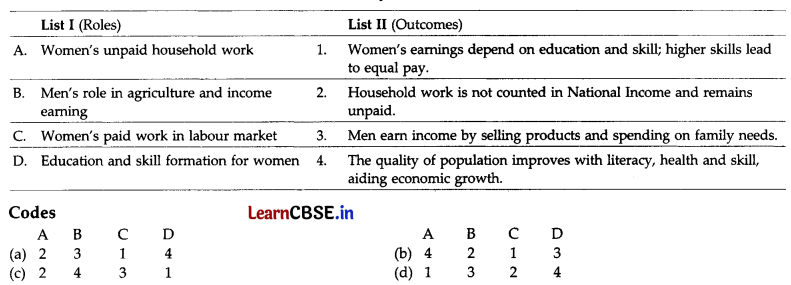
Match the following.
Answer:
2 3 1 4
Question 35.
Discuss how improvements in public healthcare services contribute to enhancing the well-being of individuals and society. (3)
Answer:
Public healthcare services improve well-being by reducing diseases and infant mortality, increasing life expectancy and ensuring better nutrition and child care. Healthy individuals can work more efficiently, contributing to economic growth. Access to affordable healthcare especially benefits underprivileged groups, promoting social equity. Thus, a strong healthcare system supports both personal health and overall societal progress, reflecting the country’s development.
Question 36.
“Addressing social exclusion is essential for ensuring equal access to formal sector loans and promoting national development.” Explain this statement. (3)
Answer:
Addressing social exclusion is essential for ensuring equal access to formal sector loans and promoting national development as
- Social exclusion prevents marginalised groups from accessing formal loans, limiting their opportunities for economic growth.
- When loans are inaccessible due to caste, gender or other biases, poverty persists and deepens.
- Ensuring inclusive loan access helps vulnerable communities build assets, improve education and health and find better jobs. This inclusive approach promotes equality and supports overall national development by empowering all citizens.
Question 37.
Identify three major factors that contribute to food insecurity in certain regions of India.
Answer:
Three major factors that contribute to food insecurity in certain regions of India are
- Food insecurity in India is mainly caused by poverty in economically backward states, frequent natural disasters and the seasonal nature of agricultural work.
- States like Bihar, Jharkhand and Odisha face high hunger levels due to low income and lack of consistent employment.
- Seasonal hunger affects rural and urban casual laborers who lose work during off-seasons, worsening their inability to buy sufficient food.
Question 38.
A research student interviewed two individuals, R and S , to understand the nature of unemployment they face. Based on the interviews, the student concluded that R was experiencing rural unemployment, while S was facing urban unemployment. Analyse the key differences between rural and urban unemployment that led to this conclusion. (5)
Or
Explain how disguised unemployment in the primary sector affects rural employment and migration patterns in India.
Answer:
Rural unemployment mainly includes seasonal and disguised unemployment. Seasonal unemployment occurs as agricultural activities like sowing or harvesting happen only during certain months, leaving people without work in off-seasons. Disguised unemployment happens when more people work on a farm than needed, with extra workers not adding to productivity.
On the other hand, urban unemployment is mostly educated unemployment where even graduates and postgraduates struggle to find jobs. This leads to wastage of skilled manpower, social despair and economic burden. The differences in the type and causes of unemployment in rural and urban areas helped the student to reach this conclusion.
Or
Disguised unemployment in the primary sector occurs when more family members work on the land than actually needed, sharing the produce to ease unemployment hardships. Although this reduces immediate joblessness, it does not eliminate rural poverty. Because surplus labour doesn’t increase productivity, many workers remain underemployed.
Over time, this leads to migration as surplus labour leaves villages in search of better jobs. The decline in dependence on agriculture is partly due to disguised unemployment. Many surplus workers move to the secondary sector, especially small-scale manufacturing or to the tertiary sector, where new services like IT and biotechnology are growing. This shift helps absorb labour but also highlights the need to create more employment opportunities beyond agriculture.