Students must start practicing the questions from CBSE Sample Papers for class 9 Social Science with Solutions Set 1 are designed as per the revised syllabus.
CBSE Sample Papers for Class 9 Social Science Set 1 with Solutions
Time Allowed: 3 hours
Maximum Marks: 80
General Instructions:
- Question paper comprises five Sections – A, B, C, D, and E. There are 37 questions in the question paper. All questions are compulsory.
- Section A – Questions 1 to 20 are MCQs of I mark each.
- Section B – Questions no. 21 to 24 are Very Short Answer Type Questions, carrying 2 marks each. The answer to each
question should not exceed 40 words. - Section C – Questions no. 25 to 29 are Short Answer Type Questions, carrying 3 marks each. The answer to each question should not exceed 60 words.
- Section D – Questions no. 30 to 33 are Long Answer Type Questions, carrying 5 marks each. Answer to each question should not exceed 120 words.
- Section E – Questions no. from 34 to 36 are Case Based Questions with three sub-questions and are of 4 marks each.
- Section F – Question no. 37 is Map based, carrying 5 marks with two parts, 37a from History (2 marks) and 37b from
Geography (3 marks). - There is no overall choice in the question paper. However, an internal choice has been provided in a few questions. Only one of the choices in such questions has to be attempted.
- In addition to this, separate instructions are given with each section and question, wherever necessary.
Section-A
MCQs
(1 × 20 = 20 Marks)
Question 1.
Who among the following sought to refute the Doctrine of the Divine and Absolute Right of the Monarch? [1]
(A) Locke
(B) Rousseau
(C) Aristotle
(D) Plato
Answer:
Option (A) is correct.
Explanation: Locke was from the reign of King Charles I. He believed that all humans are equal. So, through his book Two Treatises of Government, he sought to refute the Doctrine of the Divine and Absolute Right of the Monarch.
Question 2.
Match the correct Columns: [1]
| Column I | Column II |
| (a) Minimum Support Price | (i) Pre-announced price |
| (b) Public Distribution System | (ii) Ration shops |
| (c) The National Food Security Act | (iii) 2013 |
| (d) Revamped Public Distribution | (iv) 1992 |
System
(A) a-i, b-ii, c-iii, d-iv
(B) a-ii, b-i, c-iii, d-iv
(C) a-i, b-i, c-ii, d-iii
(D) a-iii, b-iv, c-ii, d-i
Answer:
(A) a-i, b-ii, c-iii, d-iv
Question 3.
Study the figure carefully and answer the question that follows:
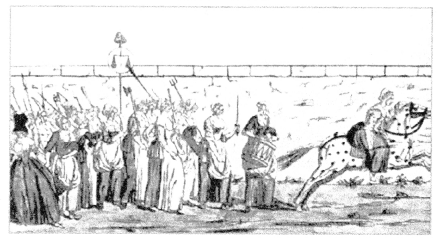
Which of the following options best signifies this figure? [1]
(A) The women demand their rights.
(B) The women marched to Versailles and brought the king back with them to Paris.
(C) People’s participation in government.
(D) None of the above
Answer:
Option (B) is correct.
Explanation: On 5th October 1789, the women marched to Versailles and brought the king back with them to Paris to reform their demands.
Question 4.
Which part of the world shows an increasing trend in poverty? [1]
(A) African region
(B) Asian region
(C) Sub-Saharan Africa
(D) European region
Answer:
Option (C) is correct. [1]
Explanation: Extreme poverty is increasingly centered in Sub-Saharan Africa. In 1990, 13% of people who were living in extreme poverty lived in the region; in 2022, an estimated 62% of people living in extreme poverty lived in Sub-Saharan Africa.
Question 5.
Match the column and choose the correct option: [1]
| Column-I | Column-II |
| (a) 1889 | (i) Hitler was born |
| (b) 1919 | (ii) The Nazi Party was formed |
| (c) 28 February 1933 | (iii) The First Decree |
| (d) 3 March 1933 | (iv) The Enabling Ad was passed |
(A) a-i, b-ii, c-iii, d-iv
(B) a-ii, b-i, c-iv d-iii
(C) a-iv, b-i, c-iii, d-ii
(D) a-i, b-iv c-ii, d-iii
Answer:
(A) a-i, b-ii, c-iii, d-iv
Question 6.
Some of the largest ghettos and gas chambers, the General Government also served as the killing fields for the ………………. . [1]
(A) Jews
(B) Polish
(C) Germans
(D) All of these
Answer:
Option (A) is correct.
Explanation: In some of the largest ghettos and gas chambers, the General Government also served as the killing fields for the Jews. Jews remained the worst sufferers in Nazi Germany. Until medieval times Jews survived mainly through trade and moneviending.
Question 7.
Which is not a sign of democratic elections? [1]
(A) Everyone should have one vote and every vote should have equal value.
(B) Parties and candidates should be free to contest elections and should offer some real choice to the voters.
(C) Elections must be held regularly after every few years.
(D) it is a must the candidate preferred by the people should get elected.
Answer:
Option (D) is correct.
Explanation: It is a must the candidate preferred by the people should get elected.
Question 8.
A statement of Assertion (A) is followed by a statement of Reason (R). [1]
Assertion (A): According to the variations in relief features, the Northern plains can be divided into four regions.
Reason (R): The rivers coming from southern mountains are involved in depositional work.
Mark the correct choice as:
(A) Both Assertion (A) and Reason (R) are true, and Reason (R) is the correct explanation of Assertion (A).
(B) Both Assertion (A) and Reason (R) are true, but Reason (R) is not the correct explanation of Assertion (A).
(C) Assertion (A) is true, but Reason (R) is false.
(D) Assertion (A) is false, but Reason (R) is true.
Answer:
(C) Assertion (A) is true, but Reason (R) is false.
Question 9.
How frequently is the poverty line estimated? [1]
(A) Nearly every four years
(B) Nearly every five years
(C) Nearly every ten years
(D) Nearly every eight years
Answer:
Option (B) is correct
Explanation: The poverty line is estimated periodically (normally every five years) by conducting sample surveys. These surveys are carried out by the National Sample Survey Organisation (NSSO).
Question 10.
Yamuna, Ghaghara and ¡Cosi are important tributaries of which river? [1]
(A) Ganga
(B) Kaveri
(C) Indus
(D) Satluj
Answer:
Option (A) is correct. 111
Explanation: The Ganga is joined by many tributaries from the Himalayas, such as the Yamuna, the Ghaghara, the Gandak and the Kosi.
Question 11.
A statement of Assertion (A) is followed by a statement of Reason (R). [1]
Assertion (A): People who are an asset for the economy turn into a liability.
Reason (R): Unemployment has a detrimental impact on the overall growth of an economy.
Mark the correct choice as:
(A) Both Assertion (A) and Reason (R) are true, and Reason (R) is the correct explanation of Assertion (A).
(B) Both Assertion (A) and Reason (R) are true, but Reason (R) is not the correct explanation of Assertion (A).
(C) Assertion (A) is true, but Reason (R) is false.
(D) Assertion (A) is false, but Reason (R) is true.
Answer:
Option (A) is correct. [11
Explanation: The positive aspect of large population is huge human resources because it provides easy availability of cheap labour which averse economic growth of country.
Question 12.
The Narmada and Tapi are the only long rivers that make [1]
(A) Lagoon
(B) Backwaters
(C) Estuaries
(D) Delta
Answer:
Option (C) is correct.
Explanation: The Narmada and the Tapi are the only long rivers, which flow westward and make estuaries.
Question 13.
What creates a sense of disunity and ‘factionalism’? [1]
(A) Democracy
(B) Non-democracy
(C) Political Competition
(D) Extreme political competition
Answer:
Option (D) is correct.
Explanation: Extreme political competition.
Question 14.
India lies in the region of ………………….. winds. [1]
(A) Northeasterly
(B) Southwesterly
(C) Trade winds
(D) None of these
Answer:
Option (A) is correct.
Explanation: India lies in the region of Northeasterly winds. These winds originate from the subtropical high-pressure belt of the northern hemisphere.
Question 15.
Which among these is China’s highest state body? [1]
(A) People
(B) UNO
(C) National People’s Congress
(D) Monarch
Answer:
Option (C) is correct.
Explanation: The President is elected by the National People’s Congress (NPC), China’s highest state body which also has the power to remove the president and other state officers from office.
Question 16.
What is the basis of a good democratic government? [1]
(A) It functions according to its intuition.
(B) It allows only a few people to enjoy rights.
(C) It consists of a financially sound group of people.
(D) It is accountable.
Answer:
Option (D) is correct.
Explanation: A democratic government is an accountable form of government that improves the quality of decision-making, provides a method to deal with differences and conflicts, and also enhances the dignity of citizens.
Question 17.
People from which country call themselves a part of the rainbow nation? [1]
(A) America
(B) South Africa
(C) Australia
(D) India
Answer:
Option (B) is correct.
Explanation: South Africans call themselves a rainbow nation. It is due to the unity of various cultural, racial, or ethnic groups seen in the country in the post-apartheid era.
Question 18.
Read the following data on Estimates of Poverty in India and select the appropriate option from the following.
| Number of poor (in millions) | ||
| Name of Scheme | Year of Introduction | Issue Price (₹ per kg) |
| RURAL | URBAN | TOTAL |
| 329 | 75 | 404 |
| 326 | 81 | 407 |
| 278 | 76 | 355 |
| 217 | 53 | 270 |
[Source: Economic Survey 201 7-1 8]
Find the decreased number of total poor (in million) from 1993-94 to 2011-12
(A) 49
(B) 134
(C) 3
(D) 124
Answer:
Option (B) is correct.
Explanation: 404-270 = 134
Question 19.
In which year NREGA Act was guaranteed?
(A) 2005
(B) 2009
(C) 2010
(D) 2015
Answer:
Option (A) is correct.
Explanation: NREGA stands for National Rural Employment Guarantee Act, 2005. It aims at providing 100 days of assured employment every year to every rural household. If an applicant is not provided employment within 15 days, he/she will be entitled to a daily unemployment allowance.
Question 20.
What do you call shifting labourers from a rural area to an urban area in search of work?
(A) Migration
(B) Immigration
(C) Transportation
(D) Hibernation
Answer:
Option (A) is correct.
Explanation: In rural areas, employment opportunities are less as compared to urban areas due to limited types of industries. Hence, many people shift from villages to cities in search of work.
Section-B
Very Short Answer Questions
(2 x 4 = 8 Marks)
Question 21.
Who was called the November Criminals’? [2]
Answer:
Those who supported the Weimar Republic, mainly Socialists, Catholics, and Democrats, became easy targets of attack in the conservative nationalist circles. They were mockingly called the ‘November Criminals. The famous Enabling Act was passed on 3 March 1933.
The provisions of this Act are given below:
- The Act established Hitler’s dictatorship in Germany.
- It gave Hitler all powers to sideline Parliament and rule by decree.
- All political parties and trade unions were banned except for the Nazi party and its affiliates.
- The state established complete control over the economy. media, army, and judiciary
- Special surveillance and security forces were created to control and order society in ways that the Nazis wanted.
Question 22.
Write in your own words about Public Interest Litigation. [2]
Answer:
A person can go to Court against the violation of a Fundamental Right. If it is of social or public interest, it is called Public Interest Litigation (PIL). Under the PIL, any citizen or group of citizens can approach the Supreme Court or a High Court to protect the public interest against a particular law or government action.
Question 23.
Give examples of food-insecure families in rural and urban areas. [2]
Answer:
The worst affected groups are landless people with little or no land to depend upon. traditional artisans, providers of traditional services, petty self-employed workers, and destitute including beggars. In the urban areas, food insecure families are those whose working members are generally employed in ill-paid occupations and the casual labour market.
Question 24.
Highlight any two ideals enshrined in the Indian Constitution. [2]
Answer:
Salient features:
- Sovereign-People are masters and have the supreme right to take decisions.
- Socialist-Wealth to be shared equally.
- Secular-It is based on the freedom of religion. All religions should be treated equally.
- Democratic-People have political equality
- Republic-Head of the state is a common man elected by the people.
Section-C
Short Answer-Based Questions
(3 x 5 = 15 Marks)
Question 25.
What changes were incorporated by Bolsheviks after October? [3]
OR
What effects did the First World War have on industry of Russia? [3]
Answer:
Changes were:
- Most of the industries and banks were nationalised in November 1917.
- Land was declared social property.
- In cities, Bolsheviks enforced the partition ot large houses according to family requirements.
- Banned the use of the old titles of the aristocracy.
- New uniforms were designed for the army and officials.
The First World War badly hit the Russian industries. Russia’s own industries were few in number and the country was cut off from other suppliers of industrial goods by German control of the Baltic sea. Industrial equipment disintegrated more rapidly in Russia than elsewhere in Europe. By 1916, railway lines began to break down. Able-bodied men were
called up to the war.
As a result, there were labour shortages, and small workshops producing essentials were shut down. Large supplies of grain were sent to feed the army. Thus, bread and flour became scarce for the people in the cities.
Question 26.
Why monsoon is treated as a unifying bond? Explain in your words. [3]
Answer:
Because of the monsoon’s unpredictable nature, rainfall distribution varies drastically from region to region. Major variations can also be seen in the annual precipitation from year to year. The phenomenon of monsoon is an integral part of the Indian landscape, animal, and plant life, agricultural calendar, and the life of the people and their festivities.
‘Year after year, the people of India from north to south and from east to west, eagerly await the arrival of the monsoon.
‘These monsoon winds bind the whole country’s water to set agricultural activities in motion.
Question 27.
Can Zimbabwe be called a democratic country? Give any two examples to support your answer. [3]
Answer:
The leader ruling Zimbabwe since 1980 was Robert Mugabe. His rule cannot be called democratic because of the following reasons:
- Unfair practices used in elections.
- Changes made in the Constitution to increase the powers of the President.
- This made him less accountable.
Question 28.
Explain the main causes of poverty in India. [3]
Answer:
Main causes of poverty in India are:
- Huge income inequalities make it difficult for government policies to implement properly For poverty elimination. Therefore, income inequality is a major cause of poverty in India.
- Exploitation of traditional Indian handicrafts and textile industries by the British colonial administration is another major cause of poverty.
- In order to fulfill social obligations and observe religious ceremonies, the poor spend a lot of money. Poor people borrow money for different reasons and become the victims of indebtedness.
Question 29.
Which social and economic groups are more vulnerable to poverty? [3]
Answer:
- Social groups which are most vulnerable to poverty are scheduled caste and scheduled tribe households.
- Among the economic groups, the most vulnerable group are the rural agricultural labour households.
- In urban areas the casual labour households.
Section-D
Long Answer Based Questions
(5 x 4 = 20 Marks)
Question 30.
Describe anti-poverty measures taken by the government. In your opinion, have these measures reduced poverty in India? Explain with examples. [5]
OR
Explain any five anti-poverty measures taken by the government of India.
Answer:
Anti-poverty measures taken by the Indian Government are based on two main objectives:
Increasing economic growth in the country and launching anti-poverty programmes for specific groups of people. The Government of India has launched several anti-poverty programmes like the Prime Minister Rozgar Yojna, Rural Employment Guarantee Programme, and Swarnajayanti Gram Swarozgar Yojna which are aimed at generating self-employment opportunities in rural areas.
Human poverty extends beyond the traditional definition of poverty to include lack of housings education, healthcare, job security, and lack of equal opportunities or dignity due to discrimination based on caste, colour, or gender.
India’s future in combating poverty appears bright. Rising economic growth, falling population growth rate, radical schemes for free elementary education for all, and empowerment of women and the weaker sections of society should result in an appreciable reduction of poverty in the years to come.
OR
The current anti-poverty strategy of the government is based broadly on two planks:
- Promotion of economic growth.
- Targeted anti-poverty programmes. Important anti-poverty programmes which are in operation in rural and urban areas are:
(a) Prime Minister Rojgar Yojana (PMRY): to every rural household in 200 districts. Later, the scheme will be extended to 600 districts.
(b) National Food for Work Programme (NFWP): This was launched in 2004 in 150 most backward districts of the country. The programme is open to all rural poor who are in need of wage employment and desire to do manual unskilled work. Once the NREGA is in forces the NWFP will be subsumed within this programme.
(c) Swarnajayanti Gram Swarojgar Yojana (SGSY): SGSY was launched on 1st April 1999. It aims at promoting enterprises at the village level. it helps the rural people to organise themselves into self-help groups. The objective of SGSY is to bring the existing poor families above the poverty line by providing them income-generating assets through bank credit and government subsidy.
(d) Pradhan Mantri Gramodaya Yojana (PMGY)
- PMGY was introduced in 2000.
- Its objective is to focus on village-level development in five critical areas, that is, primary health, primary education, rural shelter, drinking water, and roads. As a result of this, the quality of life of rural people will improve.
(e) National Rural Employment Guarantee Act (NREGA): NREGA was passed in September 2005. The Act provides for 100 days assured employment to every rural household in 200 districts. Later, the scheme will be extended to 600 districts.
(f) National Food for Work Programme (NFWP): This was launched in 2004 in 150 most backward districts of the country. The programme is open to all rural poor who are in need of wage employment and desire to do manual unskilled
work. Once the NREGA is in force, the NWFP will be subsumed within this programme.
Question 31.
Explain the violation of rights in the USA and Yugoslavia. [5]
OR
Write any three arguments in favour and two against democracy as a form of government.
Answer:
Violation of rights in the USA About 600 people were secretly picked up by US forces from all over the world and put in a prison in Guantanamo Bay, an area near Cuba controlled by the American Navy.
- The American Government said that they were enemies of the US and linked to the attack on New York on 11th September 2001.
- Families of prisoners, media, or even UN representatives were not allowed to meet them. The US Army arrested them, interrogated them, and decided to keep them there. There was no trial before any magistrate in the US.
- Amnesty International, an International human rights organisation, collected information on the condition of the prisoners in Guantanamo Bay and reported that the prisoners were being tortured in ways that violated US laws.
Violation of rights in ‘Yugoslavia Kosovo was a province of Yugoslavia before its split. In this province, the population was overwhelmingly ethnic Albanian Muslims. But in the entire country, Serbs (Christians) were in the majority.
A narrow-minded Serb nationalist Milosevic had won the election. His government was very hostile to the Kosovo Albanians. He wanted the Serbs to dominate the country. Many Serb leaders thought that ethnic minorities like
Albanians should either leave the country or accept the dominance of the Serbs.
74-year-old Batisha Hoxha was sitting in her kitchen with her 77-year-old husband Izet, staying warm by the stove. She knew five or six soldiers had burst through the front door and were demanding her children.
‘They shot Izet three times in the chest. When her husband was dying, the soldiers pulled the wedding ring off, and even before she came out of the house, they burnt her house.
OR
Arguments in favour of democracy:
- A democratic form of government is more accountable
- It improves the quality of decision-making.
- It provides a method to deal with differences and conflicts.
- It enhances the dignity of citizens.
- It allows us to correct our mistakes.
Arguments against democracy
- Change of leaders leads to instability.
- It involves only political competition with no scope for morality.
- Consulting more people leads to delays.
- It leads to corruption.
- Ordinary people don’t know that what is good for them.
Question 32.
Describe the regional variations in the climatic conditions of India with the help of suitable examples. [5]
OR
Describe any five characteristic features of the hot weather season in India.
Answer:
Though there is an overall unity in a general pattern of monsoon, there are still some regional variations in climatic conditions. The two important elements that cause these variations are temperature and rainfall. For example, in summer the temperature is about 50 degrees in Rajasthan, and on the same day, it is about 20 degrees in Pahalgam of Jammu and Kashmir.
In the same way on a winter night temperature at Drass it may be as low as minus 45 degrees and in Thiruvananthapuram, it is 20 degrees.
OR
- March to May.
- Low pressure develops extending from Thar Desert, in the North-west to Patna and Chota Nagpur Plateau in the East and South-east.
- Temperature ranges between 38 degrees Celsius and 45 degrees Celsius in the North.
- Pre-monsoon showers are common; are known as KM Baisakhi, Mango Showers.
- Striking feature: Loo, a hot, dry, dusty, and strong wind blows over the North and North-west India.
Question 33.
Highlight five main features of Nazi schooling to establish a strong Nazi Society. [5]
OR
Explain the role women played in Nazi society.
Answer:
Important features of education imparted in Nazi schools:
- Children were segregated. The Germans and the Jews could not sit or play together. Subsequently. undesirable children like Jews and the physically handicapped; the Gypsies were thrown out of schools.
- All schools were cleansed or purified. This meant that teachers who were Jews or seen as politically unreliable were dismissed.
- Good German children were subjected to a process of Nazi schooling, a prolonged period of ideological training.
- Boxing was introduced as Hitler believed that it could make children iron-hearted, strong, and masculine.
- School textbooks were rewritten.
- Children were taught to be love and to hate Jews and worship Hitler.
OR
Status of women in Germany:
- Children in Nazi Germany were told that women were radically different from men.
- While boys were taught to be aggressive, masculine, and steel-hearted, girls were told to be good mothers and rear pure-blooded Aryan children. They had to teach Nazi values to their children.
- Women bearing undesirable children were punished and those bearing desirable were awarded.
- Girls had to maintain the purity of race.
- They had to keep distance from the Jews, look after their home and teach Nazi values to their children.
- To encourage women to produce more children, a bronze cross was given for four, silver for six, and gold for eight or more children.
- Those who maintained contacts with the Jews, Poles, or Russians were severely punished.
Section-E
Case-based Questions
(4 x 3 = 12 Marks)
Question 34.
Read the source given below and answer the questions that follow: (1+1+2=4)
The Indian desert lies towards the western margins of the Aravalli Hills. It is an undulating sandy plain covered with sand dunes. This region receives very low rainfall below 150 mm per year. It has an arid climate with low vegetation cover. Streams appear during the rainy season. Soon after they disappear into the sand as they do not have enough water to reach the sea. Luni is the only large river in this region. Barchans (crescent-shaped dunes) cover larger areas hut longitudinal dunes become more prominent near the IndoPakistan boundary. If you visit Jaisalmer, you may go to see a group of barchans.
1. What are barchans?
2. Which river flows through the That desert?
3. Write a short note on Thar desert.
Answer:
1. Barchans (crescent-shaped dunes) cover larger areas but longitudinal dunes become more prominent near the Indo. Pakistan boundary.
2. Luni is the only large river in this region.
3. The Indian desert lies towards the western margins of the Aravalli Hills. It is an undulating sandy plain covered with sand dunes. This region receives very low rainfall below 150mm per year. It has an arid climate with low vegetation cover. Streams appear during the rainy season.
Question 35.
Read the source given below and answer the questions that follow: (1+1+1+2=4)
One of the groups which looked to change society was the liberals, liberals wanted a nation that tolerated all religions. We should remember that at this time European states usually discriminated in favour of one religion or another (Britain favoured the Church of England, Austria and Spain favoured the Catholic Church). Liberals also opposed the uncontrolled power of dynas6c rulers.
They wanted to safeguard the rights of individuals against governments. They argued for a representative elected parliamentary government, subject to laws interpreted by a well-trained judiciary that was independent of rulers and officials. However, they were not democrats’. They did not believe in the universal adult franchise, that is, the right of every citizen to vote. They felt men of the property mainly should have the vote. They also did not want the vote for women.
I. What type of nation did liberals want?
2. Which group argues about parliament government?
3. How conservatives were different from radicals and liberals.
Answer:
1. Liberals wanted a nation that tolerated all religions. They wanted to safeguard the rights of individuals against governments.
2. Liberals
3. Uberals: Russian Society wanted to reform
Russia and wanted to have a country that accept all religions and faith liberals promoted democracy secularism, individual rights, freedom of speech, freedom of the press, freedom of knowledge, and a market economy.
Radicals: Radicals are a group of individuals who desire to have a country where the government focuses on the majority population of a country They rejected the privilege of wealthy factory owners and rich people.
Conservatives: This group of people hated radicals and liberals they believed that a gradual process is necessary to have a big change and they also thought that history should be honoured.
Question 36.
Read the source given below and answer the questions that follow: (1+1+2=4)
China’s lamine of 1958-1961 was the worst recorded famine in world history. Nearly, three crore people died in this famine. During those days, India’s economic condition was not much better than China. Yet, India did not have a famine of the kind China had. Economists think that this was a result of different government policies in the two countries. The existence of democracy in India made the Indian Government respond to food scarcity in a way that the Chinese government did not. They point out that no large-scale famine has ever taken place in an independent and democratic country. If China too had multiparty elections, an opposition party, and a press free to criticise the government, then so many people may not have died in the famine.
This example brings out one of the reasons why democracy is considered the best form of government. Democracy is better than any other form of government in responding to the needs of the people. A non-democratic government may and can respond to the people’s needs, but it all depends on the wishes of the people who rule. If the rulers don’t want to, they don’t have to act according to the wishes of the people. A democracy requires that the rulers have to attend to the
needs of the people. A democratic government is a better government because it is a more accountable form of government.
1. Which party is ruling in China?
2. Mark the features of non-democratic.
3. Describe about features of Democratic government.
Answer:
1. CCP
2. A non-democratic government may and can respond to the people’s needs, but it all depends on the wishes of the people who rule. If the rulers don’t want to, they don’t have to act according to the wishes of the people.
3. A democracy requires that the rulers have to attend to the needs of the people. A democratic government is a better government because it is a more accountable form of government.
Section-F
Map Skill-Based Questions
Question 37.
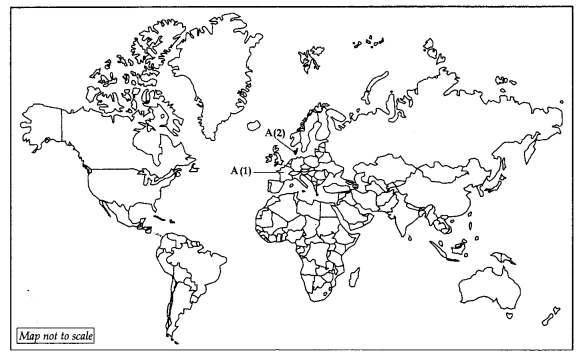
(A) On the given political map of the world, locate and label: (1 x 2 = 2)
(1) Locate and label the country where the French Revolution started
(2) Identify the territory that was under German expansion- Nazi power.
Answer:
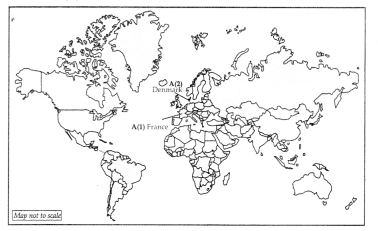
(A)
(1) France
(2) Denmark
(B)
(1) On the given political map of India, locate and label the following:
(i) Anamudi Peak
(ii) Wular Lake
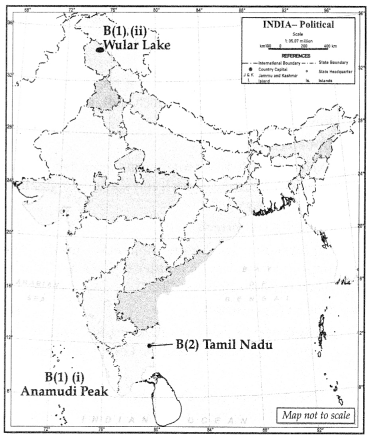
(2) Identify the state having low density of population.
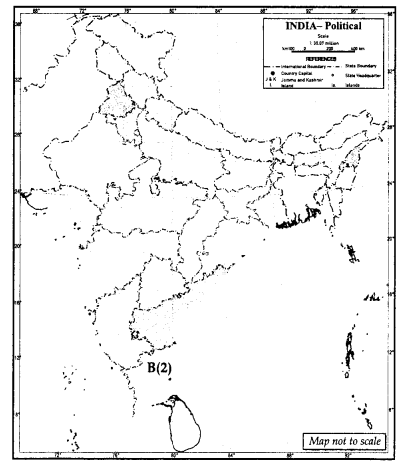
Answer:
(B)
(1) (i) (ideals) and (ii) Wular Lake
(2) Tamil Nadu.