Students must start practicing the questions from CBSE Sample Papers for Class 9 Science with Solutions Set 5 are designed as per the revised syllabus.
CBSE Sample Papers for Class 9 Science Set 5 with Solutions
Time Allowed :3 Hours
Maximum Marks:80
General Instructions:
Read the following instructions carefully.
- This question paper consists of 39 questions in 5 sections.
- All questions are compulsory. However, an internal choice is provided in some questions. A student is expected to attempt only one of these questions.
- Section A consists of 20 objective-type questions carrying 1 mark each.
- Section B consists of 6 Very Short questions carrying 2 marks each. Answers to these questions should be in the range of 30 to 50 words.
- Section C consists of 7 Short Answer type questions carrying 3 marks each. Answers to these questions should be in
the range- of 50 to 80 words. - Section D consists of 3 Long Answer type questions carrying 5 marks each. Answer to these questions should be in the range of 80 to 120 words.
- Section E consists of 3 source-based/case-based units of assessment of 4 marks each with sub-parts.
Section – A
(Select and write the most appropriate option Out of the four options given for each of the questions 1-20. There is no negative mark for incorrect response:)
Question 1.
Tina found three syringes of the same size closed with rubber cork. She took the piston out of each syringe and filled them with coconut oil, sawdust, and cotton. Tina closed the end of each syringe with a piston. She then tried to press the piston of each syringe as much as possible. [1]
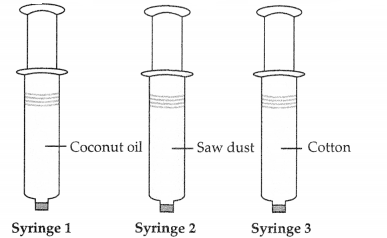
Arrange the syringes in increasing order of difficulty of pressing the piston.
Key: less difficult → more difficult
(A) Syringe 1 → Syringe 2 → Syringe 3
(B) Syringe 3 → Syringe 2 → Syringe 1
(C) Syringe 1 → Syringe 3 → Syringe 2
(D) Syringe 2 → Syringe 3 → Syringe 1
Answer:
Option (C) is correct.
Explanation: Increasing order of difficulty to press the piston:
Syringe 1 → Syringe 3 → Syringe 2,
as syringe 1 contains a liquid, syringe 2 contains a solid, and syringe 3 contains a solid with a lot of air spaces.
Question 2.
Which of the following statements are true for pure substances? [1]
(i) Pure substances contain only one kind of particles.
(ii) Pure substances may be compounds or mixtures.
(iii) Pure substances have the same composition throughout.
(iv) Pure substances can be exemplified by all elements other than nickel.
(A) (i) and (ii)
(B) (i) and (iii)
(C) (iii) and (iv)
(D) (ii) and (iii)
Answer:
Option (B) is correct.
Explanation: A pure substance is one which is made up of only one kind of atoms or molecules. They have the same composition throughout.
Question 3.
In a laboratory, while doing an experiment, carbon dioxide was taken in an enclosed cylinder and compressed by applying pressure and keeping a low temperature. Which state of matter we will obtain after completion of the above-given process? [1]
(A) Solid
(B) Liquid
(C) Gas
(D) Both (A) and (B)
Answer:
Option (B) is correct.
Explanation: Liquid state of matter will be obtained and the process is known as liquefication. Liquefication is the change of state from gas to the liquid by increasing pressure or decreasing temperature.
Question 4.
The pictures show the arrangement of electrons in tle shells of different atoms.
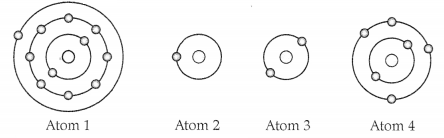
Which atom has the highest atomic number?
(A) Atom 1
(B) Atom 2
(C) Atom 3
(D) Atom 4
Answer:
Option (A) is correct.
Explanation: Atom 1 has 11 electrons means 11 protons. So its atomic number is 11, which is highest among the given atoms.
Question 5.
Rutherford’s a-particle scattering experiment showed that:
(i) Electrons have a negative charge.
(ii) The mass and positive charge of the atom is concentrated in the nucleus.
(iii) Neutron exists outside the nucleus.
(iv) Most of the space in the atom is empty.
Which of the above statements are correct?
(A) (i) and (iii)
(B) (ii) and (iv)
(C) (i) and (iv)
(D) (iii) and (iv)
Answer:
Option (B) is correct.
Explanation: Points (ii) and (iv) are correct. An atom consists of a positively charged, dense and very small nucleus which has all the protons and neutrons. Positive charge is due to protons, as neutrons have no charge. Most of the space is empty because most of the alpha particles pass straight through the gold foil without any deflection. Electrons have negative charge.
Question 6.
Seema visited a Natural Gas Compressing Unit and found that the gas can be liquefied under specific temperature and pressure conditions. While sharing her experience with friends she got confused. Help her to identify the correct set of conditions. [1]
(A) Low temperature, low pressure
(B) High temperature, low pressure
(C) low temperature, high pressure
(D) High temperature, high pressure.
Answer:
Option (C) is correct
Explanation: There is a lot of space between the particles of a gas. On applying high pressure, the particles of gas move so close that they start attracting each other sufficiently forming a liquid. Keeping the temperature low keeps the energy of gas particles low, making it easier to liquefy.
Question 7.
Tincture of iodine has antiseptic properties. This solution is made by dissolving: [1]
(A) iodine in potassium iodide
(B) iodine in vaseline
(C) iodine in water
(D) iodine in alcohol
Answer:
Option (D) is correct.
Explanation. A tincture of iodine is made by dissolving iodine in alcohol.
Question 8.
The only cell organelle seen in prokaryotic cell is: [1]
(A) Mitochondria
(B) Rihosome
(C) Plastids
(D) lysosomes
Answer:
Option (B) is correct.
Explanation: A prokaryotic cell Lacks membrane-bound organelles like plastids, mitochondria and endoplasmic reticulum but smaller and randomly scattered ribosomes are seen.
Question 9.
Which of the following does not lose their nucleus at maturity?
(A) Companion cells
(B) Red blood cells
(C) Vessel
(D) Sieve tube cells
Answer:
Option (A) is correct.
Explanation: Companion cells do not lose nucleus at maturity. RBC, vessels, and sieve tube cells lose their nucleus at maturity.
Question 10.
Fats are stored in the human body as; [1]
(A) Cuhoidal epithelium
(B) Adipose tissue
(C) Bones
(D) Cartilage
Answer:
Option (B) is correct.
Explanation: Adipose tissue stores tat and acts as an insulator.
Question 11.
Contractile proteins are found in: [1]
(A) Bones
(B) Blood
(C) Muscles
(D) Cartilage
Answer:
Option (C) is correct
Explanation: Contractile proteins are found in muscles, as they are associated with the movement of body or limbs.
Question 12.
Organelle other than the nucleus, containing DNA is [1]
(A) Endoplasmic reticulum
(B) Golgi apparatus
(C) Mitochondria
(D) Lysosome
Answer:
Option (C) is correct.
Explanation: Mitochondria contains DNA and are able to synthesize their own proteins. They are also known as semi-autonomous organelles.
Question 13.
Suppose a boy is enjoying a ride on a merry-go-round which is moving with a constant speed of 10 ms-1. It implies that the boy is: [1]
(A) At rest
(B) Moving with no acceleration
(C) In accelerated motion
(D) Moving with uniform velocity
Answer:
Option (C) is correct.
Explanation: in merry-go-round, the speed is constant but velocity is not constant, because its direction goes on changing i.e., there is acceleration in the circular motion. So, we can say that the boy is in accelerated motion.
Question 14.
Expression for the power of an object is equal to: [1]
(A) Power = Work done x Time
(B) Power = \(\frac{\text { Time }}{\text { Work done }} \)
(C) Power = \(\frac{\text { Work done }}{\text { Time }}\)
(D) Power = Force × Displacement
Answer:
Option (C) is correct.
Explanation: Power is rate at which work is done.
Question 15.
Find out the wrong statement from the following. [1]
(A) White Revolution is meant for increase in milk production.
(B) Blue Revolution is meant for increase in fish production.
(C) Increasing food production without compromising environmental quality is called sustainable agriculture.
(D) None of the above [1]
Answer:
Option (D) is correct.
Explanation: All the statements are correct. White revolution is meant for increase in milk production, blue revolution is meant for increase in fish production and green revolution is for high production of food grains. Sustainable agriculture is the increasing food production without compromising with environmental quality.
Question 16.
Animal husbandry is the scientific management of: [1]
(i) Animal breeding
(ii) culture of animais
(iii) animal livestock
(iv) rearing of animals
(a) (i), (ii), and (iii)
(b) (ii), (iii), and (iv)
(c) (i), (ii), and (iv)
(d) (i), (iii), and (iv)
Answer:
Option (D) is correct.
Explanation: Animal husbandry is scientific management of animal breeding, animal’s livestock, and rearing of animals.
Assertion-Reason Based Questions
Question No. 17 to 20 consist of two statements – Assertion (A) and Reason (R). Answer these questions selecting the appropriate option given below:
(A) Both (A) and (R) are true, and (R) is the correct explanation of (A).
(B) Both (A) and (R) are true, and (R) is not the correct explanation of (A).
(C) (A) is true but (R) is false.
(D) (A) is false but (R) is true.
Question 17.
Assertion (A): ElemcnLs and compounds are pure substances. [1]
Reason (R): The properties of compounds are different from those of its constituent elements.
Answer:
Option (B) is correct
Explanation: A pure substance may either contain constituent particles of only one kind or of different kinds. A pure substance has a fixed composition. Thus, elements and compounds are example of pure substances. Properties of compounds are different from those of its constituent elements.
Question 18.
Assertion (A): Chloroplast performs photosynthesis. [1]
Reason (R): Chloroplast comprises photosynthetic pigments.
Answer:
Option (A) is correct.
Explanation: Chioroplast is involved in the process of photosynthesis. It comprises a photosynthetic pigment called chlorophyll, which haps energy from the Sun.
Question 19.
Assertion (A): Motion of satellites around their planets is considered an accelerated motion. [1]
Reason (R): During their motion, the speed remains constant, while the direction of motion changes continuously,
Answer:
Option (A) is correct
Explanation: Satellites revolve around their planets in almost circular orbits with constant speed. Thus, during their motion, the speed remains constant, while the direction of motion changes continuously. As a result, there is a change in their velocity. Therefore, the motion of satellites around their planets is considered as accelerated motion.
Question 20.
Assertion (A): Fisheries are important place in the Indian economy. [1]
Reason (R): It provides income and employment to millions of farmers and fishermen, particularly in coastal states.
Answer:
Option (A) is correct.
Explanation: Fisheries are an important place in the Indian economy as it provides income and employment to millions of farmers and fishermen, particularly in coastal states.
Section – B
(Questions No. 21 to 26 arc very short answer questions)
Question 21.
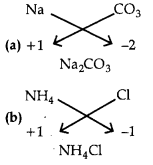
Write the chemical formula of: [2]
(a) Sodium carbonate
(b) Ammonium chloride
Answer:
Question 22.
Give any two functions of plastids. [2]
Answer:
- Chloroplast is the site of photosynthesis and helps in preparing the food (in case of plants).
- Leucoplasts are the site of storage of food.
- Chrornoplast provide colour to various flowers and fruits. (Any two)
Question 23.
list two points of differences between parenchyma and sclerenchyma. [2]
OR
Mention one region in the human body where adipose tissue is present and state one function of the tissue.
Answer:
Parenchyma tissue: In this, cells are found with thin cell walls and are usually loosely packed so that large intercellular spaces are found.
Scierenchyma: Cells are dead and cell wall is thickened due to lignin. It provides strength to plants.
OR
It is found below the skin. It acts as an insulator.
Question 24.
To establish the relation between the loss in weight of a solid when immersed in water with the weight of water displaced by it, four students A and B, performed an experiment. They noted following readings.
| Student | Wt. of the object in air | Weight lost by the object | Buoyant force | Weight of the water displaced |
| A | 100 N | 30 N | 70 N | 30 N |
| B | 100 N | 30 N | 30 N | 70 N |
Readings of which students are correct and why? [2]
Answer:
The reading of student A is correct. This is because,
Buoyant force = weight of the object in the air – weight lost by the object. = 100-30 = 70 N.
Weight of water displaced = 100 – 70 = 30 N.
Question 25.
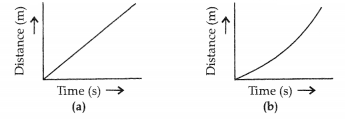
Which of the following figure represents the uniform motion of a moving object correctly? Why? [2]
Why is it easier to stop a tennis ball in comparison to a cricket ball moving with the same speed?
Answer:
Figure (a) represents uniform motion correctly. This is because, for uniform motion, the distance-time graph is a straight line, as in uniform motion object covers an equal distance in equal interval of time.
OR
Tennis ball is lighter (less mass) than a cricket ball. Tennis ball moving with the same speed has less momentum (mass × velocity) than a cricket ball. It is easier to stop tennis ball having less momentum than a cricket ball.
Question 26.
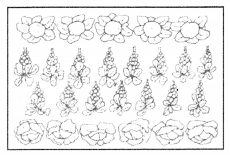
(a) What type of cropping pattern is shown in a diagram shown?
(b) How are the crops selected for this type of cropping pattern? [2]
Answer:
(a) The cropping pattern shown in the diagram is intercropping.
(b) Crops for this pattern are selected in such a way that their nutrient requirements are different. Due to it there is maximum utilisation of the nutrients supplied.
Section – C
(Question No. 27 to 33 are short answer questions)
Question 27.
Give an example for each of the following:
(a) Solid – Liquid homogeneous mixture
(b) Gas – Gas homogeneous mixture
(c) liquid – Liquid heterogeneous mixture [3]
Answer:
(a) Sugar in water
(b) Air
(c) Oil in water.
Question 28.
What are the three different states of matter? Which one of these has a aennite snape. distinct boundaries and fixed volume? Compare the three on the basis of compressibility. [3]
OR
You are provided with a fine white coloured powder which is either sugar or salt. How would you identify it without tasting?
Answer:
Three states of matter are solid, liquid, and gas. Solid has a definite shape distinct boundary and fixed volume. Solids are not compressible, liquids are less compressible while gases are highly compressible.
OR
On heating the powder. it will char if it is a sugar. Alternatively, the powder may be dissolved in water and checked for its conduction of electricity. If it conducts, it is a salt.
Question 29.
Write one function each of ribosomes, Vacuole, Plasma membrane. [3]
Answer:
Ribosomes: It helps in protein synthesis.
Vacuole: Vacuoles are full of cell sap and provide turgidity and rigidity to the cell in plants.
Plasma membrane: It allows or permits the entry and exit of some materials in and out of the cell. It prevents the movement of some other materials not required or are harmful for cells.
Question 30.
List the characteristics of cork. How are they formed? Mention their role. [3]
Answer:
- Non-living
- Compactly arranged
- No intercellular spaces
- Multilayered
- Contains suberin
A strip of secondary meristem replaces the epidermis. Cells on the outside are cut forming cork. Protection makes the plant impervious to gases, prevents loss of water, and prevents mechanical injury or infection.
Question 31.
In which direction do the following forces act when an object is in motion? Explain with the help of an example.
(a) Frictional force
(b) Gravitational force [3]
Answer:
(a) Frictional force: Backwards
Example: If a book slides across the surface of a desk, then the desk exerts a frictional force in the opposite (i.e., backwards) direction of its motion.
(b) Gravitational force: Downwards Example: When we throw a ball in the air, it returns to the ground.
Question 32.
A body can have zero average velocity but not zero average speed. justify giving an example. [3]
Answer:
Average velocity = \(\frac{\text { Net displacement }}{\text { Total time taken }}\)
Average speed = \(\frac{\text { Net distance }}{\text { Total time taken }}\)
Net displacement can be zero but total distance cannot he zero. Hence, average velocity can be zero but not the average speed. e.g., body thrown vertically comes down to the ground has zero displacement. but distance travelled is 2h where h is height reached by the body.
Question 33.
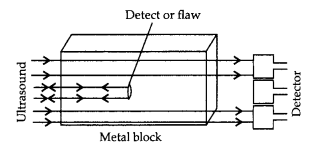
How defects in a metal block can be detected by using ultrasound? Explain. [3]
Answer:
Ultrasound can be used to detect cracks and flaws in metals blocks. The cracks or holes inside the metal blocks, which are invisible from outside reduces the strength of structure. Ultrasonic waves are allowed to pass through the blocks and detectors are used to detect the transmitted waves. If there is a small defect, the ultrasound gets reflected back.
Section – D
(Question No. 34 to 36 are long answer questions)
Question 34.
(a) Name the international organisation who approves names of elements.
(b) Give an example with explanation to show that the law of conservation of mass applies to physical changes also. [5]
OR
Describe Rutherford’s a-particle scattering experiment and mention the important observations and conclusions drawn from this experiment.
Answer:
(a) International Union of Pure and Applied Chemistry (IUPAC),
(b) when ice melts into water it is a physical change. Take a piece of ice in a small flask, cork it and weigh it and denote it as ice (s). Heat the flask gently and ice (solid) slowly melts into water (liquid). Then, weigh the flask again as Water.
It is found that there is no change in the weight i.e.,
Wice = Wwater

This shows the law of conservation of mass holds true for physical changes.
OR
in this experiment, fast-moving a-particles were made to fall on a thin gold foil.
The following observations were made:
- Most of the fast-moving a-particles passed straight through the gold foil.
- Some of the a-particles were deflected by the foil by small angles.
- One out of every 12000 particles appeared to rebound.
Conclusions:
- Most of the space inside the atom is empty because most of the a-particles passed through the gold foil without getting deflected.
- Very few particles were deflected from their path. indicating that the atom’s positive charge occupies very little space.
- A very small fraction of a-particles was deflected by 180°, indicating that all the positive charge and mass of the gold atom were concentrated in a very small volume within the atom.
Question 35.
Analyse the reason behind the following statements:
(a) Epidermis is thicker in desert plants though it is usually single-layered.
(b) Presence of a waxy layer (secreted by epidermis) on the outer surface of plants.
(c) Discuss the cell arrangement which supports the fact that epidermis is a protective tissue. [5]
OR
Name the following tissues:
(a) That forms the inner lining of our mouth.
(b) Present in the brain.
(c) Found in the iris of the eye.
(d) That connects two bones.
(e) Epithelial tissue present on the tongue
Answer:
(a) In desert habitats, protection against water loss is essential so, the epidermis is thicker in desert plants.
(b) The waxy covering aids in protecting the plant against loss of water, mechanical injury and invasion by parasitic fungi.
(c) Epidermis is the outermost covering of cells in plants. It is usually made up of a single layer of cells. On aerial parts of a plant epidemial cells often create a waxy, water-resistant layer on their outer surface to prevent loss o water from plant.
The cells of epidermis are present in a continuous layer without intercellular spaces. Small pores are present on the epidermis of the leaf. These pores are called as stomata, which help in gaseous exchange and transpiration.
As the plant grows older, a strip of secondary meristem replaces the epidermis nl the stem and forms a thick cork
OR
- Epithelial tissue-squamous epithelium
- Nervous tissue
- Involuntary muscular tissue.
- Ligament
- Stratified squamous epithelium
Question 36.
(a) State the law of conservation of momentum.
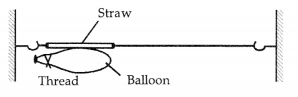
(b) Observe the following diagram and answer the questions, Stiaw given below:
(i) Which direction does the balloon move when the thread tied to its neck is removed and why?
(ii) State the conclusion drawn from this activity. [5]
OR
(a) Prove that if the Earth attracts two bodies placed at the same distance from the center of Earth, with equal force; then their masses will be the same.
(b) Mathematically express the acce1eraon due to gravity that is expressed by a free-falling object.
(c) Why is ‘G’ called a universal constant?
Answer:
(a) When two or more bodies act upon one another their total momentum remains constant, provided no external forces are acting.
(b)
- Air from inside the balloon escapes from the mouth of the balloon.
The balloon moves in the opposite direction that is from left to right. - Forces of action and reaction are equal and opposite.
OR
(a) Let mass of the first body be m1
Let mass of second body be m2
Force on 1st body = Forcc on 2 body
\(\frac{\mathrm{GMm}_1}{\mathrm{R}^2}=\frac{\mathrm{GMm}_2}{\mathrm{R}^2}\)
This implies, m1 = m2, Hence proved.
g=GM/R2
(c) Its value is constant anywhere in the universe.
Section – E
(Question No. 37 to 39 are case-based! data-based questions with 2 to 3 short sub-parts. Internal choice is provided in one of these sub-parts.)
Question 37.
Madhu poured 100 ml. of water to each of four different glass vessels. She kept all the four vessels under the Sun.
Madhu noted the time taken for the water in each vessel to evaporate completely Observe the table and answer the questions below:
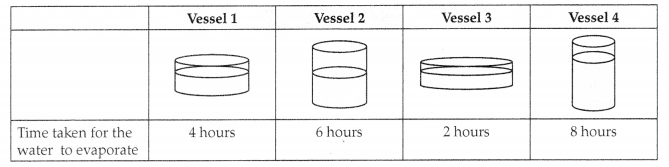
(a) Water in which vessel has taken the least time to evaporate?
(b) Water in which vessel has taken maximum time to evaporate?
(c) Does the rate of evaporation of a liquid depend on the open surface area? Explain your answer. [4]
OR
Why did Madhu pour an equal amount of water in each vessel?
Answer:
(a) Vessel 3
(b) Vessel 4
(c) Yes, the rate of evaporation depends on the surface area, as in vessel 3 surface area is more, so the water has taken the least time to evaporate as compared to vessel 4 where the surface area is less.
OR
To reliably compare the evaporation time for the vessels.
Question 38.
Study the given diagram and answer the following questions.
(a) Identify the tissue:
(b) Where do we find collenchyma tissues?
(c) Why do these cells have irregularly thickened cell walls? [4]
OR
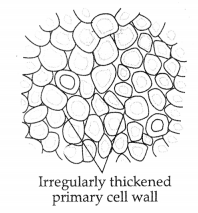
What type of tissues are collenchyma tous tissues? How do collenchyma tous cells appear in cross-section?
Answer:
(a) Collenchyma.
(b) Leaf stalks. Collenchyn-ia tissues form long flexible but strong strands in leaf stalk.
(c) The irregular thickening is due to the deposition of pectin.
OR
- Collenchymatous tissues are simple permanent tissues.
- Collenchyma cells appear polygonal in cross-section.
Question 39.
Study the given figure’ and answer the following questions.

(a) What will be the work done in Fig (ii)?
(b) Write an expression for work in terms of force and displacement.
(C) What is the angle between force and displacement when the work done is negative? [4]
OR
Why will be the work done in Fig (i) called zero?
Answer:
(a) In fig (ii), work done is positive. I
(b) W = F × d (Work = Force × Displacement)
(c) In case of negative work, the angle between the force and displacement is 180°.
OR
In figure (i), the direction of force, (F) and displacement are perpendicular to each other. There is no displacement in the direction of force so the work done is zero.