Students must start practicing the questions from CBSE Sample Papers for Class 9 Science with Solutions Set 1 are designed as per the revised syllabus.
CBSE Sample Papers for Class 9 Science Set 1 with Solutions
Time Allowed : 3 Hours
Maximum Marks: 80
General Instructions:
Read the following instructions carefully.
- This question paper consists of 39 questions in 5 sections.
- All questions are compulsory. However, an internal choice is provided in some questions. A student is expected to attempt only one of these questions.
- Section A consists of 20 objective-type questions carrying 1 mark each.
- Section B consists of 6 Very Short questions carrying 2 marks each. Answers to these questions should be in the range of 30 to 50 words.
- Section C consists of 7 Short Answer type questions carrying 3 marks each. Answers to these questions should be in the range of 50 to 80 words.
- Section D consists 0(3 Long Answer hipe questions carrying 5 marks each. Answer to these questions should be in the range of 80 to 120 words.
- Section E consists of 3 source-based/case-based units of assessment of 4 marks each with sub-parts.
Section – A
(Select and write the most appropriate option out of the four options given for each of the questions 1- 20. There is no negative mark for in correct response:)
Question 1.
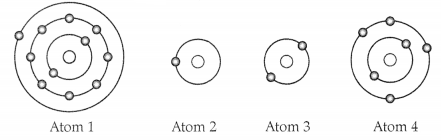
The pictures show the arrangement of electrons in the shells of different atoms. which two atoms have the same valency? [1]
(A) Atom 1 and Atom 2
(B) Atom 2 and Atom 3
(C) Atom 3 and Atom 4
(D) Atom 4 and Atom 1
Answer:
Option (A) is correct
Explanation: Valence electrons are the electrons in the outermost shell, or energy level, of an atom. As both the atoms, Atom 1 and atom 2 have only one valence electron, their valency will be the same.
2. Which of these is common for all chemical changes? [1]
(A) Change in shape
(B) Absorption of heat
(C) Increase in volume
(D) Formation of a new substance
Answer:
Option (D) is correct.
Explanation: Chemical reaction is associated with the formation of a new substance.
Question 3.
Which of the following molecules is triatomic? [1]
(A) H2
(B) C
(C) CO
(D) H2O
Answer:
Option (D) is correct.
Explanation: H2O has two atoms of hydrogen and one atom of oxygen.
Question 4.
Which of the following atoms are isobars? [1]
(A) 612C and 614C
(B) 1840Ar and 2040Ca
(C) 614C and 1840Ar
(D) 36Li and 612C
Answer:
Option (B) is correct.
Explanation: Isohars have different atomic numbers but the same atomic mass number. Ar and Ca have the same atomic mass number, i.e., 40 but different atomic numbers i.e., 18 and 20 respectively.
Question 5.
What would be the valency of an element that is chemically inactive? [1]
(A) 0
(B) 1
(C) 2
(D) 5
Answer:
Option (A) is correct.
Explanation: Elements with valency zero are chemically inactive as they have completely filled octet/duplet state.
Question 6.
A few substances are arranged in the increasing order of forces of attraction between their particles. Which one of the following represents a correct arrangement? [1]
(A) Water, air, wind
(B) Air, sugar, oil
(C) Oxygen, water, sugar
(D) Salt, juice, air
Answer:
Option (C) is correct.
Explanation: It is because the force of attraction increases in the order: Gas
Question 7.
On converting 25°C, 38°C and 66°C to Kelvin scale, the correct sequence of temperatures will be: [1]
(A)298K,311K and 339K
(B) 298K,300K and 338K
(C) 273 K, 278 K and 543 K
(D) 298 K, 310 K and 338 K
Answer:
Option (A) is correct.
Explanation: On converting 25°C, 38°C and 66°C, to Kelvin scale, we get the following temperatures:
25C + 273 = 298 K
38°C + 273 = 311 K
66°C+273 = 339K
Question 8.
Why do cells of apical meristem lack vacuoles? [1]
(A) They store food materials
(B) They have thin cell walls.
(C) They contain dense cytoplasm.
(D) They are actively dividing cells.
Answer:
Option (D) is correct.
Explanation: Apical meristem cells are young cells and are actively dividing, so they require food instantly and there is no requirement of storing food. Also, they do not produce large amount of waste. Hence, they lack vacuoles.
Question 9.
Which of these cells is the longest? [1]
(A) Bone cell
(B) Nerve cell
(C) Stomach cell
(D) Heart muscle cell
Answer:
Option (B) is correct.
Explanation: Nerve cell is the longest cell in the human body
Question 10.
Amoeba acquires its food through a process, termed: [1]
(A) Exocytosis
(B) Endocytosis
(C) Plasmolysis
(D) Both exocytosis and endocytosis
Answer:
Option (B) is correct.
Explanation: Amoeba acquires its food through a process, termed endocytosis. Endocytosis is the ingestion of material by the cells through their plasma membrane.
Question 11.
The kitchen of the cell is: [1]
(A) Mitochondria
(B) Endoplasmic reticulum
(C) Chloroplast
(D) Golgi apparatus
Answer:
Option (C) is correct.
Explanation: Chioroplasi has a green pigment called chlorophyll and they are involved in the photosynthesis of food. Hence, they are also known as the ‘Kitchen of the Cells’.
Question 12.
Flexibility in plants is due to: [1]
(A) Collenchyrna
(B) Sclerenchyma
(C) Parenchyma
(D) Chlorenchyrna
Answer:
Option (A) is correct.
Explanation: Collenchyrna is a mechanical tissue in young dicotyledonous stems and provides great tensile strength with flexibility to those organs in which it is found. It allows easy bending in various parts of a plant.
Question 13.
What is the correct unit for measuring the acceleration of a moving object? [1]
(A) m
(B) s
(C) ms-2
(D) ms
Answer:
Option (C) is correct.
Explanation: Acceleration of a moving object is measured in metres per second per second or metre per second square.
Question 14.
Which of these involves the conversion of kinetic energy to potential energy? [1]
(A) A person diving into a pool of water from a board.
(B) A person gliding in the air with the help of a parachute.
(C) A person sliding down from the top of a water slide.
(D) A person riding a motorbike to the top of an overbridge.
Answer:
Option (D) is correct.
Explanation: The person riding motorbike has kinetic energy due to motion, which gets converted into potential energy after getting to the top of an overbridge.
Question 15.
Which of these nutrients is required by plants in large quantities? [1]
(A) Iron
(B) Zinc
(C) Potassium
(D) Manganese
Answer:
Option (C) is correct.
Explanation: Potassium is a macronutrient that means plants require potassium in larger quantities.
Question 16.
To solve the food problem of the country, which among the following is necessary? [1]
(A) Increased production and storage of food grains.
(B) Easy access of people to the food grains.
(C) People should have money to purchase the grains.
(D) All of the above
Answer:
Option (D) is correct.
Explanation: To solve the food problem of the country there should be increase in the production and storage of food grains, There should be easy access of people to the food grains and people should have money to purchase the grains.
Assertion-Reason-Based Question’s
Question No. 17 to 20 consist of two statements — Assertion (A) and Reason (R). Answer these questions selecting the appropriate option given below:
(A) Both (A) and (R) are true, and (R) is the correct explanation of (A).
(B) Both (A) and (R) are true, and (R) is not the correct explanation of (A).
(C) (A) is true but (R) is false.
(D) (A) is false but (R) is true.
Question 17.
Assertion (A): When heat energy is supplied to the solid, it starts melting.
Reason (R): Solid particles take up the heat and help in melting. [1]
Answer:
Option (A) is correct.
Explanation: When heat energy is supplied to the solid, the solid particles take up the heat energy supplied to them and vibrate
more rapidly as they absorb kinetic energy. Eventually, the organisation of the particles within the solid structure begins to break down, and the solid starts to melt.
Question 18.
Assertion (A): Guard cells are specialised epidermal cells.
Reason (R): Stomata are found in the epidermis of leaves. [1]
Answer:
Option (B) is correct.
Explanation: Stomata are present in the epidermis of leaves. They are essential for transpiration and gaseous exchange. Stomata are minute apertures bounded by two specialised epidermal cells called guard cells.
Question 19.
Assertion (A): Mass of an object is always zero.
Reason (R): Mass of an object is the measure of its inertia and the substance contained by the body. [1]
Answer:
Option (D) is correct.
Explanation: Mass of an object can never be zero because mass of an object is the measure of its inertia and the substance contained by the body.
Question 20.
Assertion (A): The presence of weeds affects the crop field.
Reason (R): Weeds compete for food, space and light. [1]
Answer:
Option (A) is correct.
Explanation: Vecds are unwanted plants in the cultivated field. e.g., Xanthiurn, Partheniurn, Cyperusrotundus. ‘&eds take up nutrients and reduce the growth of the crop. Therefore, their removal is necessary.
Section – B
(Questions No. 21 to 26 are very short answer questions)
Question 21.
What are polyatomic ions? list two examples. [2]
Answer:
A group of atoms carrying a charge is known as polyatomic ion.
e.g., PO43-’ , SO42-, NH4+
Question 22.
List two points of differences between parenchyma and sclerenchyma. [2]
Answer:
Parenchyma: In this, cells with thin cell walls are found and are usually loosely packed so that large intercellular spaces are found.
Sclerenchyma: In this, cells are dead and cell wall is thickened due to lignin It provides strength to plants.
Question 23.
What is plasrnolvsis? What happens to a plasmolysed cell when it is placed in water? [2]
OR
Differentiate the following activities on the basis of voluntary(V) or involuntary (IV) muscles.
(a) Jumping of frog
(b) Pumping of the heart
(c) Writing with hand
(d) Movement of chocolate in your intestine.
Answer:
Shrinkage of protoplast from the cell wall in the presence of hypertonic solution due to exosmosis is known as plasmolysis. When a plasmolyse cell is placed in water, the concentration of water in the outside medium is more than the concentration of water inside the cell, Hence, water moves inside the cell leading to its swelling.
OR
(a) Voluntary muscle: Jumping of a frog is a voluntary activity as a frog jumps on its own will.
(b) Involuntary muscle: Pumping of the heart is an involuntary activity as in the heart, there are cardiac muscles which contract
and relax rhythmically throughout their life involuntarily.
(c) Voluntary muscle: Writing with hand is a voluntary activity because we write on our will.
(d) Involuntary muscle: Movement of chocolate in your intestine is an involuntary activity due to the presence of smooth muscles in the intestine.
Question 24.
A man pushes four boxes of different mass. [2]
The table shows the acceleration produced for each box during the push.
| Mass of the box (kg) | Acceleration produced (m/s2) |
| 10 | 200 |
| 20 | 100 |
| 40 | 50 |
| 80 | 25 |
What amount of force does the man exert on each box? Is the force acting on each box unbalanced? Explain ‘our answer.
Answer:
By using the formula for force,
F = ma
Here, in each case, it will be 2000 N.
To have unbalanced forces means that the force applied in one direction is greater than the force applied in the opposite direction, When unbalanced forces are acting on an object, there is a change in speed and, or direction. Here, the force acting on each box is unbalanced as acceleration is produced in each case and each box gets pushed.
Question 25.
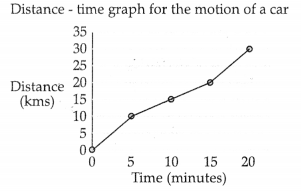
The given graph shows how the car travelled from house to school. [2]
Distance – time graph for the motion of a car
Did the car move with uniform motion from house to school? Explain your answer.
OR
While driving a vehicle how does the use of safety belts prevents accidents? To show that a body remains at rest unless acted upon by an unbalanced force, mention one situation from everyday life.
Answer:
No, the car did not travel with uniform motion. This is because the car moved with different speed in between 10 km and 20 km in its way. The speed (distance/time) up to 10 km was 2 km/mm, then it travelled at a speed 1 km/min till it reached 20 km distance. Afterwards, it again resumed with the speed of 2 km/mm to reach 30 km distance. So, the car travelled in non-uniform motion as it travelled with different speeds at different time intervals.
OR
As per Newton’s first law of motion, when a car abruptly stops or crashes, Due to inertia of motion, a person sitting in a moving car may be pushed forward potentially causing damage.
To prevent the above accident, a seat belt must be used while driving a car. An example to show that a body remains at rest unless acted upon by an unbalanced forcer: is pedalling of the bicycle.
when we stop pedalling, the bicycle begins to slow down. In order to keep the bicycle moving, we have to start pedalling again. It thus appears that an object maintains its motion under the continuous application of an unbalanced force and as soon as the unbalanced force is removed it tends to get back to its rest position.
Question 26.
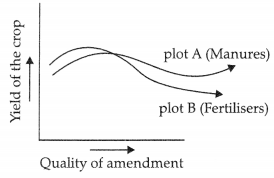
The graph below shows two crop yields Eplot A and B that have been treated by manures and chemical fertilisers respectively, keeping other environmental factors the same. [2]
Answer the following questions:
(a) Why does plot B show sudden increase and then gradual decrease in yield?
(b) Why is the highest peak in plot A graph slightly delayed?
Answer:
(a) Addition of chemical fertilisers in plot B will increase yield suddenly due to availability of NPK nutrients which improve the soil fertility but it is for short duration so there is a gradual decrease in yield afterwards.
(b) In plot A, manures supply nutrients slowly to the soil. Manures contain large quantity of organic matter that is slowly decomposed by microbes to release nutrients in small quantities. Thus, manures enrich soil fertility gradually.
Section – C
(Questions No. 27 to 33 are short answer questions)
Question 27.
(a) Define latent heat of vaporisation. [3]
(b) Give reasons for the following: You feel cold when you pour some nail polish remover on your palm.
(c) Explain: During summer, sitting under a fan makes us comfortable.
Answer:
(a) The amount of heat energy required to change 1 kg of a liquid to gas at atmospheric pressure at its boiling point is called latent heat of vaporisation.
(b) Particles gain heat energy from the palm and evaporate causing the palm to feel cool.
(c) When we sit under a fan during summer, rate of evaporation of sweat increases due to increase in wind speed. Sweat takes heat from body to evaporate leaving us cool.
Question 28.
Rahul and Manav each were given a mixture of iron filings and sulphur powder. Rahul heated the mixture strongly and a new substance was formed. Write three points of difference between the two. [3]
OR
A teacher told three students A, B and C to prepare 25% solution (mass by volume) of KOH. Student A dissolved 25 g of KOH in 1oo g of water, student B dissolved 25 g of KOH in 100 mL of water and student C dissolved 25 g KOH in water and made the volume 1X mL Which one of them has made required 25% solution? Give your answer with reason. [3]
Answer:
Rahul has a compound formed after heating the two components of a mixture, Manav still has an untreated mixture. The difference between a compound and mixture are as follows:
| Compound | Mixture |
| (i) Elements react to form a compound. | Elements of compounds get mixed together. |
| (ii) Fixed composition. | Variable composition. |
| (iii) Totally different properties. | Shows properties of constituent substances. |
OR
‘C’ has made the desired solution. ‘C’ dissolved the 25g of KOH in water and made the volume up to 100 ml, which is 25% solution of KOH (mass by volume). ‘A’ dissolved 25 g of KOH is 1oo g of water that made the volume 150 g. ‘B dissolved the 25 g of KOH in 100 ml of water which also made the volume 150 ml.
Question 29.
Why are lysosomes known as suicidal bags? [3]
Answer:
Lysosomes are a kind of waste disposal system of cell. They help to keep the cell clean by digesting any foreign material as well as worn-out cell organelles. Foreign material entering the cell such as bacteria or food ends up in lysosomes.
During the disturbance in cellular metabolism, lysosomes may burst and the enzymes digest their own cell. Therefore, lysosomes are also known as suicidal bags. Lysosomes are able to do this because they contain powerful enzymes capable of breaking down all organic material.
Question 30.
Classify meristematic tissues on the basis of the region the are present. Also, mention their functions. [3]
Answer:
On the basis of the region they are present, meristems can be of following types:
- Apical meristems: Increase the length of stem and roots.
- Lateral meristems: Increase girth.
- Intercalary meristems: Increase the length of internodes.
Question 31.
A particle moves over three-quarters of a circle of radius r cm. Calculate the magnitude of:
(a) its distance and
(b) displacement.
Answer:
(a)
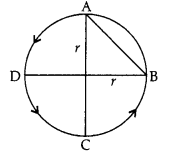
A particle moves over three-quarters of a circle to radius r cm.
Distance travelled = 2πr × \(\frac{3}{4}=\frac{3}{2}\) = \(\frac{3}{2}\) πr cm
(b)
AB is the displacement
To find AB, let us use Pythagoras’ theorem in Δ AOB
AB22 = OA2 + OB2
Or AB2 = r2 + r2
Or AB2 =2r2
or AB = \(\sqrt{2 r^2}\)
AB = r \(\sqrt{2}\)
Thus the magnitude of the displacement is r \(\sqrt{2}\)
Question 32.
Explain:
(a) Universal gravitational constant
(b) Free fall
Answer:
(a) Universal gravitational constant is the constant ‘G’ appearing in Newton’s law of gravitation.
F = \(\frac{\text { GMm }}{r^2}\)
where F is the force between two masses m and M at a distance r apart. The numerical value of G is equal to 6.673 × 10⁻¹¹ Nm2kg-2 The value of G was found out by Henry Cavendish (1731- 1810) by using a sensitive balance.
(b) Free fall: Whenever objects fall towards the Earth under the effect of gravitational force alone, we can say that the objects are in free fall. While falling there is no change in the direction of motion of the objects. But the objects get accelerated towards earth with acceleration due to gravity 9.8m/s2.
Question 33.
In which direction do the following forces act when an object is in motion:
(a) Frictional force
(b) Gravitational force
(c) Centripetal force
Answer:
(a) Opposite to the direction of motion.
(b) Downwards
(c) Towards the centre
Section – D
(Questions No. 34 to 36 are long answer questions)
Question 34.
(a) Can a homogeneous mixture have a variable composition? Justify giving an example.
(b) What happens when:
(i) Dilute sulphuric acid is added to a mixture of iron filings and sulphur powder.
(ii) Dilute sulphuric acid is added to a mixture of iron filings and sulphur powder heated to red hot followed by cooling. [5]
OR
(a) List any two properties that liquids have in common with gases.
(b) Give two reasons to justify that an iron almirah is a solid at room temperature.
(c) What happens to the heat energy which is supplied to the solid once it starts melting?
Answer:
(a) Homogenous mixtures can have variable composition A mixture with a variable composition means that it is composed of
molecules or atoms of differing types. These may have intermolecular bonds or bonds between molecules, but such bonds are
not nearly as strong as those formed when elements bond to form a compound. Example: sugar solution.
(b)
(i) Results in the formation of ferrous sulphate and evolution of hydrogen.
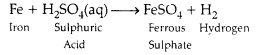
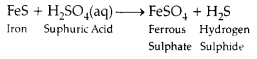
(ii) Results in the formation of iron sulphide which reacts with sulphuric acid to form ferrous sulphate and release ol hydrogen
disulphide gas.
Question 35.
On the basis of the number of cells. living organisms are classified as unicellular and multicellular.
(a) Name two unicellular organisms.
(b) What is meant by division of labour ii multicellular organisms?
(c) Name one prokaryotic and one eukaryotic unicellular organism.
(d) ‘Every multicellular organism has come from a single cell.’ Justify this statement.
(e) Write one common feature between an Amoeba and white blood cells of humans.[5]
OR
(a) Name the connective tissue which is the hardest. What makes it so hard?
(b) List any three important functions of this tissue. [5]
Answer:
(a) Amoeba and Euglena arc unicellular organisms.
(b) Multicellular organisms are made up of millions and trillions of cells. All these cells perform specific functions. All the cells
specialised for performing similar functions are grouped together as tissues in the body. Hence, a particular function is carried out by a group of cells at a definite place in the body. Similarly, different functions are carried out by different groups of cells in an organism. This is known as the division of labour in multicellular organisms.
(c) Prokaryotic- Bacteria, Eukaryotic – Amoeba.
(d) Yes, every cell of the multicellular organism has come from a single cell. After fertilisation, a single cell is formed. The zygote is actually a single cell. The zygote gives rise to all the cells of our body.
(e) Both, Amoeba and white blood cells of humans do not have any fixed shape.
OR
(a) Bone is the hardest connective tissue. Hard matrix composed of Ca and P compounds makes it hard.
(b) Functions:
(i) Forms framework of body.
(ii) Anchors muscles.
(iii) Supports the main organs of body and provides protection to them (e.g., brains, lungs).
Question 36.
(a) State Newton’s Second Law of Motion. Express it mathematically and find the SI unit of force from it.
(b)
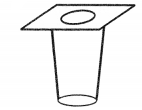
In the diagram given above, if the card is flicked away with a jerk, what will you observe? Explain the reason for this observation. [5]
OR
(a) Define momentum. Write iLs 5.1. unit.
(b) How much momentum will an object of mass 10 kg transfer to the floor, if it falls from a height of 5 m (g =10 m/s2)?
(c) Explain how a karate player can break a pile of bies with a sng1e blow of his hand?
Answer:
(a) Newton’s Second Law of Motion states that the rate of change of momentum of an object is proportional to the applied unbalanced force in the direction of force. It is expressed mathematically as,
Mathematical formulation: If a body of mass (m), moving with velocity (u) accelerates uniformly for time (t), so that its velocity
changes to ν, then
Initial momentum p1 = mυ
Final momentum P2 = mν
Change in momentum = P2 – P1
= mv – mu
= m (v – u)
According to the second law of motion, force change in momentum
F ∝ \(\frac{\text { change in momentum }}{\text { time }} \)
F ∝ \(\frac{p_2-p_1}{t}\)
F ∝ \(\frac{m(v-u)}{t}\)
F = \(\frac{k m(v-u)}{t}\)
F = kma
F = ma
Thus,
we know that
∴ a = \(\frac{v-u}{t}\)
(Here k= 1)
Unit of force = kg m-2
The SI unit of force is Newton (N).
(b) We will observe that the card moves ahead allowing the coin to fall vertically into the glass. This is due to inertia. The inertia of the countries to maintain its state of rest.
OR
(a) The momentum of an object is the product of its mass and velocity and has the same direction as that of the velocity.
SI unit of momentum is kg m/s.
(b) ν2 = υ2+2gh
ν2 = (0)2 + 2(10) (5)
ν2 = 100
∴ u = 10m/s
Momentum, p = m × ν
= 10 × 10 = 100 kgm/s
(c) The karate player strikes the pile of tiles with his hand very fast. In doing so, the large momentum of a fast-moving hand is reduced to zero in a very short time. This exerts a very large force on the pile of tiles which is sufficient to break them.
Section – E
(Questions No. 37 to 39 are case-based! data-based questions with 2 f03 short sub-parts. Internal choice is provided in one of these sub-parts.)
Question 37.
The following data represents the distribution of electrons, protons and neutrons in atoms of four elements A, B, C, and D. Understand the data carefully and answer the following questions.
| Element | Protons | Neutrons | Electrons |
| A | 9 | 10 | 9 |
| B | 16 | 16 | 16 |
| C | 12 | 12 | 12 |
| D | 17 | 18 | 17 |
(a) State the electronic configuration of element B. What will he the vaìencv of element B? [4]
(b) What will he atomic number of element D?
OR
Calculate the atomic mass number for element D.
Answer:
(a) The electronic configuration of element B = 2, 8, 6.. There are six valence electrons in its outermost shell, So, valency = (8 – no. o
valence electrons) = 8 – 6 = 2.
(b) Atomic number of elements = Number of protons in that element = Number of electrons, so the atomic number of element D will be 17.
OR
Mass number = Number of Protons + Number of Neutrons, so for element D it will be 17 + 18 = 35.
Question 38.
Study the given figure and answer the following questions.
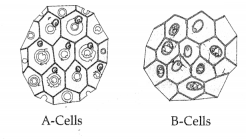
(a) Identify A and B cells.
(b) What will happen if B cells are kept in a hypotonic solution?
(c) What is an isotonic solution? [4]
OR
What is plasmolysis? [4]
Answer:
(a) A cells – Turgid cells, B cells – Plasmolysed cells
(b) B cells kept in a hypotonic solution will become deplasmolysed if done so immediately after plasmolysis.
(c) Isotonic solution: A solution that has the same tonicity as another solution with which it is compared.
OR
Shrinkage of protoplast mainly caused due to loss of water in the cell.
Question 39.
A sound wave travelling in a medium is represented as shown in the figure:
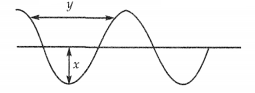
(a) Which letter represents the amplitude of the sound wave?
(b) Which letter represents a wavelength of the wave?
(c) What is the frequency of the source of sound if the vibrating source of sound makes 360 oscillations in two minutes? [4]
OR
Calculate the time period of the source of sound in the above case. [4]
Answer:
(a) x
(b) y
m = \(\frac{\text { Number of oscillations }}{\text { Time }} \)
= \(\frac{360}{2 \times 60}\)
= 3 Hz
OR
Time period. T = \(\frac{1}{n}=\frac{1}{3}\) = s.