Students must start practicing the questions from CBSE Sample Papers for Class 10 Social Science with Solutions Set 8 are designed as per the revised syllabus.
CBSE Sample Papers for Class 10 Social Science Set 8 with Solutions
Time : 3 Hours
Maximum Marks: 80
General Instructions
- Question paper comprises five Sections – A, B, C, D, and E There are 37 questions in the question paper. All questions are compulsory.
- Section A – From question 1 to 20 are MCQs of 1 mark each,
- Section B – Question no. 21 to 24 are Very Short Answer Type Questions, carrying 2 marks each. Answer to each question should not exceed 40 words.
- Section C contains Q.25 to Q. 29 are Short Answer Type Questions, carrying 3 marks each. Answer to each question should not exceed 60 words.
- Section D – Question no. 30 to 33 are long answer-type questions, carrying 5 marks each. Answer to each question should not exceed 120 words.
- Section E – Questions no. from 34 to 36 are case-based questions with three sub-questions and are of 4 marks each.
- Section F – Question no, 37 is map-based, carrying 5 marks with two parts, 37a from History (2 marks) and 37b from Geography (3 marks).
- There is no overall choice in the question paper. However, an internal choice has been provided in few questions. Only one of the choices in such questions have to be attempted.
- In addition to this, separate instructions are given with each section and question, wherever necessary
Section A
Section A consists of 20 questions of 1 mark each
Question 1.
While teaching, Miss Suchi asked her students about the first book printed by Gutenberg Press. Here, Miss Suchi is
referring to …………………………. . (1)
(a) Diamond Sutra
(b) Chapbooks
(c) Bible
(d) Almanac
Answer:
(c) Bible
Question 2.
Germany was unified by:
(a) The military actions
(b) Revolutionary upsurge
(c) Peasants uprising
(d) Liberals revolution
Answer:
(a) The military actions

Question 3.
In 1860, the artist Lorenz Ciasen was commissioned to paint this image. The inscription on Germania’s sword reads. ‘The German sword protects the German Rhine.’ Which of the following options host signifies the idea behind this image? Identify. (2)
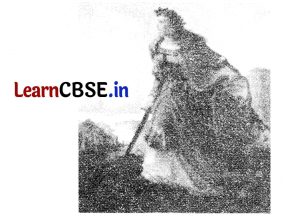
(a) It was a response to French sabre raising about recapturing French IerriLorv across the Rhine.
(b) It was used as an example of classical themes for political reasons 19th century Germans’.
(c) It signifies the readiness to fight.
(d) Both (a) and (b)
Answer:
(d) Both (a) and (b)
Question 4.
Arrange the following in chronological order:
I. The T- Model Ford was the world’s first mass-produced car.
II. China became an attractive destination for investment by foreign MNCs competing to capture world markets.
III. During the Great Depression, agricultural regions and communities were the worst affected.
IV. The Second World War caused an immense amount of economic devastation and social disruption.
Options:
(a) I, II, III, IV
(b) IV, I, II, III
(c) III, IV, II, I
(d) I, III, IV, II
Answer:
(d) I, III, IV, II
Question 5.
Which of the following is true for geothermal energy?
(a) Experimental projects are set up in Puga Valley Ladakh.
(b) The Aravalli ranges of Rajasthan have small reserves of it.
(c) It develops in regions where there is low temperature.
(d) They are good sources for exhaustible conventional fuels.
Answer:
(a) Experimental projects are set up in Puga Valley Ladakh.
Question 6.
Which one of the following factors is mainly responsible for the declining water level in India?
(a) Irrigation
(b) Industrialisation
(c) Urbanisation
(d) Over-utilisation
Answer:
(a) Irrigation
Question 7.
Cotton thrives in soil that has good drainage and can hold water. The cotton plant suffers from excessive wetness and waterlogging. …………………… is appropriate for the growth of cotton because it has a high clay content and a good capacity to retain water. (1)
(a) Black soil
(b) Red soil
(c) Alluvial soil
(d) Saline soil
Answer:
(a) Black soil
Question 8.
Consider the following statements regarding democracy and identify the incorrect one from the following:
(a) It brings improvement in the quality of decision-making.
(b) It provides room to correct mistakes.
(c) It respects public opinion.
(d) Decision-making is much faster and quicker.
Answer:
(d) Decision-making is much faster and quicker.
Question 9.
While giving a presentation, the Water Board Chairman of Gorakhpur listed down some appropriate reasons for water being considered a renewable resource. As per ‘our knowledge, which of the following statements were used by him in the respective seminar?
(a) 3/4th of the Earth is covered with water.
(b) Large amount of freshwater is stored as groundwater
(c) Existence of a hydrological cycle on the Earth.
(d) It is available everywhere on the Earth.
Answer:
(c) Existence of a hydrological cycle on the Earth.
Question 10.
What is a major problem associated with coalition government?
(a) Formation of coalition government with regional powers.
(b) Problems to keep satisfied coalition partners in the government.
(c) Formation of coalition governments with small parties.
(d) Formation of coalition government with opposite ideological parties.
Answer:
(b) Problems to keep satisfied coalition partners in the government.
Question 11.
While making her geography notes, Seeta found out the term Conuco. She searched the term on Google and found that this term denotes slash and burn agriculture practiced in a country The ‘slash and burn agriculture’ is known as ‘Conuco’ in which of the following countries? (1)
(a) Venezuela
(b) Brazil
(c) Indonesia
(d) Mexico
Answer:
(a) Venezuela
Question 12.
There are two statements marked as Assertion (A) and Reason (R). Mark your answer as per the codes provided below:
Assertion (A): Not the entire service sector is growing equally well.
Reason (R): Services that employ highly skilled and educated workers are not producing more.
Options:
(a) Both (A) and (R) are true and (R) is the correct explanation of (A).
(b) Both (A) and (R) are true but (R) is not the correct explanation of (A).
(c) (A) is correct, but (R) is wrong.
(d) (A) is wrong, but (R) is correct.
Answer:
(c) (A) is correct, but (R) is wrong.
Question 13.
The population of India in 2019 was around 1.36 trillion with a GDP of $ 2.72 trillion. Calculate the per capita of India and choose the correct option from the following. (1)
(a) $ 1000
(b) $ 2000
(c) $ 2500
(d) $ 3000
Answer:
(b) $ 2000
Question 14.
Read the given data and find out which sector has maximum contribution in GDP?
| Year | Primary (Rupees) | Secondary (Rupees) | Tertiary (Rupees) |
| 2000 | 56,000 | 49,000 | 1,33,500 |
| 2013 | 8,20,500 | 11,74,500 | 38,68,000 |
(a) Primary Sector
(b) Secondary Sector
(c) Tertiary Sector
(d) None of these
Answer:
(c) Tertiary Sector
Question 15.
Suppose you are a native craftsman working in the small town of Odisha. What would be your top priority in the developmental goal? Identify from the given options. (1)
(a) More days of work and better wages.
(b) More demand for local and hand-made goods.
(c) Expansion of rural economy
(d) All of the above
Answer:
(b) More demand for local and hand-made goods.
Question 16.
Choose the correct option to complete the statement.
If a government provides its citizens a right and means to examine the process of decision, it is
(a) An accountable government
(b) A responsible government
(c) A transparent government
(d) A stablë government
Answer:
(a) An accountable government
Question 17.
There are two statements marked as Assertion (A) and Reason (R). Mark your answer as per the codes given below. (1)
Assertion (A) Belgium managed to accommodate its diversities.
Reason (R) It took care of the interests of both French and Dutch-speaking communities.
Codes
(a) Both A and R are true and R is the correct explanation of A
(b) Both A and R are true, but R is not the correct explanation of A
(c) A is true, but R is false
(d) A is false, but R is true
Answer:
(a) Both A and R are true and R is the correct explanation of A
Question 18.
Ajay lives in Sadhupur. a village in India. Ajay has taken a loan for farming. The loan provider charges a low interest which cannot create burden on Ajay. All the activities of loan providers are monitored by RBI. RBI sees that the lender does not give loan only to businessmen or only to earn profit. If it fails to follow the norms it is penalised. Also, lender has to submit a periodically report to RBI. Analyze the information given above, considering one of the following correct options:
(a) Cooperative society
(b) Money lender
(c) Commercial bank
(d) Traders
Answer:
(c) Commercial bank
Question 19.
Arrange the following in a chronological order. (1)
I. Formation of Indian National Congress
II. Formation of the Communist Party of India
III. Formation of Aam Aadrni Party
IV. Formation of Bharatiya Janata Party
Codes
(a) I, III, II, IV
(b) IV, I, III, II
(c) I, II, IV, III
(d) I, III, IV, II
Answer:
(c) I, II, IV, III
Question 20.
Identify the correct statement/s about Self Help Group (SHG):
I. A typical SHG has 25-30 members, usually belonging to one neighborhood, who meet and save regularly.
II. Saving per member varies from Rs 25 to Rs loo or more, depending on the ability of the people to save.
III. Members can take small loans from the group itself to meet their needs.
IV. The SHG helps borrowers overcome the problem of lack of collateral.
Options:
(a) I & II
(b) I & III
(c) III & IV
(d) II, III & IV
Answer:
(d) II, III & IV
Section B
Section B consists of 4 questions of 2 marks each
Question 21.
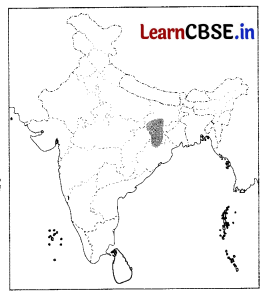
Study the map thoroughly and explain why this Indian plateau is considered a storehouse of minerals. (2)
Answer:
Chota Nagpur Plateau is considered a storehouse of minerals due to the following reasons Iron ore is found in abundance and about 40% of iron ore in India is found in this area. Over 50% of manganese. 60% of copper and 60% of bauxite in India are found in this region.
Question 22.
Analyse any two factors that were responsible for increasing the feeling of alienation among the Sri Lankan Tamils.
OR
Distinguish between community government in Belgium and majoritarian government in Sri Lanka.
Answer:
- In 1956, Sinhala was recognised as the only official language in Sri Lanka.
- The governments followed preferential policies that favoured Sinhala applicants for university positions and government jobs.
OR
| Community Government in Belgium | Majoritarian Government in Sri Lanka |
| (i) The Belgian leaders adopted a policy of power sharing. | The Sri Lankan leaders adopted a policy of majoritarianism. |
| (ii) They gave equal powers to all communities no matter whether they are in majority or minority. | They gave preferences to the majority Sinhala community alone, thus disregarding the minority Tamil community. |
Question 23.
Why has India adopted a multi-party system?
Or
Name the institution which has passed an order making it necessary for political parties to hold their organisational elections and file their income tax returns. (2)
Answer:
India adopted a multi-party system because As India is a vast and diverse country, the multi-party system was needed to accommodate the vast population.
The social and geographical diversity of India could not be represented by two or three parties
or
The Election Commission has passed an order making it necessary tot political parties to hold their organisational elections and tile their income tax returns.
Question 24.
Mention any two features of unorganised sector.
Answer:
- This sector is characterised by small and scattered units which are largely outside the control of the government.
- There is no job security for workers.
- There is no provision for overtime, paid leave, holidays, leave due to sickness, etc.
Section C
Section C consists of 5 questions of 3 marks each
Question 25.
Analyze the table given below and answer the following questions. (1+2)
| Year | Primary | Secondary | Tertiary |
| 2000 | 52,000 | 48,500 | 1,33,500 |
| 2013 | 8,00,500 | 10,74,000 | 38,68,000 |
(a) What is the basic conclusion you can draw from the following table?
(b) in India, the share of agriculture in GDP has declined at a very fast rate in recent years. What is the reason behind this?
Answer:
(a) Conclusions drawn Irorri the bar diagram are share of the primary sector and secondary sector in GDP has decreased. Whereas, the share of the tertiary sector in GDP has increased.
(b) The agricultural growth rate in India has been growing earlier, but in the last few years, it is constantly declined. While, since India is a developing economy, the share of other sectors towards GDP has risen in India The reason for the decline can be attributed to the growing share of other sectors as well as the lack of technology, irrigation, and energy facilities in the rural areas have led to falling growth in the agricultural sector.
Question 26.
What are the most important attributes for comparing countries and why?
OR
What is Human Development Report? Discuss its emergence.
Answer:
The most important attributes for comparing countries are:
- The income of the countries is considered to be one of the most important attributes for their comparison.
- Generally, countries which have higher income are considered more developed than the countries which have less income.
- This is based on the understanding that more income provides more of all things that human beings need. People will be able to get whatever they required and want with greater income. That’s why greater income itself is considered to be one important goal.
OR
Human Development Report: Human Development Report is annual report which compares countries based on the educational levels of the people, their health status, and per capita income. It is published by United Nations Development Programme. Emergency of Human Development Report: When it is realised that the level of income alone is not able to reflect the true picture of the development of a country, other parameters on which development could be measured begin to develop. A long list such criteria was thought but only small number of the most important things were selected which included health and education indicators. Over the past decade or so, health and education indicators have come to be widely used along with income as a measure of development. Human Development Report uses these indicators.
Question 27.
What is community government? Explain the concept of community government with context to Belgium. (1.5= 1.5)
Answer:
A community government is one in which different social groups are given the power to handle the affairs related to their communities. They are expected to work jointly for the benefit of the common masses without undermining any community.
In Belgium, there is a community government This community government is elected by people belonging to one language community, viz, Dutch. French and German speaking, no matter where they live. This government has the power regarding cultural, educational, and language-related issues.
Question 28.
Discuss the various efforts made at the international level for the conservation of natural resources.
Answer:
Efforts made at international level for the conservation of natural resources are as follows:
- The first effort at the international level was made in 1968 with the Club of Rome which promoted resource conservation more systematically. Then, in 1974, Schumacher in his book ‘Small is Beautiful’ argued about resource conservation in Gandhian philosophy.
- The Brundtland Commission Report, 1987 made an influential contribution in resource conservation at the global level. The concept of ‘Sustainable Development’ was introduced by this report and promoted as a way for resource conservation. After that, it was published in a book entitled ‘Our Common Future’.
- The Earth Summit in Rio de Janeiro, Brazil in 1992 was another major contribution concerning resource conservation.
Question 29.
What is the importance of the opposition party in a democracy? (3)
Answer:
The opposition party plays a very important role in a democracy in the following ways
- It acts as a pressure group.
- It mobilizes the government.
- It keeps a check on the working of the ruling party.
- It puts different views in the Parliament and criticizes the government for its failures and wrong policies.
- It shapes public opinion. Often, it influences the minds of the people against the ruling party.
Section D
Section D consists of 4 questions of 5 marks each
Question 30.
Why was there a conflict between the Sinhala and Tamils?
OR
Discuss the arrangements made under the Constitution of Belgium to solve the problem of community conflict.
Answer:
(i) After emerging of Sri Lanka as an independent country in 1948, the leaders of the Sinhala community looked to secure dominance over government because of their majority. Soon, a series of majoritarian measures were adopted by the democratically elected government to establish the supremacy of Sinhala.
(ii) With an Act passed by the Sri Lankan Parliament in 1956, Sinhala was recognised as the only official language ignoring Tamil. Also, the preferential policies followed by the Sri Lankan government used to favour Sinhala applicants for university positions and government jobs.
(iii) Protecting and promoting Buddhism was made the duty of state by the new constitution. As government had adopted these measures step by step, the feeling of alienation among the Sri Lankan Tamils increased.
(iv) Tamils were begun to believe that all the major political parties led by the Buddhist Sinhala leaders were not sensitive to their language and culture.
(v) They felt that the constitution and government policies were not giving them equal political rights, discriminated against them in getting jobs and other opportunities and ignored their interests. Due to these, the relations between the Sinhala and Tamil communities spoiled over time.
OR
Following were the arrangements made under the constitution of Belgium to solve the problem of community conflict.
- According to the Constitution, Central government shall have the equal numbers of Dutch and French-speaking ministers.
- Some special laws can only be passed with the support of majority of members from each linguistic group. These provisions ensure that no single community can make decisions unilaterally.
- Many powers of the central government have been given to state governments of the two regions of the country. The state governments are not subordinate to the central government.
- There is a separate government in Brussels in which both the communities have equal representation. Despite being majority community in Brussels, the French-speaking people accepted equal representation in government because the Dutch-speaking community has accepted equal representation in the central government despite being majority community all over the country.
- Besides the Central and the State governments, there is a third kind of government also i.e., Community government. It is elected by people belonging to one language viz., Dutch, French, and German-speaking community irrespective of their living area. Community governments have the power regarding cultural, educational and language-related issues.
Question 31.
Define the term democracy. What outcomes are expected from a democracy? (1+4)
Or
Evidence shows that in practice, many democracies did not fulfill the expectations of producing economic development in the
country. Validate the statement with the help of relevant examples. (5)
Answer:
Democracy is a form of government that allows people to choose their own representatives. People have the freedom to express their opinion and organise protests.
- The outcomes expected from a democracy are
- People should get a chance to choose their representatives without any fear.
- Free and fair elections should be conducted by an independent machinery.
- Elections must be held periodically based on Universal Adult Franchise,
- The elected representatives should be accountable to the people.
- Freedom of press should be allowed.
- People should be vigilant and participate actively in the process of governance.
- There should be a strong opposition which should act as a watchdog on government both inside and outside the Parliament.
- It must provide methods to resolve conflicts in the society.
- It must promote equality among the citizens.
Or
Evidence shows that in practice, many democracies did not fulfill the expectations of producing economic development in the country. If we consider all democracies and all dictatorships for the fifty years between 1950 and 2000, dictatorships have slightly higher rate of economic growth.
Economic development depends on several factors. These factors are the country’s population size, global situation, cooperation from other countries, economic priorities adopted by the country, etc. However, the difference in the rates of economic development between less developed countries with dictatorships and democracies is negligible. Overall, it cannot be said that democracy is a guarantee of economic development. But we can expect democracy not to lag behind dictatorships in this respect.
With such a significant difference in the rates of economic growth between countries under dictatorship and democracy, it is better to prefer democracy as it has several other positive outcomes. For example, North Korea has a higher rate of economic growth than India.
Question 32.
Name the two most important cereal crops grown in India. Describe the conditions required to grow these two crops.
OR
“The Government of India has introduced various institutional and technological reforms to improve agriculture in the 1980s and 1990s.” Support this statement with examples.
Answer:
Rice and wheat are the two most important cereal crops grown in India.
Rice is the staple food crop of most people in India especially in coastal regions.
The geographical conditions required for growth of rice are as follows:
- It is a kharif crop and requires hot and humid climate for cultivation. Temperature above 25°C and high humidity with annual rainfall above loo cm is favourable for growth of rice.
- Rich alluvial soils of the flood plains, river basins and deltaic areas which are renewed every year are ideal for rice cultivation.
- Rice requires abundant rainfall or good water supply through irrigation and flooded fields during the earlier part of its growing season in June-July. Ankle-deep water in the field helps the crops grow.
- Plenty of cheap labour is required as most of the farming involves manual labour. Wheat is the main food crop for the people residing in the North and North-western part of the country.
The geographical conditions favourable for growth of wheat are as follows:
- Wheat is a rabi crop and requires a cool growing season. Average temperature should be between 10°C to 15°C at the time of sowing, but higher temperatures and bright sunshine is required at the time of harvesting for proper ripening of grains.
- Wheat requires moderate rainfall of 50 cm to 75 cm annually, evenly distributed over the growing season. A little winter rain before ripening helps in increasing the yield.
- Deep alluvial clayey soils of Northern Plains and black soil of Deccan are suitable for growing wheat. There are two important wheat-growing zones in the country: the Ganga-Sutlej plains in the northwest and the black soil region of the Deccan. Punjab, Haryana, Uttar Pradesh, Madhya Pradesh, Bihar, and Rajasthan are the major wheat-growing states.
OR
The Government of India has introduced various institutional and technological reforms under comprehensive Land Development Programme to improve agriculture in the 1980s and 1990s.
Land Development Programme:
- Provision for crop insurance against drought, flood, cyclone, fire and disease.
- Establishment of Grameen (regional rural) banks, cooperative societies, and banks for providing loan facilities to the farmers at lower rates of interest.
Other Reforms:
Apart from land development programme, government has initiated many other benefit schemes for the farmers.
- Kisan Credit Card (KCC) Scheme for giving easy and cheap loans to small farmers. Personal Accident Insurance Scheme (PAIS) for Kisan Credit Card (KCC) holders.
- Special weather bulletins and agricultural programmes for farmers were introduced through radio and television channels.
- Government also announced Minimum Support Price (MSP) for various agricultural products like cereals, pulses and others to check the exploitation of farmers by middlemen.
Question 33.
Explain how did the ideas of national unity in early 19th-century Europe allied to the ideology of Liberalism. Explain. (5)
Or
How did the revolutionaries spread their ideas in many European states after 1815. Explain briefly with the support of examples. (5)
Answer:
The ideas of national unity in early 19th century Europe allied to the ideology of liberalism in the following ways
For the liberal middle classes, the ideas of national unity means the abolition of aristocratic privileges Liberalism stood for freedom for the individual and equality of all before the law
Liberalism emphasised the concept of government It urges for a Constitution and representative government through Parliament, National unity can be maintained by the proper governance of the Parliament.
In the economic sphere, liberalism is in favour of the freedom of markets and the abolition of state-imposed restrictions on the movement of goods and capital. During the 19th century, this was a strong demand of the middle class which was in favour of national unity.
Or
After 1815, due to the fear of repression, many revolutionaries or liberal nationalists hide to avoid arrest. They spread their ideas in the following ways
- They established many secret societies to train revolutionaries and spread their ideas.
- They opposed monarchical forms of government that were established after the Vienna Congress.
- They fought for liberty and freedom and thought the creation of a nation-state as a necessary part of their struggle for freedom,
Giuseppe Mazzini founded secret societies like Young Italy and Young Europe for the unification of fragmented Italy
Following Mazzini’s model, secret societies were set up in Germany, France, Switzerland, and Poland.
Liberalism and nationalism brought revolution in many regions of Europe like the provinces of the Ottoman Empire. Ireland. Poland besides Italy and Germany.
Section E
Section E consists of 3 Case-based questions of 4 marks each
Question 34.
Read the source given below and answer the questions that follows:
The Portuguese and Spanish conquest and colonisation of America was decisively underway by the mid-sixteenth century. European conquest was not just a result of superior firepower. In fact, the most powerful weapon of the Spanish conquerors was not a conventional military weapon at all. It was the germs such as those of smallpox that they carried on their person. Because of their long isolation, America’s original inhabitants had no immunity against these diseases that came from Europe. Smallpox in particular proved a deadly killer. Once introduced, it spread deep into the continent, ahead even of any Europeans reaching there. It killed and decimated whole communities, paving the way for conquest.
Question 34.1
Which two nations were the earliest colonisers in America?
Answer:
Portugal and Spain were the earliest nations that colonised America around mid-sixteenth century.
Question 34.2
What were some of the reasons due to which the colonisers easily established their control over several parts of America?
Answer:
The colonisers had superior firepower, military weapons, and many advanced materials. But their most important weapon proved to be smallpox.
Question 34.3
How smallpox turned into death of native people of America?
Answer:
The Spanish conquerors transmitted the disease of smallpox to a large number of the native people in America which spread rapidly in the continent. The native people did not have immunity towards this disease and due to which there was death of thousands of people because of this disease. It led to the eradication of number of communities and made the colonisation easier.
Question 35.
Read the given extract and answer the following questions.
Another way of classifying economic activities into sectors could be based on who owns assets and is responsible for the
delivery of services. In the public sector, the government owns most of the assets and provides all the services. In the private
sector, ownership of assets and delivery of services is in the hands of private individuals or companies.
Railways or post office is an example of the public sector whereas companies like Tata Iron and Steel Company Limited (TISCO) or Reliance Industries Limited (RIL) are privately owned. Activities in the private sector are guided by the motive to earn profits. To get such services we have to pay money to these individuals and companies.
The purpose of the public sector is not just to earn profits. Governments raise money through taxes and other ways to meet expenses on the services rendered by it.
Modern-day governments spend on a whole range of activities. There are several things needed by the society as a whole but which the private sector will not provide at a reasonable cost.
(i) On what basis the bifurcation of public and private sector takes place? (1)
(ii) Define the reason behind counting the railways and post office as a public sector. (1)
(iii) Why public sector is needed in our country? (2)
Answer:
(i) The bifurcation of public and private sectors is based or who owns the assets and ¡s responsible for delivery of services
(ii) Railways and post office are counted in public sector because
Railways is owned by the government and not by any private individual.
Government is responsible for the delivery of various services through post offices.
(iii) Public sector is needed in India because Public sector spends ¡n different activities that are needed by the society which private sector cannot provide. Private sector will not provide services at reasonable price, so public sector is needed.
Question 36.
Read the given extract and answer the following questions.
Political parties are easily one of the most visible institutions in a democracy. For most ordinary citizens, democracy is equal to political parties. If you travel to remote parts of our country and speak to the less educated citizens, you could come across people who may not know anything about our Constitution or about the nature of our government. But chances are that they would know something about our political parties. At the same time, this visibility does not mean popularity. Most people tend to be very critical of political parties. They tend to blame parties for all that is wrong with our democracy and our political life. Parties have become identified with social and political divisions.
Question 36.1
What are the three main components of a political party?
Answer:
The three main components of a political party are:
- The leaders
- The active members
- The followers
Question 36.2
Who is a partisan?
Answer:
A person who is strongly committed to a party. A partisan person always takes the side of a group and is unable to give a balanced view.
Section F
Section F consists of Map based questions of 5 marks
Question 37.
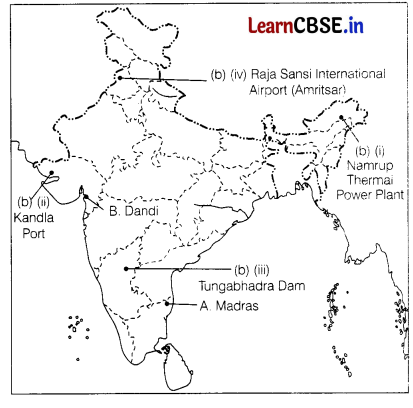
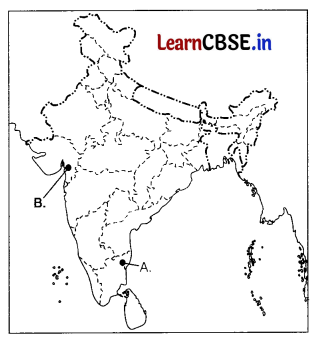
(a) Two places A and B are marked on the given outline map of India. identify them and write their correct names on the
lines drawn near them. (2)
A. The location of the Indian National Congress Session of 1927.
B. The place where the Civil Disobedience Movement started.
(b) On the same political map of India, locate and label any three of the following with suitable symbols. (3)
(i) Namrup Thermal Power Plant
(ii) Kandla Port
(iii) Tungabhadra Dam
(iv) Raja Sansi International Airport.
Answer: