Students must start practicing the questions from CBSE Sample Papers for Class 10 Social Science with Solutions Set 1 are designed as per the revised syllabus.
CBSE Sample Papers for Class 10 Social Science Set 1 with Solutions
Time : 3 Hours
Maximum Marks: 80
General Instructions
- Question paper comprises five Sections – A, B, C, D, and E. There are 37 questions in the question paper. All questions are compulsory.
- Section A – From question 1 to 20 are MCQs of 1 mark each.
- Section B – Question no. 21 to 24 are Very Short Answer Type Questions, carrying 2 marks each. Answer to each question should not exceed 40 words.
- Section C contains Q. 25 to Q.29 are Short Answer Type Questions, carrying 3 marks each. Answer to each question should not exceed 60 words.
- Section D – Question no. 30 to 33 are long answer type questions, carrying S marks each. Answer to each question should not exceed 120 words.
- Section-E – Questions no. from 34 to 36 are case-based questions with three sub-questions arid are of 4 marks each.
- Section F – Question no. 37 is map-based, carrying 5 marks with two parts, 37a from History (2 marks) and 37b from Geography (3 marks).
- There is no overall choice in the question paper. However, an internal choice has been provided in few questions. Only one of the choices in such questions have to be attempted.
- In addition to this, separate instructions are given with each section and question, wherever necessary.
SectionA
Section A consists of 20 questions of 1 mark each
Question 1.
Identify the reason why Otto von Bismarck is considered as the chief architect of German Unification. (1)
(a) He granted autonomy to Prussia with conservatives.
(b) He allied with Italy and France for the unification process.
(c) He carried out the nation-building process with the army and bureaucracy.
(d) He carried along with Liberalist and Romantic scholars for cultural movement.
Answer:
(c) He carried out the nation-building process with the army and bureaucracy.
Question 2.
Mahatma Gandhi had come from South Africa where he had successfully fought the racist regime with a novel method of mass agitation. [1]
According to the above-mentioned statement, choose the correct year in which Mahatma Gandhi returned to India.
(A) January, 1916
(B) January, 1915
(C) March, 1921
(D) April, 1917
Answer:
(B) January, 1915
Question 3.
Read the given data and information carefully and select the appropriate option from the following. (1)
| No. of Workers | Income | |
| Organised Sector | 4,00,000 | 32,000 million |
| Unorganised Sector | 10,00,000 | 28,000 million |
| Total | 14,00,000 | 60,000 million |
The number of employee in unorganised sector is more than organised sector. In unorganised sector, less resources are used
to generate large number of employees. Find out the ways for generating more employment in the city rather than in unorganised sector by the government.
(a) Providing cheap agricultural credit
(b) Increasing vocational education courses
(c) Investing money in transportation
(d) Providing work incentives
Answer:
(a) Providing cheap agricultural credit
Question 4.
India has varied relief features, landforms, climatic realms, and vegetation types. These have contributed to the development of various types of soils. [1]
Based on the above-given statement, identify the most likely states in which the various types of soils are found.
| Column A | Column B | ||
| (i) | Black Soil | (a) | Western |
| (ii) | Alluvial Soil | (b) | Himalayan Region |
| (iii) | Arid Soil | (c) | Northern Plains |
| (iv) | Forest Soil | (d) | Maharashtra |
Options:
(A) (i)-(d), (ii)-(c), (iii)-(a), (iv)-(b)
(B) (i)-(c), (ii)-(d), (iii)-(b), (iv)-(a)
(C) (i)-(b), (ii)-(a), (iii)-(d), (iv)-(c)
(D) (i)-(a), (ii)-(b), (iii)-(c), (iv)-(d)
Answer:
(A) (i)-(d), (ii)-(c), (iii)-(a), (iv)-(b)
Explanation: (i) Black soil is typical of the Basalt region spread over the northwest Deccan plateau and is made up of lava flows.
(ii) Northern plains are made of alluvial soil deposited by Himalayan rivers.
(iii) In Western Rajasthan, due to the dry climate and high temperature, only after proper irrigation does Arid soil become cultivable
(iv) In hilly and mountainous areas enough rainforests are available.

Question 5.
Why should an individual be worried about underemployment? Identify the reason by choosing the correct option. (1)
I. It reduces the earning capacity of a person.
II. It results in a poor standard of living.
III. It leads to poverty.
IV. It helps in human development.
Codes
(a) Only I
(b) Both II and III
(c) I, II and III
(d) Only IV
Answer:
(c) I, II and III
Question 6.
Which of the following pairs is incorrect? [1]
(A) State government- State List
(B) Central Government- Union List
(C) Central and State- Concurrent List Government List
(D) Local government- Residuary powers
Answer:
(D) Local government- Residuary powers
Explanation: The local governments are not empowered to legislate on any matter. They are vested with limited powers. The Constitution of India has vested the ‘Residuary Powers’ with the Centre. But, the final authority to decide whether a matter falls under the list of Residuary powers or not, rests with the Supreme Court because it is the judiciary which decides whether any matter falls’ under the residuary list or not.
Question 7.
Consider the following statements on Zila Parishad and select the answer using the codes given below. (1)
I. Zila Parishad is the lowest tier of the Panchayati Raj System.
II. Zila Parishad coordinates the activities of all the Block Samitis.
III. Most members of the Zila Parishad are elected.
IV. The Zila Parishad Chairperson is the political head of the Zila Parishad.
Select the correct option.
(a) I and II
(b) II and III
(c) I, III and IV
(d) II, III and IV
Answer:
(d) II, III and IV
Question 8.
When and where did Ford Motors set up their large plant in India? [1]
(A) In 1975 at Pune
(B) In 1985 at Gurugram
(C) In 1995 at Chennai
(D) In 2005 at Mumbai
Answer:
(C) In 1995 at Chennai
Question 9.
Which of the following options is correct about Napoleon? (1)
I. He introduced the Napoleonic Code.
II. He promoted democracy in France.
III. He made the administrative system more rational and efficient.
IV. The Napoleonic Code was exported to all the regions under French control.
Codes
(a) I and II
(b) II and III
(c) I, III and IV
(d) III and IV
Answer:
(c) I, III and IV
Question 10.
Study the picture given below and identify it : [1]
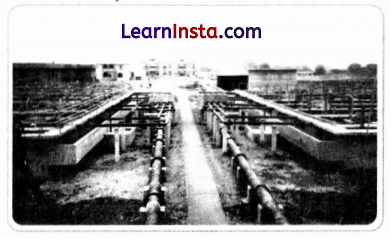
(A) Ramagundam plant
(B) Sewage Treatment Plant under Yamuna Action Plan
(C) Cable manufacturing facilities at HCL
(D) None of the Above
Answer:
(B) Sewage Treatment Plant under Yamuna Action Plan
Explanation: The Yamuna Action Plan (YAP) is a bilateral project between the Government of India and Japan, introduced in 1993. It is one of the largest river restoration projects in India.
Question 11.
The Constitution declared India as a Union of States. The Indian Union is based on the principles of federalism. What does the given image reflect? (1)
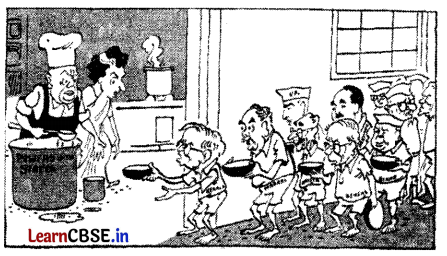
(a) It shows the supreme authority of State Governments.
(b) It shows Central Government is undermining the spirit of federalism.
(c) It shows inequality in the distribution of powers.
(d) None of the above
Answer:
(b) It shows Central Government is undermining the spirit of federalism.
Question 12.
The fast-spreading disease of Cattle Plague or Rinderpest had a terrifying impact on the African local economy. [1]
Arrange the following statements in sequential order based on the information given above:
(i) Indentured Labour was abolished.
(ii) Rinderpest (Cattle Plague) had a terrifying impact on the livelihoods of the African people and the local economy.
(iii) The First World War was fought.
(iv) Potato Famine in Ireland
(A) (iv) – (ii) – (iii) – (i)
(B) (iii) – (i) – (ii) – (iv)
(C) (i) – (iv) – (iii) – (ii)
(D) (ii) – (iii) – (iv) – (i)
Answer:
(A) (iv) – (ii) – (iii) – (i)
Explanation:
(i) Potato Famine in Ireland from 1845 to 1849.
(ii) Rinderpest (Cattle Plague) had a terrifying impact on the livelihoods of the African people and the local economy in the late 1880s.
(iii) The First World War was fought from 1914 to 1918.
(iv) Indentured Labour was abolished in 1921.
Question 13.
Credit (loan) refers to an agreement in which the lender supplies the borrower with money, goods or services in return for the
promise of …………………… . (1)
(a) future payment
(b) payment made
(c) no payment
(d) collateral
Answer:
(a) future payment
Question 14.
There are two statements marked as Assertion (A) and Reason (R). Mark your answer as per the codes provided below: [1]
Assertion (A): India has a Federal system.
Reason (R): Under a unitary system, either there is only one level of government or the sub-units are subordinate to Central Government.
(A) Both (A) and (R) are true and (R) is the correct explanation of (A)
(B) Both (A) and (R) are true but (R) is not the correct explanation of (A)
(C) (A) is correct but (R) is wrong
(D) (A) is wrong but (R) is correct
Answer:
(B) Both (A) and (R) are true but (R) is not the correct explanation of (A)
Explanation: India has a Federal Government. There is a Central Government for the entire country and State Governments for different regions.
Question 15.
A transport union announced a strike, causing lorries to refuse to transport produce such as vegetables and milk from rural areas to urban areas. As a result, food became scarce in urban areas and farmers were unable to sell their products. Which sectors were affected by the transport union’s strike? (1)
(a) Primary and secondary
(b) Secondary and tertiary
(c) Tertiary, primary and secondary
(d) Tertiary and primary
Answer:
(c) Tertiary, primary and secondary
Question 16.
Suppose there are four families in your locality, the average per capital income of whom is ₹ 10,000. If the income of three families is ₹ 6,000, ₹ 8000 and ₹ 14,000 respectively, what would the income of the fourth family be? [1]
(A) ₹ 5,000 (B) ₹ 10,000 (C) ₹ 12,000 (D) ₹ 15,000
Answer:
(C) ₹ 12,000
Explanation: Average capital income = ₹ 10,000
Income of 1st family = ₹ 6,000
Income 2nd family = ₹ 8,000
Income of 3rd family = ₹ 14,000
Let the income of 4th family be x
\(Average Income =\frac{₹ 6000+8000+14000+x}{4}\)
\(₹ 10,000=\frac{₹ 28,000+x}{4}\)
₹ 40,000 = ₹ 28,000 + x
x = ₹ 40,000- ₹ 28, 000 = ₹ 12,000
Question 17.
If there is a conflict in the laws made for the subjects in the Concurrent List, then the decision made by ………………. will prevail. (1)
(a) State Government
(b) Union Government
(c) President
(d) All of the above
Answer:
(b) Union Government
Question 18.
Which of the following countries possessed a huge bureaucratic system that recruited its personnel through the Civil Service Examination? [1]
(A) China
(B) Korea
(C) Japan
(D) Britain
Answer:
(A) China
Explanation: China possessed a huge bureaucratic system that recruited its personnel through civil service examinations.
Question 19.
In dealing with social divisions which one of the following statements is not correct about democracy? (1)
Statement I Due to political competition in a democracy, social divisions get reflected in politics.
Statement II in a democracy, it is possible for communities to voice their grievances peacefully.
Statement III Democracy is the best way to accommodate social diversity.
Statement IV Democracy always leads to the disintegration of society based on social divisions.
Codes
(a) Statements I and II are incorrect
(b) Statements I, II, and III are incorrect
(c) Statement III is incorrect
(d) Only statement IV is incorrect
Answer:
(d) Democracy always leads to the disintegration of society on the basis of social divisions.
Question 20.
The most common expression of Communalism is in: [1]
(A) everyday beliefs.
(B) religious prejudices.
(C) stereotypes of religious communities.
(D) All of the above.
Answer:
(D) All of the above.
Explanation: The most common expression of communalism is in everyday beliefs. These routinely involve religious prejudices, stereotypes of religious communities, and belief in the superiority of one’s religion over other religions.
Section B
Section B consists of 4 questions of 2 marks each
Question 21.
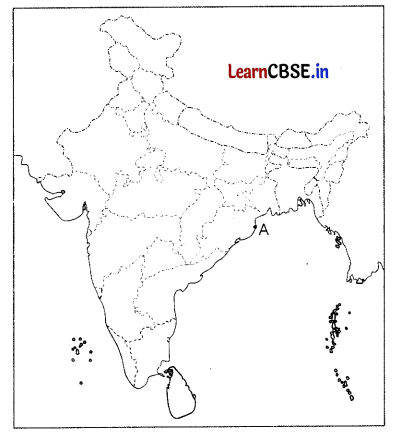
Study the political map of India and name the seaport and its location which is marked in the highlighted India state. (2)
Answer:
Paradip Port is a natural, deep-water port on the East Coast. It is located in the district of Jagatsinghapur in Odisha. It is at the confluence of the Mahanadi river and the Bay of Bengal.
Question 22.
Why is the conservation of minerals important? [2]
Answer:
Minerals are non-renewable resources.
(i) Once consumed, they cannot be created or renewed.
(ii) They are available in limited quantity. Hence we have to use them sensibly.
Question 23.
Why was the Non-Cooperation Movement started in 1920? (2)
Answer:
- Non-Cooperation Movement was started by Gandhiji in 1920 because
- Gandhiji saw this movement as an opportunity to unite Muslims and Hindus.
- He wanted a solution to the Khilafat issue.
- The most important objective of this movement was the attainment of Swaraj.
Question 24.
How can the problem of underemployment be solved in India? [2]
Answer:
(i) Change in the education system can solve the problem of underemployment.
(ii) The government can provide more assistance to self-employed people.
(iii) Emphasis should be laid on full and more productive employment.
Section C
Section C consists of 5 questions of 3 marks each
Question 25.
Distinguish between renewable and non-renewable resources. (1+2=3)
Answer:
The difference between renewable and non-renewable resources are
| Renewable Resources | Non-renewable Resources |
| Renewable resources are those that can be replenished or within a relatively short typically taking millions of human lifetimes or less. | Non-renewable resources are finite and cannot be replenished or regenerated naturally within a short time frame, period, often within a year to form. |
| They are practically inexhaustible or have a sustainable supply. | They exist in limited quantities and can be depleted over time. |
| Renewable resources are replenished through natural processes or human interventions, ensuring their continuous availability. | Non-renewable resources are formed through geological processes over long periods, and their formation rate is much slower than their extraction rate. |
Question 26.
How have intensive industrialization and urbanization posed great pressure on existing freshwater resources in India? Explain. [3]
Answer:
Post-independent India witnessed intensive industrialization and urbanization.
(i) Apart from fresh water, MNCs also require electricity, which comes from hydroelectric power.
(ii) Multiplying urban centers with large and dense populations and urban lifestyles has not only added to water and energy requirements but have further aggravated the problem.
(iii) Large-scale migration from rural to urban areas is causing over-exploitation of water resources.
Question 27.
In which sector do metropolitan cities provide employment opportunities? State any two reasons due to which this sector is gaining importance. (1+2)
Answer:
Metropolitan cities provide employment opportunities in the tertiary sector. Two reasons due to which this sector is gaining
importance are as follows
- The tertiary sector provides essential services like banking, health care, and education which are more demanded in urban areas.
- Developments in agriculture and industry have led to the requirement for services like transport, storage, trade, etc which come under the tertiary sector. These are well-developed in cities.
Question 28.
“Democracy accommodates social diversities.” Support the statement with examples. [3]
OR
Describe any two outcomes of democracy.
Answer:
Democracy accommodates social diversities:
(i) Democracies develop a procedure to conduct their competition. This reduces the possibility of social tensions becoming explosive or violent.
(ii) No society can fully and permanently resolve conflicts among different groups. But we can certainly learn to respect these differences and can evolve a mechanism to negotiate these differences.
(iii) The ability to handle social differences, divisions, and conflicts is thus a definite plus point of democratic regimes.
(iv) Example: Belgium has successfully negotiated differences among its ethnic population. This reduces the possibility of tensions
OR
(i) Promotes equality among citizens.
(ii) Enhances the dignity of the individual.
(iii) Improves the quality of decision-making.
(iv) Provides a method to resolve conflicts.
(iv) Allows room to correct mistakes.
Question 29.
‘Road transport in India is not competitive but complementary to railways.” Justify the statement by giving three points. (3)
Answer:
Road transport in India is not competitive but it provides complementary to railways in the following ways
- Door-to-Door Service Road transportation increases the reach of railways by providing the finar links from the railhead to the final destination, i.e. giving door-to-door service.
- Loading and Unloading Anywhere Railways can stop only at specific destinatïons where loading and unloading facilities are available, but vehicles on the road can be loaded or unloaded virtually anywhere.
- Speed of Transportation Bulky and non-perishable goods are transported by railways over long distances and take a longer time, whereas perishable goods can be transported through road transport in a shorter time.
Section D
Section D consists of 4 questions of 5 marks each
Question 30.
Print revolution was not just a development, a new way of producing books; it transformed the lives of people. [5]
Examine the impact of the Print Revolution in Europe during 15th and 16th century.
OR
“Print not only stimulated the publication of conflicting opinions amongst communities, but it also connected communities and people in different parts of India.” Examine the statement.
Answer:
Impact of the Print Revolution in Europe during the 15th and 16th centuries:
(i) Printing reduced the cost of books.
(ii) The time and labour required to produce each of the books came down, multiple copies could be produced with greater ease.
(iii) Books flooded the market, reaching out to an ever-growing readership.
(iv) Publishers started publishing popular ballad folk tales with beautiful pictures and illustrations.
(v) Knowledge was transferred orally.
(vi) Print created the possibility of the wide circulation of ideas and introduced a new world of debate and discussion.
(vii) Even those who disagreed with established authorities could now print and circulate their ideas. For example, Martin Luther was a German monk, priest, professor and Church Reformer. He challenged the Church to debate his ideas.
(viii) This led to division within the Church and the beginning of the Protestant Reformation.
(ix) Print and popular religious literature stimulated many distinctive individual interpretations of faith even among little-educated working people.
(x) In the sixteenth century, Menocchio, a miller in Italy, reinterpreted the message of the Bible and formulated a view of God and Creation that enraged the Roman Catholic Church.
OR
(i) Religious texts, reached a wide circle of people encouraging discussions, debates and controversies within and among different religions.
(ii) Newspapers conveyed news from one place to other creating pan-Indian identities.
(iii) Spread of ideas through printed texts and newspapers led to widespread participation of Indians.
(iv) Print propagated against social evils like sati practice, child marriage and the purdah system.
(v) Emergence of many social reforms and reform movements.
(vi) New ideas emerged through the clashes of opinions.
Question 31.
Analyse why the Lahore Session of Congress presided by Nehru, holds a special significance in the freedom struggle.
Or
Who formed Khilafat Committee? How did Gandhiji saw Khilafat Movement as an opportunity to unite Hindus and Muslims?
What were the strategies planned to make the movement successful? (1 + 1+3)
Answer:
The Lahore Session of Congress (December 1929) presided over by Jawaharlal Nehru, holds a special significance in freedom struggle because in this session, the newly adopted ‘Tri-colour National Flag, was hoisted and a decision was taken to celebrate
26th January, 1930 as the Independence Day all over India.
Congress under the Presidency of Jawaharlal Nehru took decisions to achieve Complete Independence (Poorna Swaraj).
it was decided to launch Civil Disobedience Movement, if the eleven demands put forward by Congress were not accepted by the government. other specific demands of different classes from industrialists to the peasants were put forward, decision to launch a widespread National Movement was taken if the demands were not accepted.
or
A Khilafat Committee was formed under the leadership of Maulana Azad, Hakim Amal Khan and Hasrat Mohani. Muslim leaders, Muhammad Ah and Shaukat Ahi began discussing with Mahatma Gandhi about the possibility of a united mass action on the issue.
Gandhij saw this as ‘an opportunity of uniting Hindus and Mohammedans as would not anse in hundred years.’ The Congress passed the resolution in its Calcutta Session n September 1920 to start a satyagraha on the Khilafat issue. To gain maximum success, Mahatma Gandhi proposed a stage by stage strategy implementation for the movement as
The movement had to begin with a surrender of titles, honours and honorary posts by people. It was planned to shun or boycott Civil Services, Army, Police, British Courts and Legislative Assemblies. Schools and Colleges and British goods.
The British goods were to be replaced by domestic goods or Swadeshi to promote the native cottage industries In case of government suppression, Civil Disobedience Movement will be launched.
The Non-Cooperation Movement was adopted by the Congress after a lot of debates during the Nagpur Conference in December 1920. Under Mahatma Gandhi‘s leadership, the Non-Cooperation-Khilafat Movement began in full force.
Question 32.
Describe the elements of Belgium model for accommodation. [5]
OR
How did the idea of power-sharing emerge? Explain different forms that have common arrangements of power-sharing.
Answer:
Belgium model for the accommodation of diversities:
(i) Though the Dutch were in majority in the countiy, the French and Dutch speaking population was given equal representation in the Central government.
(ii) Belgium was declared as a Federal state and thus State government were given important powers.
(iii) The state government did not act a subordinate to the Central government.
(iv) The capital city of Brussels has a separate government. Through the French speaking population was in majority in the city, they accepted equal representation in Brussels.
(v) This was because the Dutch speaking people has accepted equal representation in the Central government despite being in majority.
(vi) Community government was elected by Dutch, French and Germans peaking people and looked after educational, language and educational issues.
(vii) Any other relevant point.
OR
Idea of power-sharing emerged:
The idea of power-sharing has emerged in opposition to the notions of undivided political power.
Different forms having common arrangements of Power-Sharing:
(i) Power is shared among different organs of government such as the legislature, executive and judiciary.
(ii) Powers can be shared among governments at different levels i.e., at national and provincial or regional levels.
(iii) Power shared among different social groups such as religious and linguistic groups.
Power-sharing arrangements in the way political parties, pressure groups and movements control or influence thosein power.
Question 33.
How can more employment be created in the agriculture sector alone? (5)
Or
Why is the tertiary sector becoming more important in India? Explain.
Answer:
The following measures can be taken to increase employment in rural areas.
- Improve irrigation facilities, so that farmers harvest two or three crops in a year. Thus, more people can be employed.
- More clams should be built on rivers so that more water can be provided to small farmers to increase the number of crops grown annually.
- Provide better roads and improve transportation and storage, which will benefit small farmers and many people will be employed in these sectors.
- Alternative employment such as honey collection centres and vegetable and fruit processing units should be set up.
- More cottage industries should be promoted in rural areas with loans and marketing support to boost employment.
Or
The tertiary sector has emerged as the largest producing sector in the Indian economy in the last decade because
- Demand for tertiary sector activities like transport, storage and trade has increased substantially with the development of the primary and secondary sectors.
- Increasing requirements of information, communication and technology has created lot of jobs.
- With increase in the income levels of the people, demand for tourism, shopping, education and other services has increased.
- Liberalisation of the financial environment has boosted faster growth in financial services.
- Basic services of education and healthcare require a large number of people to be engaged in tertiary sector activities.
Section E
Section E consists of 3 Case-based questions of 4 marks each
Question 34.
Read the passage given below and answer the questions that follow: [4]
The use of money spans a very large part of our everyday life. Look around you and you would easily be able to identify several transactions involving money in any single day. Can you make a list of these? In many of these transactions, goods are being bought and sold with the use of money. In some of these transactions, services are being exchanged with money. For some, there might not be any actual transfer of money taking place now but a promise to pay money later.
Have you ever wondered why transactions are made in money? The reason is simple. A person holding money can easily exchange it for any commodity or service that he or she might want. Thus everyone prefers to receive payments in money and then exchange the money for things that they want. Take the case of a shoe manufacturer. He wants to sell shoes in the market and buy wheat. The shoe manufacturer will first exchange shoes that he has produced for money, and then exchange the money for wheat. Imagine how much more difficult it would be if the shoe manufacturer had to directly exchange shoes for wheat without the use of money. He would have to look for a wheat growing farmer who not only wants to sell wheat but also wants to buy the shoes in exchange. That is, both parties have to agree to sell and buy each others commodities. This is known as double coincidence of wants. What a person desires to sell is exactly what the other wishes to buy. In a barter system where goods are directly exchanged without the use of money, double coincidence of wants is an essential feature.
In contrast, in an economy where money is in use, money by providing the crucial intermediate step eliminates the need for double coincidence of wants. It is no longer necessary for the shoe manufacturer to look for a farmer who will buy his shoes and at the same time sell him wheat. All he has to do is find a buyer for his shoes. Once he has exchanged his shoes for money, he can purchase wheat or any other commodity in the market. Since money acts as an intermediate in the exchange process, it is called a medium of exchange.
34.1 Give reason why transactions are made in money ? [1]
Answer:
The reason why transactions are made in money is very simple. A person holding money can easily exchange it for any commodity
or service that he or she might want. Thus everyone prefers to receive payments in money and then exchange the money for things they want.
34.2 What do you mean by double coincidence of wants ? [1]
Answer:
When the seller and buyer or both parties agree to sell and buy each others commodities, it is called double coincidence of wants. What a person desires to sell is exactly what the other wishes to buy. In a barter system where goods are directly exchanged without the of money, double coincidence of wants is an essential feature.
34.3 How would the shoe manufacturer had directly exchanged shoes for wheat without the use of money ? [2]
Answer:
If the shoe manufacturer had to directly exchange shoes for without the use of money, he would have to look for a wheat growing farmer who not only wants to sell wheat but also wants to buy the shoes in exchange. That is both parties have to agree to sell and buy each others commodities.
Question 35.
Read the given extract and answer the following questions.
Irrigation has also changed the cropping pattern of many regions with farmers shifting to water-intensive and commercial
crops. This has great ecological consequences like salinisation of the soil. At the same time, it has transformed the social
landscape i.e., increasing the social gap between the richer landowners and the landless pool As we can see, the dams did
create conflicts between people wanting different uses and benefits from the same water resources.
In Gujarat, the Sabarmati-basin farmers were agitated and almost caused a riot over the higher priority given to water supply in
urban areas, particularly during droughts. Interstate water disputes are also becoming common about sharing the Costs and benefits of the multi-purpose project.
Do you know that the Krishna-Godavari dispute is due to the objections raised by Karnataka, and Andhra Pradesh governments? It is regarding the diversion of more water at Kovna by the Maharashtra government for a multi-purpose project. This would reduce downstream flow If their states with adverse consequences for agriculture and industry.
Most of the objections to the projects arose due to their filure to achieve the purposes for which they were built. Ironically, the
dams that were constructed to control floods have triggered floods due to sedimentation in the reservoir. Moreover;the big dams have mostly been unsuccessful in controlling floods at the time of excessive rainfall.
You may have seen or read how the release of water from dams during heavy rains aggravated the flood situation in Maharashtra and Gujarat in 2006. The floods have not only devastated life and property but also caused extensive soil erosion. Sedimentation also meant that the flood plains were deprived of silt, a natural fertiliser, further adding on to the problem of land degradation. It was also observed that the multi-purpose projects induced earthquakes, caused water-borne diseases and pests and pollution resulting from excessive use of water.
(i) Do you agree that farmers are responsible for the salinisation of soil? If yes, why? (1)
(ii) is it true that darns create conflict between people? State any one real life example. (2)
(iii) Is it true that multi-purpose projects are not able to achieve their major objectives? If yes, how? (1)
Answer:
(i) Yes, I agree that farmers are also responsible for salinization of soil. It is because they switched to water-intensive commercial crops which need more irrigation and cause salinisation of soil.
(ii) It is true that dams create conflicts between people. As from the same water resources, different people ‘want different uses and benefits.
For example, the Krishna-Godavari dispute is due to the objections raised by Karnataka and Andhra Pradesh governments. It is regarding the diversion of more water of Koyna by the Maharashtra government for a multi-purpose project. This reduces downstream flow in their states with adverse consequences for agriculture and industry.
(iii) It is true that multi-purpose projects fail to achieve the aim for which they were built. The dams were constructed to control floods but have triggered floods due to sedimentation in the reservoir. Moreover, the big dams have mostly been unsuccessful in controlling floods at the time of excessive rainfall.
Question 36.
Read the extract given below and answer the questions that follow: [4]
Following the defeat of Napoleon in 1815, European governments were driven by a spirit of conservatism. Conservatives believed that established traditional institutions of state and society – like the monarchy, the Church, social hierarchies, property, and the family – should be preserved. Most conservatives, however, did not propose a return to the society of pre-revolutionary days.
Rather, they realized, from the changes initiated by Napoleon, that modernization could strengthen traditional institutions like the monarchy. It could make the state’s power more effective and stronger. A modern army, an efficient bureaucracy, a dynamic economy, and the abolition of feudalism and serfdom could strengthen the autocratic monarchies of Europe. In 1815, representatives of the European powers who had collectively defeated Napoleon, met at Vienna to draw up a settlement for Europe. The Congress was hosted by the Austrian Chancellor Duke Metternich.
The delegates drew up the Treaty of Vienna of 1815 with the object of undoing most of the changes that had come about in Europe during the Napoleonic wars. The Bourbon dynasty, which had been deposed during the French Revolution, was restored to power, and France lost the territories it had annexed under Napoleon. A series of states were set up on the boundaries of France to prevent French expansion in the future.
36.1 What was the purpose behind convening the Congress of Vienna in 1815? [1]
Answer:
The purpose behind conveying the Congress of Vienna in 1815 was to restore the conservative regime in Europe.
36.2 What did conservatives focus on at the Congress of Vienna? [1]
Answer:
The main intention was to restore the monarchies that had been overthrown by Napoleon.
36.3 How did the Congress of Vienna ensure peace in Europe? [2]
Answer:
The Congress of Vienna ensured peace in Europe by laying out a balance of power between all the great powers in Europe.
Section F
Section F consists of Map based questions of 5 marks
Question 37.
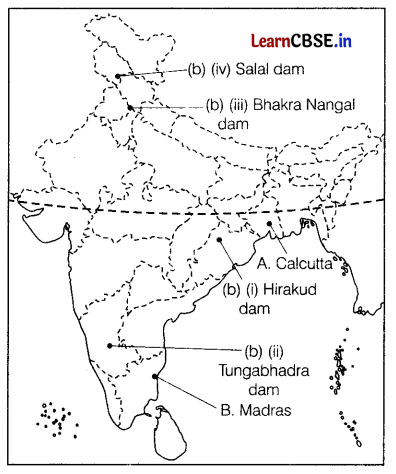
(a) Two places A and B have been marked on the given outline map of India. Identify them on the map and write their correct
names on the line drawn near them. (2)
A. A place where the Congress session was held in 1928.
B. A place where the Congress session was held in 1927.
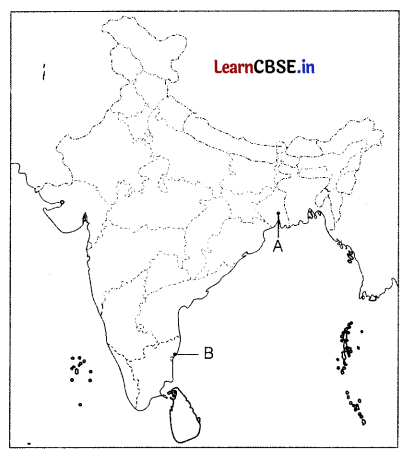
(b) On the same outline map of India, locate and label any three of the following with suitable symbols. (3)
(i) Hirakud dam
(ii) Tungabhadra dam
(iii) Bhakra Nangal darn
(iv) Salai dam
Answer: