Students must start practicing the questions from CBSE Sample Papers for Class 10 Computer Applications with Solutions Set 1 are designed as per the revised syllabus.
CBSE Sample Papers for Class 10 Computer Applications Set 1 with Solutions
Time Allowed: 2 hours
Maximum Marks: 50
General Instructions:
- This Question Paper has 5 Sections A-E.
- All Questions are compulsory. However, internal choices have been provided in some of the questions.
- Section A has 12 questions carrying 01 mark each.
- Section B has 7 Short Answer (SA-I) type questions carrying 02 marks each.
- Section C has 4 Short Answer (SA-II) type questions carrying 03 marks each.
- Section D has 1 Long Answer (LA) type question carrying 04 marks.
- Section E has 2 Source based /Case-based /Passage based Questions carrying 04 marks each.
SECTION – A (12 Marks)
(All questions are compulsory)
Question 1.
The acronym SSH stands for ………………… . [1]
(a) Safe Shell
(b) Software Shell
(c) Secure Shell
(d) Simple Shell
Answer:
(c) Secure Shell
Explanation: SSH is Secure Shell protocol. It is used to remotely log in to a system. SSH esgtablishes a direct secure connection between client and the server using encrypted data.
Protocols like Telnet, FTP and email protocols are not secure as these share unencrypted data over the internet.
Question 2.
Which of the following is an example of social networking website? [1]
(a) wikipedia.org
(b) Facebook.com
(c) cbse.gov.in
(d) ncert.gov.in
Answer:
(b) Facebook.com
Explanation: Wikipedia.org is an informational website, cbse.gov.in is a government website, ncert.nic.in is also a government website registered with National Informatics Center(NIC) Facebook.com is a commercial social networking website.
A website on which people can connect with their family, friends and colleagues and also share their activities and their interest on any topic as well, is called a social networking site.
Question 3.
M in HTML stands for: ………….. [1]
(a) Modify
(b) Management
(c) Multiple
(d) Markup
Answer:
(d) Markup
Explanation: HTML stands for Hypertext Markup Language.
HTML is used to specify layout of a document and the hyperlinks. It tells the browser how to display a web page.
Caution : HTML is not a word processor or a programming language.
Question 4.
A …………… is an online journal or informational website run by an individual, group, or corporation that offers regularly updated content about a topic. [1]
(a) News group
(b) Blog
(c) WWW
(d) e-Groups
Answer:
(b) Blog
Explanation:
A News group is an online forum where users with common interests can gather and discuss a specific topic. WWW is a collection of web pages and electronic documents that are linked using hyperlinks. E-Groups are online groups of like minded individuals where they can share their posts and also like and comment on posts by other members. A blog is a frequently updated personal diary or journal.
Different types of blogs are Personal Blogs, News and Views, Company blogs. Micro blogs.

Question 5.
Which of the following is not a valid value for the target attribute of <a> tag? [1]
(a) _blank
(b) _self
(c) _top
(d) _bottom
Answer:
(d) _bottom
Explanation: The target attribute of an anchor specifies where to open the linked document.
_blank is the default value and opens the linked document in a new window or tab.
_self opens the linked document in the same frame where it was clicked.
_top opens the document in the full body of the window where it was clicked.
Some other values of the target attribute are _parent (to open the linked document in the parent window) and framename (opens the linked document in the named frame).
Question 6.
link, vlink, alink are attributes of… ……….. tag. [1]
(a) <body>
(b) <a>
(c) <html>
(d) <img>
Answer:
(a) <body>
Explanation: link, vlink and alink attributes specify the colour of the links, visited link and active links in a document.
Question 7.
The ……………. attribute of <img> tag specifies an alternate text for an image, if the image cannot be displayed. [1]
(a) alt
(b) text
(c) alternate
(d) msg
Answer:
(a) alt
Explanation: The alt attribute’s, text is displayed as tooltip if the image is available and download is enabled at the client computer or is displayed as a label next to the image’s placeholder.
To display tool tip in browsers other than Internet Explorer the title attribute of<img> tag is used.
Caution : The text of alt attribute is displayed as tooltip only in Internet Explorer.
Question 8.
Which of the following tag can be used to draw a horizontal line in webpage? [1]
(a) <line>
(b) <hrule>
(c) <hr>
(d) <rule>
Answer:
(c) <hr>
Explanation: <hr> horizontal rule draws a horizontal line on the web page that goes across the browser window.
Default size of horizontal rule is 3 pixels. Attributes Size, width, noshade and color can be used with it.
Question 9.
In HTML <dl>, <dd> and <dt> tags are used to create: [1]
(a) Description list
(b) Definition list
(c) Detail list
(d) Dynamic list
Answer:
(a) Description list
Explanation: A description list in HTML is used to give definition of some terms. <dl> is used to specify the following list as description list, <dt> specifies the definition term and <dd> specifies the description of the term.
Description lists are specified without any bullets and are indented.
Caution: <dl> defines a description list in HTML S.O and a definition list in HTML 4.1.
Question 10.
A software ………….. is a legal instrument governing the use or redistribution of software. [1]
(a) license
(b) law
(c) document
(d) piracy
Answer:
(a) license
Explanation: A license provides end users the right to use the software without violating the copyrights. It also defines responsibilities of both the parties.
There are different types of software licenses such as Proprietary Software license and Free and Open Source Software License.
Questions No.11 and 12 are Assertion and Reason types. Each question consists of two statements, namely, Assertion (A) and Reason (R). Select the most suitable option considering the Assertion & Reason.
Question 11.
Assertion (A): Search engine is a hardware device that searches for any websites on the World Wide Web.
Reason (R): Google Search and Microsoft’s Bing are two popular search engines. [1]
(a) Both Assertion (A) and Reason (R) are true and Reason (R) is a correct explanation of Assertion (A).
(b) Both Assertion (A) and Reason (R) are true but Reason (R) is not a correct explanation of Assertion (A).
(c) Assertion (A) is true and Reason (R) is false.
(d) Assertion (A) is false and Reason (R) is true.
Answer:
(d) Assertion (A) is false and Reason (R) is true.
Explanation: Search engine is a software program that searches through a database of web pages for a particular information. Google Search, Microsoft Bing, Yahoo! Search and ASK are some of the popular search engines.
To search information using search engines, users need to enter relevant keywords . Now the software used for search algorithm scans the index to find related web pages from the WWW.
Question 12.
Assertion (A): CSS saves a lot of work. It can control the layout of multiple web pages all at once.
Reason (R): All the required style settings can be stored in an external stylesheet and a link to it can be added in the <head> section of each web page. [1]
(a) Both Assertion (A) and Reason (R) are true and Reason (R) is a correct explanation of Assertion (A).
(b) Both Assertion (A) and Reason (R) are true but Reason (R) is not a correct explanation of Assertion (A).
(c) Assertion (A) is true and Reason (R) is false.
(d) Assertion (A) is false and Reason (R) is true.
Answer:
(a) Both Assertion (A) and Reason (R) are true and Reason (R) is a correct explanation of Assertion (A).
Explanation: CSS or Cascading Style Sheet is a way of separating the document content from the document style thus providing more clarity of the content and better control over the presentation styles of the document.
A CSS rule set consists of a selector and a declaration block.
SECTION – B (14 Marks)
(2 Marks each)
Question 13.
Write any two points of comparison in between SMS and MMS. [2]
Answer:
Any two points of comparison in between SMS and MMS:
| SMS | MMS |
| It stands for Short Messaging Service. | it stands for Multi-media Messaging Service. |
| It does not support multi-media content and it allows to send only text. | It supports multi-media content and allows to send images and videos along with text. |
| It allows message length up to 160 characters. | It allows .message length up to 1600 characters. |
| It is less expensive. | It is more expensive |
| Extra Points: | |
| SMS can be sent and received using any cell phone | To be able to send or receive an MMS a multimedia enabled phone is required. |
Question 14.
What is e-Learning? Mention its two main advantages.
OR
Briefly discuss the role of e-governance in any country’s growth and development. [2]
Answer:
E-learning: It is a method of obtaining knowledge through digital or, web-enabled gadgets like computers, laptops, tablets or smartphones.
Advantages:
- E-learning is self-paced.
- E-learning is student-centered.
- E-learning is cost-effective
- E-learning accommodates individual learning styles.
Extra Points:
It provides hands on approach to many topics as it incorporates the use of various multimedia thus, enhancing the learning experience.
Some very popular e-learning softwares are moodle, udemy, skill share, udacity, etc.
OR
Role of e-governance in any country’s growth and development:
Now-a-days e-Governance has a major role in any country’s growth and development as properly designed and implemented, e-Governance can improve efficiency in the delivery of government services, simplify compliance with government regulations, strengthen citizen participation and trust in – government, and yield cost savings for citizens, businesses, and the government itself.
Question 15.
Compare 3G and 4G mobile technologies on any two major points. [2]
Answer:
Two major points of comparison in between 3G and 4G mobile technologies:
| 3G (3rd Generation) | 4G (4th Generation) |
| The maximum upload and download rate is 5 Mbps and 21 Mbps respectively. | The maximum upload and download rate is 500 Mbps and 1 Gbps respectively. |
| It uses a packet switching technique. | It uses message and packet switching technique. |
| Its frequency range is from 1.8 GHz to 2.5 GHz. | Its frequency range is from 2 GHz to 8 GHz. |
| Extra Points: | |
| 3G stands for 3rd generation. | 4G stands for 4th generation. |
| It is a wide area, cell based network architecture. | 4G integrates Wide Area cell based network architecture along with wireless LAN. |
| 3G uses Wideband Code Division Multiple Access(WCDMA), Digital Broadband packet data. etc. technologies. | 4G uses WiMax and LTE (Long Term Evolution) technologies. |
Question 16.
Which software are termed as open-source software? Name any two such software.
OR
What do you understand by the term Intellectual property right? Discuss briefly. [2]
Answer:
Open-source software is a type of computer software that is released under a license, but the source code is made available to all the users to understand it, modify it or re-distribute it. Name of any two OSS: Linux, Firefbx
An Open Source Software is available freely for distribution and change. However, it is not available free of cost. The Open Source license implies that all the modified versions are also licenced under the Open Source philosophy.
OR
Intellectual property rights (IPR): These are the rights granted to individuals over their original creative works such as inventions, literary and artistic work, designs and symbols, names, and images in commerce. These legal rights are granted through patents, copyrights, trademarks, geographical indications, etc. for a specified time period.
Extra points:
IPR also grants the owner of the creative works to decide on how much information is to be shared and what fees is to be charged for the same.
Question 17.
Mention any two purposes of using comments while designing a HTML webpage. [2]
Answer:
Any two purposes of using comments while designing a HTML webpage:
- With comments one can place notifications and reminders in the HTML code.
- Comments are also great for debugging HTML, because you can comment out HTML lines of code, one at a time, to search for errors.
Extra Points:
Comments are helpful in understanding and editing the code at a later stage. (Any two)
Question 18.
Twisha has got confused with a few tags and their attributes. Help her match the tag with correct attribute.
| (A) <font> | (I) align |
| (B) <a> | (II) face |
| (C) <hl> | (III) colspan |
| (D) <td> | (IV) href |
OR
Mention any two attributes of <font> tag along with their purposes. [2]
Answer:
| (A) <font> | (II) face |
| (B) <a> | (IV) href |
| (C) <hl> | (I) align |
| (D) <td> | (III) colspan |
Explanation:
<font> tag is used to specify the type of font to be used in the document. It takes the following attributes: size, face and color <a> is anchor tag and is used for linking. Href is its attribute.
<h1> is the heading tag. Headings in HTML can be defined in 6 different levels using <h1> to <h6>; tags. The headings can be aligned using align attribute with values left, right and center.
<td> tag defines a data cell in a table. <table> tag defines the table <tr> specifies a row. <td> tag has rowspan and colspan attributes that are used to merge two or more rows or columns into one.
OR
Any two attributes of <font> tag along with their purposes:
Size: This attribute is used to adjust the size of the text in the HTML document. The range of size of the font in HTML is from 1 to 7 and the default size is 3.
Face: Font type can be set by using face attribute with font tag in HTML document. But the fonts used by the user need to be installed in the system first.
Color: Font color is used to set the text colour. Using a font tag with the colour attribute in an HTML document, color can be specified either with its name or with its hex code.
If the font name specified in face attribute is not supported by the browser then it is displayed in the default font of the browser.
Question 19.
Write suitable html statements to display the following text on a webpage in appropriate subscript and superscript form:
(A) CO2
(B) X2 [2]
Answer:
(A) CO2
(B) X2
To display text slightly above the normal text <sup> tag is used and to display text slightly below the normal text <sub> tag is used. Both of these are container tags. The text enclosed within the opening and closing tag is displayed as subscript or superscript.
SECTION – C (12 Marks)
(3 Marks each)
Question 20.
Ronaldo, a web designer in a start-up company, wants to give headings in a webpage through <hl> tag. Additionally, he wants to implement following styles on all the <h1> tag of the same webpage at one go.
- Color-blue
- Background color-yellow
- border of the heading – 2px in red.
He is not able to implement the above- mentioned additional styles of <hl> tag through regular html code. Suggest him a way out and also help him in writing the code for same. [3]
Answer:
Ronaldo should use css to implement extra styles in <hl> tag.
HTML Code:
<html>
<head>
<style>
hi {color: blue;background-color:yellow;border: 2px soLid red}
</style>
</head>
<body>
<h1>Welcome</h1>
</body>
</html>
<style> tag should be placed inside <head> tag of a webpage.
Internal CSS tags are placed in the head tag of the HTML document and these are applied to all the tags of the same type in the entire web page.
Caution: The regular heading tag of HTML takes only align attribute.
Question 21.
Rajat, a web developer, wants to show a video named “tiger.mp4” in dimensions of 300px width and 200px height on the web page. Help Rajat by writing its html code. [3]
Answer:
HTML code to add a video in a web page: cvideo width=”300” height=”200” controls> <source src=”tiger.mp4” type=’’video/mp4”> </video>
<video> tag is used to embed a video in a web page. It has one or more source attributes which specifies video sources. Height and width attributes specify the dimensions of the video’s display area in pixels.
Question 22.
Abhilasha has just designed a web page. At the end of the web page, she wants to insert an image “next.jpg”.
She needs to link another web page with this image, i.e., whenever anyone click on the image “nextjpg”, another web page named “second.html” should open. Help her in writing the code to achieve it.
Note: Assume that image and both the web pages are stored in the same folder.
OR
Write HTML code to design the content of the web page in the form of lists as shown below: [3]
STREAM WISE CAREER OPTIONS
- Science
- Engineering
- Medical
- Research
- Commerce
- Humanities
Answer:
<a href=”second.htmr><img src=”next jpg”> </a>
<img> tag is used to add image to a HTML document. Its attribute is src that defines the name and location of the image file. <a> tag is the anchor tag and is used for linking a document to the current HTML document. It has attribute href which specifies the referenced document. It is a container tag and the text between the opening and closing tag is the hypertext. To specify an image as a hyperlink its <img> tag is given in between the opening and closing <a> tags.
OR
<html>
<body>
STREAM WISE CAREER OPTIONS <ultype=”square”>
<li>Science
<ol type=“a”>
<li>Engineering</li>
<li>Medical</Li> .
<li>Research</li>
</ol>
</li>
<li>Commerce</li>
<li>Humanities</li>
</ul>
</body>
</html>
To define a bulleted list in HTML <ul> tag is used. <ol> specifies an ordered list. Individual items of the list are specifies using <li> tag in either list and type attribute of both <ul> and <ol> specifies the type of bullet or numbering style.
Question 23.
What do you understand by the term “Digital Divide”? Mention any two measures to overcome it.
Answer:
The digital divide is the unequal access to digital technology, including smartphones, tablets, laptops, and the internet in the society.
Any two measures to overcome it:
- Increase affordability of digital technologies
- More focus on development of internet infrastructure
Extra Points:
Measures to overcome to Digital divide. - Making the content available in multiple languages and not just English.
Digital divide can be due to:
- Difference in availability of internet in rural and urban areas
- Social economic differences such as differernce in income, education and social status
- Difference in developing and developed nations.
- Lack of ICT skills
- Negligence towards learning new technology.
SECTION – D (4 Marks)
(4 marks each)
Question 24.
Customer Analytics firm needs to design a survey form as shown below:
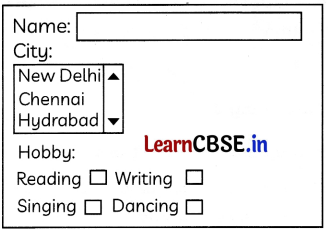
Write the suitable HTML code to design it.
OR
Observe the screenshot of the given web page:
| Skill Workshops | ||
| S. No. | Skill | Days |
| 1. | Communication Skills | Monday, Wednesday |
| 2. | Art & Craft | Tuesday, Friday |
| 3. | Personality Development | Wednesday, Saturday |
Write suitable HTML code to design it
Answer:
HTML code to design survey form:
<form>
Name: <input type="text"><br>
City: <br>
<select size=3>
<option>New Delhi</option>
<option>Chennai</option>
<option>Hydrabad</option>
</select><br>
Hobby: <br>
Reading<input type="checkbox">
Writing<inputtype="checkbox"><br>
Singingcinput type="checkbox">
Dancingcinput type=”checkbox">
</form>
OR
HTML code to design given html page:
<html>
<body>
<table border=1>
<tr>
<th colspan=3>
SKILL WORKSHOPS
</th>
</tr>
<tr>
<th>SNO</th>
<th>SKILL</th>
<th>DAYS</th>
</tr>
<tr>
<td>Communication Skills</td>
<td>Monday, Wednesday</td>
</tr>
<tr>
<td>2</td>
<td>Art & Craft</td>
<td>Tuesday, Friday</td>
</tr>
<tr>
<td>3</td>
<td>Personality Development</td>
<td>Wednesday, Saturday</td>
</tr>
</table>
</body>
</html>
SECTION – E (8 Marks)
(4 marks each)
Question 25.
Case Study 1
Sanchay, has recently joined the Global Network company as a network trainee. Help Sanchay by suggesting the best suitable answers for the following issues which needs to resolved:
(A) Company wants to engage employees in some online fun filled activities to strengthen their inter-personal skills. Suggest any two popular video conferencing software to be used for the same. [1]
(B) Company wants employees to upgrade themselves by exploring internet about latest happenings in the networking field. Suggest any two suitable web browsers for the same. [1]
(C) Sometimes few of the employee needs to remotely login to their office PC from their home. Suggest any one popular software and the protocol being used for the same. [1]
(D) Company wants its employees to be safe while entering their login credentials and bank account details on the internet. Out of http and https, which protocols should be preferred and why? [1]
Answer:
(A) Any two popular video conferencing software: Skype, Zoom, Teams, Whatsapp.
(B) Any two suitable web browsers: Google Chrome, Mozilla Firefox
(C) Remote login Software: Any Desk
Protocol used in remote login: TelNet
(D) https should be preferred as https allows transferring the data in an encrypted form.
Question 26.
Case Study 2
It is an era of Internet and we as a netizen spend most of our time in the cyber world. Saumya, a class X student, is new to the cyber world. Help her in the following:
(A) Suggest any two netiquettes, which she should follow in order to become a good netizen. [1]
(B) As the last day was approaching, so one of her friends has just submitted the science project by copying and pasting from the internet, without even acknowledging the original source. Is this the right act or wrong? Name the term which is being used for this act. [1]
(C) E-commerce is growing exponentially and so is the risk involved in it. Mention any two common E-commerce frauds in order to make Saumya aware about it. [1]
(D) Suggest her any two precautions to be taken while using E-commerce. [1]
Answer:
(A) Any two netiquettes:
- We should not violate copyright
- We should share our expertise with others on the network.
(B) No its not the right act
This act is called plagiarism.
(C) Any two common E-commerce frauds:
- Identity Theft
- Phishing
(D) Any two precautions to be taken while using E-commerce:
- Use updated antivirus software
- Always ensure to check https in the web address.