Students can find accurate Class 7 English Extra Questions and Class 7 English Chapter 2 Try Again Extra Questions and Answers for better understanding.
Try Again Extra Question Answer Class 7 English Chapter 2
Try Again Very Short Questions and Answers
Question 1.
Why was King Bruce in despair?
Answer:
Because he failed in his attempts to help his people.
Question 2.
What lesson did King Bruce learn from the spider?
Answer:
To never give up (persistence leads to success).

Question 3.
What did King Bruce do after being inspired by the spider?
Answer:
He tried again and succeeded.
Question 4.
What phrase did King Bruce exclaim when the spider succeeded?
Answer:
“Bravo, bravo!”
Question 5.
Who was King Bruce?
Answer:
King Bruce was the ruler of Scotland, known for his perseverance and determination in battle.
Question 6.
Why was King Bruce feeling disheartened at the start of the poem?
Answer:
King Bruce was feeling disheartened at the start of the poem had faced multiple failures in battle and was losing hope in his ability to succeed.
Question 7.
What event caused King Bruce to pause his thoughts?
Answer:
King Bruce saw a spider attempting to climb to its web, which caught his attention and caused his thoughts to pause.
Question 8.
How can we describe the spider based on its actions in the poem?
Answer:
Based on the spider’s actions in the poem we can describe it as determined and brave.
Question 9.
What did King Bruce learn from observing the spider?
Answer:
By observing the spider King Bruce learned the importance of perseverance and decided to try again instead of giving up.
Question 10.
What does the poet want the reader to notice in the spider’s climb?
Answer:
The poet wants the readers to notice that the spider never gave up, no matter how many times it fell.
Question 11.
Briefly comment on the transformation in the King’s mindset following his observation of the spider.
Answer:
The king’s attitude changed for the better. He went from despair to determined after watching the spider’s effort.
Question 12.
State the reason the poet avoids direct instruction while delivering the central message of the poem.
Answer:
The poet avoids direct instruction while delivering the central message of the poem because the poet uses a story to show, not tell, that trying again brings success.
Try Again Short Questions and Answers
Question 1.
Why did King Bruce say, “All honour to those who try”?
Answer:
King Bruce said this because he realized that true success comes to those who keep trying despite failures. He admired the spider’s persistence and applied the same spirit to his own life.
Question 2.
What did King Bruce observe while he was lost in thought?
Answer:
He observed a spider repeatedly trying to climb up its delicate thread to reach its cobweb, failing multiple times before finally succeeding.
Question 3.
What was the turning point in King Bruce’s attitude?
Answer:
The turning point was when he saw the spider succeed after many failures, which motivated him to try again with renewed determination.
Question 4.
What does the phrase “He conquered, and why shouldn’t I ?” signify?
Answer:
It signifies King Bruce’s realization that if a tiny spider could succeed through perseverance, he too could overcome his challenges.
Question 5.
How does the poem highlight the theme of perseverance?
Answer:
The poem shows perseverance through the spider and King Bruce. Even after failing many times, the spider keeps trying to reach its web. This inspires King Bruce to try again too. It teaches us to never give up.
Question 6.
Why is the spider’s struggle significant in the poem?
Answer:
The spider’s struggle is significant in the poem because it shows how not giving up can lead to success. It helps King Bruce understand that failures are natural and trying again is the key to winning.
Question 7.
Describe King Bruce’s emotions at the beginning and end of the poem.
Answer:
At the beginning, King Bruce feels sad and hopeless because he has failed many times. By the end, he feels hopeful and determined after watching the spider try again and succeed.
Question 8.
What message does the poem convey to students?
Answer:
The poem teaches students to keep working hard and not to lose hope. Even if we fail, we should try again because success comes to those who don’t give up.
Question 9.
How does nature serve as a teacher in this poem?
Answer:
Nature serves as a teacher through the spider’s actions. The spider, being part of nature, doesn’t speak. But by trying again and again, it gives a powerful lesson to King Bruce. It shows that we can learn important things from nature if we choose to stop and observe, just like King Bruce observed the spider.
Question 10.
Explain the emotional tension suggested by the line “Ah me! ’tis an anxious minute”
Answer:
This line shows the suspense and hope that even the King feels while watching the spider’s final attempt, indicating how deeply he is emotionally involved.
Question 11.
Comment on the effect created by the poet’s use of repeated phrases like ‘up, up’ and ‘tried and tried’.
Answer:
The repetition mirrors the spider’s repeated efforts and emphasises how constant effort builds strength, even when results are not immediate.
Question 12.
What lesson does the King learn that changes his actions afterward?
Answer:
He learns that determination, even after repeated failure, can lead to success and this inspires him to try again for his people.
Try Again Long Questions and Answers
Question 1.
Why was King Bruce so surprised by the spider?
Answer:
King Bruce was so surprised because the tiny spider didn’t give up even when things were difficult. At first, he thought the spider would quit after falling so many times. But when it kept trying, he realised how brave and determined the little spider was.
Question 2.
Describe the feelings of King Bruce at the beginning of the poem. How does his attitude change by the end?
Answer:
At the beginning of the poem, King Bruce is feeling sad, discouraged, and hopeless because of his repeated failures in achieving his goal for his people. He flings himself down in despair, feeling as though he has no choice but to give up.
However, after watching a small spider struggle to climb to its web, failing multiple times but never giving up, King Bruce is inspired. He realises that perseverance is the key to success. His attitude changes from hopelessness to determination. By the end of the poem, he decides to try again and ultimately succeeds, proving that hard work and persistence leads to victory.
Question 3.
Compare and contrast the struggles of King Bruce and the spider. How are their experiences similar?
Answer:
Both King Bruce and the spider face repeated failures in their attempts to reach their goals.
Similarities:
- Both struggle to achieve something difficult.
- Both fail multiple times before succeeding.
- Both consider giving up but ultimately continue their efforts.
Differences:
- King Bruce initially feels hopeless and wants to quit, while the spider never stops trying.
- The spider’s success is immediate, as it succeeds on its tenth attempt, whereas King Bruce’s success is learned and applied later.
- The spider serves as an inspiration, while King Bruce is the one who learns from it.
- Through these similarities and differences, the poem highlights the importance of perseverance in achieving success.
Question 4.
Explain how the spider’s perseverance serves as a metaphor for human struggles.
Answer:
In the poem, ‘Try Again’, the spider keeps trying to reach its web despite falling several times. This becomes a powerful metaphor for human struggles. Just like the spider doesn’t give up, people too face failures in life and must continue trying until they succeed.
The spider’s determination shows that effort and patience are necessary in the face of difficulties. It teaches us that success often comes after repeated failure. This comparison between the spider and humans encourages us to stay strong and never give up, no matter how hard the situation.
Question 5.
What would have happened if King Bruce had not observed the spider?
Answer:
If King Bruce had not observed the spider, he might have remained hopeless and never returned to fight for his kingdom. He had already failed many times in battle and was hiding, feeling discouraged.
Watching the spider try again after falling gave him a new perspective and strength. It showed him that even small creatures don’t give up easily. This gave him courage to make one final attempt, which led to his victory.
Without that moment of inspiration, he may never have succeeded. So, the spider’s actions changed his destiny.
Question 6.
How does King Bruce’s story inspire individuals today?
Answer:
King Bruce’s story continues to inspire individuals today because it teaches the value of perseverance. Even a powerful king faced failure but what made him great was his courage to try again.
His experience reminds us that success does not come easily, and one must not give up after failure. The spider’s determination gave him the strength to stand up once more and win.
This story motivates students, leaders and common people to keep trying despite setbacks. It shows that hope and effort can lead to great achievements.
Question 7.
What lesson does the spider teach indirectly?
Answer:
Though the spider doesn’t speak, it teaches an important life lesson through its actions. It falls again and again but never gives up until it reaches its web.
This tells us that failure is not the end and persistence leads to success. The spider becomes a silent teacher, showing us the importance of patience, effort and determination.
It also reminds us that we can learn from everything around us, even from small and simple creatures. Its example is a lesson in quiet strength and steady courage.
Question 8.
In what ways does this poem reflect real-life leadership qualities?
Answer:
The poem reflects real-life leadership qualities like patience, courage and never giving up. King Bruce, though a strong leader, faces defeat, which shows that even great people struggle.
But what makes him a true leader is his willingness to learn and try again. He gets inspired by a small spider. He uses that lesson to regain his strength and win back his kingdom.
This shows that leaders should be open to learning from any source. Real leadership is not just about success but also about rising again after failure.
Question 9.
How does the poem prove that strength is not always about size or power?
Answer:
In the poem, a tiny spider becomes a teacher to a mighty king. The spider’s size doesn’t limit its willpower. It falls again and again but never quits. This quiet struggle speaks louder than any words and shows that real strength lies in the mind.
The King understands that if a spider can keep trying, he must do the same, no matter how strong his enemies are.
Question 10.
If the spider had not succeeded on the last attempt, would the message of the poem change?
Answer:
Even if the spider had failed again, its effort would still inspire. The poem is not about winning easily-it’s about not quitting. Success becomes meaningful because of the failures before it.
The King didn’t learn from the victory alone but from the spider’s courage to try again. So, the core message stays the same: persistence matters more than instant success.
Try Again Competency Based Questions
Question 1.
If you were in King Bruce’s place, how would you react after failing multiple times? Would you have learned the same lesson from the spider, or would you interpret its actions differently? Justify your answer.
Answer:
If I were in King Bruce’s place, I might feel frustrated after repeated failures, just like he did. However, watching the spider’s persistence would likely inspire me too. I might interpret its actions as a sign that small, consistent efforts matter more than immediate success.
Unlike Bruce, who initially thought the spider was “foolish,” I might admire its courage from the start. This difference shows how the same situation can teach different lessons based on our mindset. The key takeaway is that failure is part of learning, and patience leads to success.
Question 2.
How does the poem teach the importance of learning from nature? Can nature be a good teacher? Explain.
Answer.
Yes, nature can be a great teacher. The poem shows how King Bruce learns a life lesson from a small spider.
Animals, birds, and insects often show qualities like hard work, patience, and teamwork. For example:
- Ants work tirelessly to collect food.
- Bees cooperate to build hives.
- Spiders keep trying to build their webs.
Question 3.
Imagine you are a teacher. How would you explain the poem’s lesson to students?
Answer:
If I were a teacher, I would explain that the poem teaches perseverance and resilience. I would give real-life examples, like learning to ride a bicycle or mastering a new language, to show that failure is not an endpoint but a stepping stone to success.
I would encourage students to recall a moment when they failed at something but later succeeded with practice. Then, I would connect their personal experience to King Bruce’s struggle, helping them understand that hard work and determination can lead to victory.
Question 4.
If the spider had given up, how might the poem’s message change?
Answer:
If the spider had stopped making efforts, the poem’s core lesson would be lost. Instead of showing the power of resilience, it would suggest that failure is permanent and unavoidable, which isn’t true.
King Bruce likely would have remained discouraged and never attempted his goal again. The story would serve as a warning about losing hope too soon, rather than an inspiration to keep trying until success is achieved.
Question 5.
How can perseverance lead to success in different fields of life?
Answer:
Perseverance is important in all aspects of life. In academics, students must keep learning despite challenges. In sports, athletes improve through practice, even after losses. In science, inventors and researchers experiment repeatedly before making discoveries.
The poem teaches us that no great achievement comes without effort and failure is simply a step toward success. Whether in school, hobbies or personal goals, determination can turn failure into victory.
Try Again Extract Based Questions and Answers
Read the following extracts and answer the questions that follow:
I. “King Bruce of Scotland flung himself down In a lonely mood to think; ‘Tis true he was monarch, and wore a crown, But his heart was beginning to sink.” (Page 17)
Question 1.
How was the king feeling at the beginning?
Answer:
He was feeling lonely and sad.
Question 2.
What was sinking in the poem?
(a) The sun
(b) A boat
(c) The king’s heart
(d) The spider
Answer:
(c) The king’s heart
Question 3.
Though he was a ____ his heart was sinking.
Answer:
monarch
Question 4.
“Flung” is similar to “threw.” (True/False)
Answer:
True
II “It soon began to cling and crawl Straight up with strong endeavour; But down it came with a slippery sprawl, As near to the ground as ever.” (Page 18)
Question 1.
What was the spider trying to do?
Answer:
Climb up to its web.
Question 2.
What happened when the spider tried to climb?
(a) It succeeded immediately
(b) It fell down
(c) It reached the ceiling
(d) It stopped climbing
Answer:
(b) It fell down
Question 3.
The spider tried to _____ and crawl.
Answer:
cling
Question 4.
“Endeavour” means strong effort. (True/False)
Answer:
True
III “Again it fell and swung below, But again it quickly mounted; Till up and down, now fast, now slow, Nine brave attempts were counted.” (Page 18)
Question 1.
How did the spider move?
Answer:
Sometimes fast, sometimes slow.
Question 2.
How many times did the spider attempt to climb before he succeeded?
(a) Five
(b) Nine
(c) Three
(d) Ten
Answer:
(b) Nine
Question 3.
Despite falling, the spider did not lose _____.
Answer:
hope
Question 4.
“Mounted” is to “climb” as “descended” is to “fall. (True/False)
Answer:
True
IV “Bravo, bravo!” the King cried out, “All honour to those who try; The spider up there, defied despair; He conquered, and why shouldn’t I?” (Page I8)
Question 1.
What lesson did the king learn from the spider?
Answer:
Never give up and keep trying.
Question 2.
What does “Bravo” mean?
(a) Well done!
(b) Goodbye
(c) Try again
(d) Hello
Answer:
(a) Well done!
Question 3.
The king praised those who ______
Answer: try
Question 4.
The spider taught the king to stop trying. (True/False)
Answer: False
Grammar and Writing :
A. Find one example of a simile in the poem. Then explain what two things are being compared and what the poet wants us to feel or understand.
Hint: Look for lines with ‘as’ or ‘like’.
Simile ___________________
________________________
What is being compared _______
________________________
What it shows ______________
________________________
Answer:
Simile “As grieved as man could be”
What is being compared The King’s sadness is being compared to the deepest sorrow a man can feel.
What it shows It shows how heartbroken and discouraged the King felt.
B. Find a metaphor in the poem. Then explain what it means in your own words.
Hint: A metaphor describes something as if it were something else, without using ‘like’ or ‘as’.
Metaphor ___________
__________________
What it means ________
__________________
Answer:
Metaphor “His heart was beginning to sink.”
What it means The King was starting to feel hopeless and full of sadness. His emotions were falling like something sinking in water.
C. From the poem, find the words that are opposite in meaning to the ones given below. Then, use each of the opposite words in your own sentence.
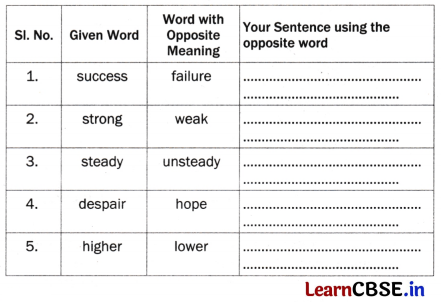
Answer:
1. The team worked hard but faced failure in their first match.
2. After climbing for hours, he felt too weak to continue.
3. The ladder was unsteady, so he stepped down carefully.
4. Even in difficult times, she held on to hope.
5. The kite flew lower when the wind stopped blowing.
D. Imagine you are King Bruce of Scotland. After watching the spider succeed, you feel hopeful again. Write a letter to your friend sharing what you saw and how it inspired you to be determined despite challenges.
Answer:
Castle of Scotland
18th April, 20XX
Dear Friend,
I hope this letter finds you in good health and spirits. Today, I experienced something truly unexpected, yet deeply inspiring. I was feeling defeated and disheartened, as all my efforts to help my people had failed time and again. I was on the verge of giving up.
Just then, my eyes fell upon a small spider attempting to climb up to its web on the ceiling. It struggled, slipping and falling, not once but nine times! Yet, despite each failure, it persisted. On its tenth attempt, with unwavering determination, the spider finally reached its web.
Watching this tiny creature fight against adversity made me realise something profound, that success comes to those who refuse to surrender. If something as small as a spider can display such resilience, then surely, we too must find the strength to keep trying and stay determined to achieve our goals.
I wanted to share this moment with you as a reminder that persistence leads to victory. Let’s both remember that no matter how many times we fall, we must rise again!
Your friend,
Bruce
Try Again Extra Questions for Practice
Multiple Choice Questions
1. What lesson did King Bruce learn from the spider?
(a) Patience is key
(b) Never give up
(c) Hard work pays off
(d) All of the above
2. What did King Bruce do after being inspired by the spider?
(a) He gave up completely
(b) He tried again and succeeded
(c) He punished his enemies
(d) He left Scotland
3. How did King Bruce feel after watching the spider?
(a) More discouraged
(b) Motivated
(c) Angry
(d) Indifferent
4. What does the phrase “defied despair” mean in the poem?
(a) Ignored sadness
(b) Overcame hopelessness
(c) Fought bravely
(d) Accepted failure
5. What is the central theme of the poem?
(a) Revenge leads to success
(b) Perseverance leads to victory
(c) Luck is more important than effort
(d) Kings should never give up
6. What was King Bruce’s initial reaction after watching the spider fail repeatedly?
(a) He admired its persistence
(b) He believed it would give up
(c) He laughed at its attempts
(d) He ignored it completely
7. What did King Bruce do after witnessing the spider succeed?
(a) He decided to abandon his goal
(b) He strengthened his resolve and tried again
(c) He caught the spider
(d) He wrote a poem about the spider
8. What does the phrase ‘steadily, steadily, inch by inch’ convey in the poem?
(a) Fear and uncertainty
(b) Continuous effort and patience
(c) A sudden burst of strength
(d) Confidence and arrogance
9. Why does King Bruce praise the spider at the end of the poem?
(a) Because the spider proved to be stronger than him
(b) Because the spider showed wisdom in building its web
(c) Because the spider symbolised resilience
(d) Because the spider helped him win a battle
10. What is the primary theme of the poem?
(a) Accepting defeat
(b) Learning from nature
(c) The importance of giving up after failure
(d) The idea that success comes easily
Fill in the Blanks
1. King Bruce was the monarch of ……………..
2. The spider fell down …………….. times before succeeding.
3. King Bruce wore a …………….. but his heart was beginning to sink.
4. The spider made a bold little …………….. at the very last moment to reach its web.
5. The poem teaches us the importance of ………. and ………. in overcoming challenges.
6. King Bruce regained his ………. after observing the spider’s success.
7. The thread the spider hung from was extremely ………. .
8. The poem is based on the real-life struggles of King ………. .
9. At the end of the poem, King Bruce tries again and does not ………. .
State Whether True or False
1. The spider reached its cobweb home in one smooth attempt. ……………. .
2. King Bruce compared his struggles to the spider’s efforts. ……………..
3. The spider’s thread was thick and strong, making it easy to climb. ……………. .
4. The spider gave up after falling a few times. ……………. .
5. King Bruce was inspired by how the spider kept trying despite falling.
6. The poem shows that the spider succeeded on the tenth attempt.
7. The King mocked the spider for continuing to try.
8. The spider’s success motivated the King to make one final attempt.
9. The poem ends with the King failing once again.
Assertion and Reason Question
1. Assertion (A): King Bruce was inspired by the spider’s perseverance.
Reason (R): Watching the spider struggle and succeed made him realise the importance of trying again.
Codes:
(a) Both (A) and (R) are true, and (R) is the correct explanation of (A).
(b) Both (A) and (R) are true, but (R) is not the correct explanation of (A).
(c) (A) is true, but ( R ) is false.
(d) (A) is false, but (R) is true.
Extract Based Questions
1. “Again it fell and swung below, But again it quickly mounted; Till up and down, now fast, now slow, Nine brave attempts were counted.”
1. What does this stanza show about the spider’s determination?
2. State whether the following sentence is True or False. The spider succeeded on the fifth attempt.
3. What does the word ‘mounted’ mean here?
4. Choose the correct option.
The poet praises the spider for
(a) being lucky
(b) never giving up
(c) being clever
(d) finding another spider
2. “And Bruce of Scotland braced his mind, And gossips tell the tale, That he tried once more as he tried before, And that time did not fail.”
1. What lesson did King Bruce learn from the spider?
2. State whether the following sentence is True or False. The King succeeded because he gave up at the right time.
3. What does the phrase ‘braced his mind’ mean?
4. Choose the correct option.
What does the phrase ‘gossips tell the tale’ suggest?
(a) The story is a rumour
(b) The story was made up by the King
(c) The story was passed down over time
(d) The King wrote the poem
Very Short Answer Type Questions
1. What creature inspired King Bruce?
2. Who was feeling sad despite being a king?
3. How many times did the spider fall before succeeding?
4. What did King Bruce initially decide before seeing the spider?
5. How did King Bruce react when the spider finally succeeded?
6. What does the spider symbolise in the poem?
7. Whac happened when the splater foll fowor than berove?
8. Why did King Bruce assume the spider would give up?
9. What was the outcome for King Bruce after watching the spider?
Short Answer Type Questions
1. Why was King Bruce of Scotland in despair despite being a monarch?
2. Describe the efforts of the spider in the poem.
3. Why did King Bruce initially decide to give up, and what changed his mind?
4. What is the moral lesson conveyed through this poem?
5. How is King Bruce’s behaviour similar to that of the spider?
6. Why does the King initially pity the spider?
7. What literary device is used in “Steadily, steadily, inch by inch”?
8. Why is King Bruce’s transformation crucial in the poem?
9. How does this poem relate to real-life situations?
Long Answer Type Questions
1. What did King Bruce decide after watching the spider?
2. How many times did the spider fail before it succeeded? What does this show us?
3. What was King Bruce trying to do for his people? Why couldn’t he do it?
4. How does the poet’s description of the setting contribute to the effectiveness of the poem?
5. What is the moral of the poem?
6. How does the poet use contrast to highlight perseverance?
7. Why does King Bruce relate to the spider’s journey?
Competency-Based Question
1. The spider failed multiple times but still kept trying. Why do you think failure is important in the learning process?