These Class 7 Poorvi Worksheet and Class 7 English Chapter 2 Try Again Worksheet with Answers Pdf are perfect for home study.
Class 7 English Chapter 2 Try Again Worksheet with Answers
Class 7 English Try Again Worksheet
Class 7 English Chapter 2 Worksheet – Class 7 Try Again Worksheet
Multiple Choice Questions
Question 1.
What does the poem suggest about King Bruce’s feelings despite wearing
(a) He was joyful
(b) He was proud
(c) He felt hopeless
(d) He was excited
Answer:
(c) He felt hopeless
Question 2.
What did King Bruce aim to do for his people?
(a) Build a castle
(b) Fight a war
(c) Achieve something noble
(d) Hide from enemies
Answer:
(c) Achieve something noble
Question 3.
What unusual sight made the King pause his thoughts?
(a) A falling leaf
(b) A spider climbing
(c) A bird soaring
(d) A soldier calling
Answer:
(b) A spider climbing
Question 4.
Why did the King call the spider foolish?
(a) It was slow
(b) It fell too many times
(c) It made noise
(d) It scared him
Answer:
(b) It fell too many times

Question 5.
Where was the king when he observed the spider?
(a) In a battlefield
(b) In a cave
(c) Inside his palace
(d) On a mountain
Answer:
(b) In a cave
State True or False
(i) King Bruce was in a cheerful mood when the poem began.
Answer:
False
(ii) The spider made no attempts to climb again after it fell.
Answer:
False
(iii) King Bruce was inspired by the spider’s determination.
Answer:
True
(iv) The thread used by the spider was strong and thick.
Answer:
False
(v) The spider failed more than once before succeeding.
Answer:
True
(vi) The King gave up and left after seeing the spider fail.
Answer:
False
(vii) The poem encourages us to keep trying like the spider.
Answer:
True
Answer the following Questions
(i) Why did King Bruce feel like giving up?
Answer:
King Bruce felt like giving up because he felt discouraged and hopeless after failing repeatedly to achieve something great for his people.
(ii) What lesson did the King learn from the spider?
Answer:
King Bruce learned from the spider that one should not give up, even after failing multiple times. Success requires persistence.
(iii) How does the spider’s journey teach about determination?
Answer:
The spider’s journey teaches determination by showing how it keeps trying to reach its web, even after failing many times. It never gives up and finally succeeds.
(iv) What motivates the readers of the poem?
Answer:
The poem is motivating because it shows that even small creatures like a spider can succeed through persistence. It inspires readers to keep trying and not give up, just like King Bruce.
(v) Describe the change in King Bruce’s attitude from the beginning to the end.
Answer:
At the beginning, King Bruce feels hopeless and wants to give up. By the end, inspired by the spider’s persistence, he regains courage and decides to try again with determination.
Extract Based Questions
I. “Up, up it ran, not a second to stay,
To utter the least complaint;
Till it fell still lower, and there it lay,
A little dizzy and faint.”
(i) What is the meaning of the word ‘faint’ as used in the extract?
(a) Loud
(b) Weak or tired
(c) Bright
(d) Confused
Answer:
(b) Weak or tired
(ii) Use the word ‘utter’ in your own sentence.
Answer:
She didn’t utter a single word during the entire class.
(iii) The spider did not stop to complain because it was _________.
Answer:
determined to reach its web despite falling.
(iv) What does the line “not a second to stay, to utter the least complaint” tell us about the spider’s character?
Answer:
It shows that the spider was determined, focused and did not waste time complaining or giving up despite difficulties.
(v) What can be inferred about the spider from this extract?
(a) It was scared to try again.
(b) It was lazy and resting,
(c) It kept trying without giving up.
(d) It ran away from danger
Answer:
(c) It kept trying without giving up.
II. “The harder the battle you’re trying to win,
The more is the honor and glory within.
So stick to your goal though it seems too far,
You’ll reach it for sure, if you try again hard.”
(i) Who is the speaker in this extract, and what is the speaker doing?
Answer:
The speaker is the poet, and she is motivating the readers to stay determined and not give up.
(ii) What suggestion does the speaker give to the reader?
Answer:
The speaker advises the reader to stay focused on their goal and keep trying, even if it feels difficult.
(iii) What does the phrase ‘stick to your goal’ suggest in this context?
(a) Change your aim
(b) Ask others for help
(c) Stay committed and keep working towards it
(d) Take a break
Answer:
(c) Stay committed and keep working towards it
(iv) Which emotion is the speaker trying to inspire through these lines?
Answer:
The speaker is trying to inspire hope, courage and determination.
(v) What lesson can be learned from the speaker’s advice in this extract?
(a) Winning is only for the strong
(b) Difficult journeys are not worth it
(c) Success comes from effort and persistence
(d) It’s better to avoid challenges
Answer:
(c) Success comes from effort and persistence
Working with Language!
Match the following phrases in column A with their literal meanings in column B.
| Column A | Column B |
| (i) The spider kept trying | (a) he learned to persevere |
| (ii) King Bruce watched silently | (b) the thread broke again and again |
| (iii) The spider finally succeeded | (c) the King was filled with hope |
| (iv) The King had lost many battles | (d) he had taken shelter in a cave |
| (v) King Bruce saw the spider | (e) it reached the ceiling |
Answer:
| Column A | Column B |
| (i) The spider kept trying | (b) the thread broke again and again |
| (ii) King Bruce watched silently | (c) the King was filled with hope |
| (iii) The spider finally succeeded | (e) it reached the ceiling |
| (iv) The King had lost many battles | (d) he had taken shelter in a cave |
| (v) King Bruce saw the spider | (a) he learned to persevere |
Use the words given in the box correctly to complete the paragraph.
| Crown, Thread, Fail, Web, Great, Scotland, Despair, Spider, Nine, Bravo |
King Bruce of (i) _________ was feeling sad and sat down in deep (ii) _________, Though he wore a (iii) _________, his heart was heavy because he had failed to do a (iv) _________ deed for his people. As he sat thinking, a (v) _________ dropped down by its filmy thread. The spider tried to climb up the (vi) _________, but it slipped and fell again and again. Despite falling (vii) _________ times, it kept trying without giving up. Finally, the spider reached its (viii) _________ at the top. Watching this, the King felt inspired and shouted, “(ix) _________, bravo!” He gathered courage and decided to try once more-and this time, he did not (x) _________,
Answer:
(i) Scotland
(ii) despair
(iii) crown
(iv) great
(v) spider
(vi) thread
(vii) nine
(viii) web
(ix) bravo
(x) fail
Arrange the following statements in the correct sequence according to the poem ‘King Bruce and the Spider’.
(i) The spider climbed again with steady head and strong endeavour. _________
(ii) The King of Scotland sat in despair after repeated failures. _________
(iii) The King saw a spider drop down by a silken thread. _________
(iv) The spider failed nine times but never gave up. _________
(v) It finally reached its web after a bold little run. _________
(vi) King Bruce was deeply inspired by the spider’s efforts. _________
(vii) He exclaimed, “Bravo, bravo!” admiring the tiny creature’s spirit _________
(viii) He decided to try again and finally succeeded. _________
Answer:
(ii) → (iii) → (iv) → (v) → (vi) → (vii) → (viii)
Let us Learn!
Read each sentence and identify whether it contains a Simile or a Metaphor.
(i) The spider’s thread was as thin as a hair _________
(ii) King Bruce’s heart was a heavy stone _________
(iii) She moved like a graceful dancer _________
(iv) The classroom was a zoo during recess _________
(v) He was as brave as a lion in the face of danger _________
(vi) Her smile was sunshine on a rainy day _________
(vii) The baby cried like a siren _________
(viii) His mind was a battlefield of thoughts _________
(ix) The cloud floated like a feather in the sky _________
(x) The stars were diamonds scattered across the sky _________
Answer:
(i) Simile
(ii) Metaphor
(iii) Simile
(iv) Metaphor
(v) Simile
(vi) Metaphor
(vii) Simile
(viii) Metaphor
(ix) Simile
(x) Metaphor
Convert the Metaphors into Similes.
(i) Her voice was music to his ears
_____________________________________
Answer:
Her voice was like music to his ears.
(ii) The classroom was a battlefield during the debate
_____________________________________
Answer:
The classroom was like a battlefield during the debate.
(iii) He is a rock in times of trouble
_____________________________________
Answer:
He is like a rock in times of trouble.
(iv) Time is a thief
_____________________________________
Answer:
Time is like a thief that steals moments.
(v) Her eyes were shining stars
_____________________________________
Answer:
Her eyes were like shining stars.
Convert the Similes into Metaphors,
(i) She was as graceful as a swan
_____________________________________
Answer:
She was a graceful swan.
(ii) He fought like a lion in the battle
_____________________________________
Answer:
He was a lion in the battle.
(iii) The baby was sleeping as soundly as a log
_____________________________________
Answer:
The baby was a sleeping log.
(iv) His mind is like a maze
_____________________________________
Answer:
His mind is a maze.
(v) The wind howled like a wolf
_____________________________________
Answer:
The wind was a howling wolf.
Write the opposites of the following words taken from the poem.
(i) Weak _________
(ii) Lose _________
(iii) Despair _________
(iv) Lazy _________
(v) Coward _________
(vi) Give up _________
(vii) Tired _________
Answer:
(i) Strong
(ii) Win
(iii) Hope
(iv) Hardworking / Industrious
(v) Brave / Courageous
(vi) Persevere / Keep going / Continue
(vii) Energetic / Fresh / Rested
Let us Write!
Have you ever faced a situation where you failed at something but didn’t give up? Describe it in a paragraph and how you felt after succeeding.
Narrate a real or imaginary incident when you failed at something but succeeded later because you tried again, inspired by the poem.
_____________________________________
_____________________________________
_____________________________________
_____________________________________
Let us Explore!
Explore the importance of small acts and their big impact.
How did something as small as a spider change a King’s decision? Can small actions lead to big changes in real life?
_____________________________________
_____________________________________
_____________________________________
_____________________________________
Try Again Class 7 Worksheet
Let us do these activities before we read
I. Who inspires you to do your best?
Write the names of 3 people who you admire in your life. How do they help you in your life? One of them could be your teacher.
- My teacher who encourages learning.
______________________________________ - A family member who supports personal growth.
______________________________________ - A friend who motivates during tough times.
______________________________________ - A public figure who demonstrates perseverance, like King Bruce.
______________________________________
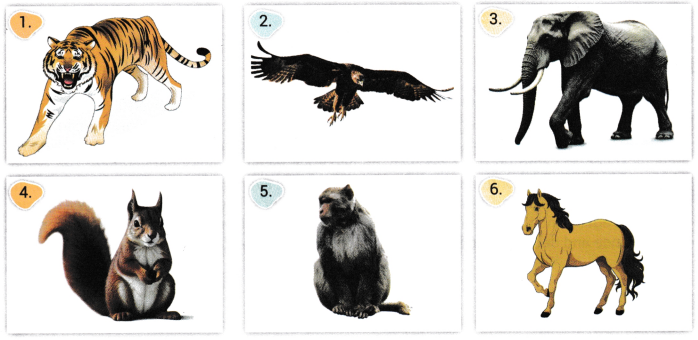
II. Work in pairs. Identify the animals you see in the pictures given below. You see the picture of a tiger, an elephant, a monkey, an eagle, a horse and a squirrel. What are these animals well- known for? What lessons can we learn from their behaviour? Share your answers.
1. __________________
2. __________________
3. __________________
4. __________________
5. __________________
6. __________________
Let us discuss
I. Complete the summary of the poem by filling in the blanks with suitable words from the text, given in the box below. One has been filled for you.
| failure, courage, lessons, observe, attempts, success, inspire, example |
This poem tells the story of a Scottish king who was feeling defeated after repeated
(i) failure He sat alone in despair, wondering whether to give up. Just then, he saw a spider and began to (ii) __________________ it closely. The spider made several (iii) __________________ to reach its web but kept falling. However, it did not give up and finally achieved (iv) __________________ This simple (v) __________________ taught the king an important life (vi) __________________ to never stop trying. The spider’s bravery and determination helped (vii) __________________ the king to gather (viii) __________________ and try again.
Complete the following sentences suitably.
1. The story of the spider teaches us that we can achieve success if __________________
2. The poem shows that even small creatures can teach us big lessons through their __________________
III. Give two examples for each of the following.
1. Lines that reflect King Bruce’s sadness:
“But his heart was beginning to sink.”
______________________________________
2. Lines showing action or movement:
“Up, up it ran, not a second to stay”
______________________________________
IV. In the following instances given below the poet puts emphasis to what he is saying, by repeating certain words or phrases. Why?
“Bravo, bravo!” and Steadily, steadily
______________________________________
V. Fill in the blanks by choosing the correct answer from within the brackets.
1. The mood of the king at the beginning of the poem is __________________ (joyful/hopeless/excited)
2. The spider’s repeated effort symbolizes __________________ (anger/laziness/perseverance)
3. The poem ends on a note of __________________ (defeat/victory/confusion)
VI. Identify Metaphors and Similes
A metaphor is a figure of speech that involves an implied comparison between two unlike things without using ‘like’, ‘as’, or ‘as…as’. It suggests that one thing is another, highlighting similarities between them to add deeper meaning or understanding. A simile is a figure of speech that compares two unlike things using the words ’like’ or as.
1. Read the following sentences and identify Metaphors and Similes. Write M for Metaphor and S for Simile in the box.
(i) His eyes were as sharp as an eagle’s.
(ii) Time is a thief that steals our moments.
(iii) She danced like the leaves in the wind.
(iv) The moon was a silver coin in the sky.
(v) He was as brave as a lion.
(vi) Her mind is a maze of thoughts.
(vii) The rain fell like needles on the rooftop.
(viii) Life is a rollercoaster of emotions.
(ix) The wind whispered like a secret in the night.
(x) His temper was a volcano waiting to erupt.
2. Read the following sentences and transform similes into metaphors and metaphors into similes. Two examples have been done for you.
Examples:
a. Simile: She was as gentle as a dove.
Metaphor She was a gentle dove.
b. Metaphor His heart was a locked door.
Simile: His heart was like a locked door.
(i) The fog was a ghost creeping through the streets.
Simile: ______________________________________
(ii) He was as stubborn as a mule.
Metaphor: ______________________________________
(iii) Her words were daggers that pierced deeply.
Simile: ______________________________________
(iv) The stars sparkled like diamonds in the sky.
Metaphor: ______________________________________
(v) The city was a jungle of confusion and noise.
Simile: ______________________________________
(vi) He smiled like the sun after a storm.
Metaphor: ______________________________________
(vii) Her eyes were pools of mystery.
Simile: ______________________________________
(viii) The baby’s cry was as loud as a siren.
Metaphor: ______________________________________
Think beyond
I. Read the extracts given below and answer the questions that follow.
1. He watched the ant with careful eyes,
That carried food through rain and sun,
It stumbled once but did not quit,
And soon, its task was done.
(i) Select the line which best shows determination.
______________________________________
(ii) What do the words “careful eyes” suggest about the observer’s mood?
______________________________________
(iii) Choose the correct option to complete the sentence: The ant’s action teaches the observer to
(a) rest after work
(b) never give up
(c) avoid hard tasks
(d) share food with others
(iv) The ant is carrying food “through rain and sun”. This imagery symbolizes:
(a) Change in weather
(b) A journey across nature
(c) Struggles and effort in all conditions
(d) Time passing in a day
2. Not once, not twice, but thrice he failed,
Yet stood again each time,
No crowd to cheer, no hand to help,
He climbed the hill to shine.
(i) Pick the metaphor used in the above stanza.
______________________________________
(ii) What emotion is reflected in the line: “No crowd to cheer, no hand to help”?
______________________________________
(iii) Choose the correct option to complete the sentence:
The repetition of “not once, not twice …” is used to show:
(a) Drama
(b) Number game
(c) Emphasis on persistence
(d) Rhythm
(iv) The word “thrice” in the extract refers to:
(a) Three different people
(b) Three successful tries
(c) Three times he failed
(d) Three steps up the hill
II. Answer the following questions.
1. What is the appreciable quality in the spider?
______________________________________
2. Why is help or cheering not important for the spider?
______________________________________
3. What does the poet want us to learn from nature in his poem?
______________________________________
4. How does the use of repetition enhance the poem’s theme?
______________________________________
5. How many attempts did the spider make to reach its cobweb?
______________________________________
6. Did King Bruce learn a lesson from the spider?
______________________________________
Let us learn
I. Write the opposites of the following words (from the poem):
| Word | Opposite |
| 1. rise × | |
| 2. strong × | |
| 3. brave × | |
| 4. hope × | |
| 5. effort × |
II. Choose the correct meaning of the underlined words from the box and frame your own sentences:
Meanings to choose from:
- to continue firmly despite difficulty
- a sudden idea or impulse
- to prepare for impact or change
- a thoughtful or careful consideration
(i) He persevered even after failing seven times.
Meaning: __________________
Sentence: __________________
(ii) A notion struck him as he watched the falling leaf.
Meaning: __________________
Sentence: __________________
(iii) The crew braced for the storm ahead.
Meaning: __________________
Sentence: __________________
(iv) He paused for a moment of reflection.
Meaning: __________________
Sentence: __________________
III. Classify the following words based on whether they refer to Far or Near. (Use a dictionary or context clues if needed)
Words/Phrases:
miles away, nearby, remote, adjoining, at arm’s length, distant, just here, across the valley, close by, beyond the hills
Far
__________________
__________________
__________________
__________________
Near
__________________
__________________
__________________
__________________
IV. Read the following tongue-twisting line:
“Peter proudly painted pretty pebbles purple.”
Now say it five times quickly. Were you able to say it clearly?
Now create your own tongue twisters!
Here are a few fun examples to get you started:
1. Silly snails slide slowly southward.
2. Brave birds boldly bounce between branches.
3. Flickering flames flash fiercely in forests.
4; Greedy goats gobbled green grapes gladly.
5. Ten tiny tigers tiptoed through the tulips.
Let us listen
I. Read out the transcript of the story given at the end of the workbook. As you listen choose the correct option. (Transcript Page 120)
Question 1.
What was the squirrel known for?
(a) laziness
(b) courage
(c) curiosity
Question 2.
What made the squirrel stop on the branch?
(a) a loud noise
(b) a shiny object
(c) the chirping of birds
Question 3.
What was the owl doing?
(a) flying over the trees
(b) reading a book
(c) watching the squirrel carefully
Question 4.
What did the squirrel learn from the owl?
(a) to fly
(b) to think before acting
(c) to store food
Question 5.
How did the other squirrels help?
(a) by laughing at the squirrel
(b) by warning her
(c) by building a safe path
Let us Speak
I. Narrate a personal experience about a time when you were motivated by someone or something to carry on and never give up. Your perseverance helped you.
Use the following sentence prompts as a guide for your narration. Use as per your topic.
1. Introduction
- When I was in Grade 3, my father faced a serious __________________
- I was not sure whether he would be able to __________________
2. What was the challenge?
- The challenge that my father faced was __________________
- The whole family was suffering because of __________________
3. I was very dejected
- Initially, the whole of my family was __________________
- We were never sure how my father __________________
4. Who helped us out?
- My teacher came into the picture. He asked what problem my __________________
- My teacher came to my house and __________________
5. Efforts to solve my father’s problem
On the advice of my teacher, my father __________________
6. Problem gets solved
With the help of my teacher’s advice __________________
7. Reflection
- This experience taught me __________________
- It is very true that perseverance __________________
- I will always remember this __________________
Let us Write
King Bruce was inspired by the spider that kept on trying till it was successful.
Think of a time when you felt disappointed or faced a failure, but you did not give up. Reflect on what you did to come out of that situation.
Now, write a letter to your friend or cousin telling them about this incident. Encourage them to stay motivated when facing a tough time.
Use transition words like:
“First…
“Then …”
“Later… ”
“After that…”
“In the end …”
You may begin this way:
H. No. 25, Green Avenue
Karnal
14 April 20XX
Dear Aditya,
Thank you for your message. I was really happy to read it. You asked how I deal with tough times, so let me share one such experience with you
________________________________________________________
________________________________________________________
________________________________________________________
________________________________________________________
Yours affectionately
(Your Name)
Let us explore
I. Nature & Culture Project Activity Task:
Collect folk songs, proverbs, or sayings from your region/language that reflect people’s relationship with trees, rivers, seasons, animals, or farming. Work in pairs or groups. Translate or explain their meaning and share their messages in class.
SAMPLE RESPONSE
FolkSong
(Water, 0 water, what is your colour? You become like whatever you mix with.) Message: This folk song shows how water adapts to everything, teaching us flexibility and simplicity in life.
II. Observation of animals around you (Science Integration)
In our day-to-day life, we come across a variety of animals.
For example, we come across rats, mouses, ants, lizards, dogs, cats, cows etc. Observe them closely and see what behaviour they show. Note at least 5 differences between them. You can also make a chart or sketch. Ask your Science teacher to explain your observations.
Sample Observation Table:
| Feature | Dog | Cat |
III. “Spider Web of Goals” Activity
1. ACTIVITY TITLE: Weave Your Web of Goals
MATERIALS NEEDED:
- Cardboard or paper plate
- Yarn, thread or old wool
- Marker pens
STEPS:
1. Cut out the center of a paper plate to make a ring.
2. Wrap the yarn around it, criss-crossing like a web.
3. Write one personal goal on each “web line” using sticky notes or small cards (e.g., “Read daily,” “Be kind,” “Don’t give up”).
DECORATION SUGGESTION:
Add words like patience, effort, never give up, brave, on the outer ring.
LEARNING OUTCOME:
This helps students visualize their dreams and how they are connected, just like threads of a spider’s web.