Students can find accurate Class 8 English Extra Questions and Class 8 English Chapter 8 The Magic Brush of Dreams Extra Questions and Answers for better understanding.
The Magic Brush of Dreams Extra Question Answer Class 8 English Chapter 8
The Magic Brush of Dreams Short Questions and Answers
Question 1.
Who gives the magic brush to Gopi and what does he instruct her?
Answer:
A mysterious man gives the magic brush to Gopi. He tells her to keep it a secret. He warns her not to use it for the wealthy but only for the poor. This shows that the brush is meant to help those in need. His instruction forms the moral foundation of the story.
Question 2.
What does Gopi do instead of collecting food?
Answer:
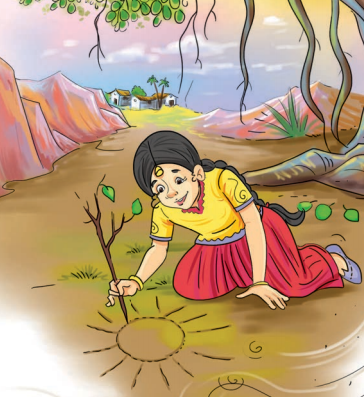
Instead of collecting food, Gopi sits under a banyan tree. She uses a twig to draw pictures in the sand. She lets her imagination flow rather than focusing on her chores. Though the wind blows her drawings away, it shows her creative nature. Her dream-like act soon becomes reality with the magic brush.
Question 3.
How does Gopi use the brush to help the villagers?
Answer:
Gopi uses the brush to paint useful items. She paints a bowl of khichdi that becomes real. She also paints a muffler, a shawl, a fan, and even a plough for the villagers. Her kindness makes life better for the poor. The villagers admire her generosity.
Question 4.
How does the village react to Gopi’s magic?
Answer:
The villagers are amazed and overjoyed. They gather around her house to see the magic brush. Young and old people come to see the wonders she creates. Her fame spreads quickly. They are grateful for her kind use of the magic brush.

Question 5.
Why does the Zamindar become interested in Gopi’s brush?
Answer:
The Zamindar hears of the magic brush from others. He sees it as a way to gain more wealth. His desire for power and riches drives him to act selfishly. He demands Gopi to paint treasures for him. His greed contrasts with Gopi’s kindness.
Question 6.
What does the Zamindar ask Gopi to paint for him?
Answer:
He commands her to paint a grand fortress. He also wants treasures, jewels, and rare riches. His wishes are centered around wealth and ruling the land. He thinks the brush will fulfill his greedy dreams. Gopi refuses to obey him.
Question 7.
Why does Gopi refuse the Zamindar’s order?
Answer:
Gopi had promised to help only the poor. She stays true to her values. She refuses to serve the greedy Zamindar. Her decision shows bravery and integrity. She values kindness over fear.
Question 8.
What does the Zamindar do when Gopi disobeys him?
Answer:
The Zamindar becomes angry and shouts. He orders his men to seize both Gopi and the brush. He throws Gopi into a prison cell. He tries to force her to paint for him. His actions show his cruel and selfish nature.
Question 9.
How does Gopi escape from prison?
Answer:
Gopi paints a winding road and a strong horse. The road leads out of the prison gates. She jumps onto the horse and escapes. She gallops through fields and villages. Her cleverness and courage help her break free.
Question 10.
How do the villagers respond to Gopi’s return?
Answer:
They are delighted and joyful. They shout, “It’s Gopi! She’s back again!” They celebrate her bravery. Gopi continues to help them. The villagers clearly love and support her.
Question 11.
What does Gopi paint to stop the Zamindar and his men from chasing her?
Answer:
She paints a wide, mighty river. The river flows fast and deep. The Zamindar and his men cannot cross it. This halts their chase. It protects Gopi from further harm.
Question 12.
What threat does Gopi give to the Zamindar?
Answer:
She says she will paint a beast to chase them. The beast will feast on all of them. This frightens the Zamindar. He begs her to stop and runs away. Her threat works without actual violence.
The Magic Brush of Dreams Long Questions and Answers
Question 1.
Describe the journey of Gopi from a simple girl to a village hero.
Answer:
Gopi begins as a simple village girl who enjoys drawing pictures in the sand. When a mysterious man gives her a magic brush that brings her paintings to life, she starts using it to help the poor villagers by painting food, clothes, and tools for them. When the greedy Zamindar demands that she paint for him to increase his wealth, she refuses, standing up for her values. Despite being imprisoned by the Zamindar, Gopi uses her magic brush cleverly to escape and protect her village, ultimately becoming a hero who defends justice and helps her community.
Question 2.
Compare and contrast Gopi and the Zamindar. What values do they represent?
Answer:
Gopi represents kindness, generosity, creativity, and justice. She uses her magic brush to support the needy and bring happiness to her community. The Zamindar symbolizes greed, selfishness, and misuse of power. He wants to use Gopi’s magic for his own wealth and domination. While Gopi cares for the people, the Zamindar cares only about himself.
Question 3.
What lesson can we learn from Gopi’s refusal to paint for the Zamindar?
Answer:
Gopi’s refusal teaches the importance of standing firm for one’s principles and using gifts or power to help others rather than to serve selfish interests. It also shows courage in opposing injustice and greed.
Question 4.
How does the poem reflect the theme of using power responsibly?
Answer:
The poem contrasts Gopi’s responsible use of the magic brush to help the poor with the Zamindar’s desire to exploit it for personal gain. Gopi’s choice to paint only for those in need highlights that power should be used ethically and for the greater good.
Question 5.
Explain how the poet builds suspense and excitement throughout the poem.
Answer:
The poet builds suspense by showing the growing tension between Gopi and the Zamindar—her refusal, imprisonment, escape, and chase. Vivid imagery of magical paintings coming to life and the villagers’ anticipation adds excitement. The climax with the river and beast stopping the Zamindar’s men heightens the thrill.
Question 6.
What role does nature play in Gopi’s escape from prison? Describe it in detail.
Answer:
Nature, summoned by Gopi’s magic brush, helps her escape through the painting of a winding road and a strong horse that carries her swiftly away. Later, a mighty river with fast currents blocks the Zamindar and his men. Nature acts as an ally, symbolizing support for justice and freedom.
Question 7.
Do you think the magic brush could have been dangerous? Justify your answer.
Answer:
Yes, the magic brush could be dangerous if misused. Since it brings paintings to life, it holds great power that could cause harm or chaos if wielded by someone greedy or cruel, like the Zamindar. However, in Gopi’s hands, it is a force for good.
Question 8.
Explain how art and imagination are powerful tools, using examples from the poem.
Answer:
In the poem, Gopi’s paintings literally come to life, showing how creativity can change reality. She imagines food, clothes, tools, and escape routes that help her village and herself. This demonstrates that imagination and art can solve problems, inspire, and bring about positive change.
The Magic Brush of Dreams Extract Based Questions and Answers
1. “Go and gather wild beans, Gopi,
Go and fetch some rice.
Go and pluck the mangoes
And bring home something nice. ”
Gopi sits beneath the banyan,
A twig is in her hand.
She sits there drawing pictures,
Pictures in the sand.
The winds blow by and sweeps away
The pictures in the sand.
Question 1.
Fill in the blank by selecting the correct option from those given in the brackets. The pictures that Gopi draws in the sand are _________________(long-lasting / temporary).
Answer:
temporary
Question 2.
What does Gopi use to draw the pictures, and why is this significant?
Answer:
Gopi uses a twig to draw pictures in the sand. This shows her creativity and love for drawing even with simple, natural tools.
Question 3.
Complete the sentence with a suitable reason.
The winds sweep away the pictures in the sand because _________________
Answer:
the pictures are made on the loose sand which cannot hold the drawing for long.
Question 4.
Select the most appropriate title for the extract from the options below:
A. Gopi’s Magical Brush
B. Gopi’s Drawing in the Sand
Answer:
B. Gopi’s Drawing in the Sand
2. “Did you gather wild beans, Gopi?
Did you fetch some rice?
Did you pluck the mangoes And bring home something nice?”
“No beans, no rice, no mangoes!”
Gopi grins and runs inside.
She paints a bowl of khichdi and waits,
Until the paint has dried.
Question 1.
Fill in the blank by selecting the correct option from those given in the brackets.
Gopi paints a bowl of _________________ (rice / khichdi) instead of gathering food.
Answer:
khichdi
Question 2.
What does Gopi’s grin and running inside suggest about her?
Answer:
It suggests that Gopi is playful and clever; she has something special planned instead of collecting food.
Question 3.
Complete the sentence with a suitable reason.
Gopi paints the bowl of khichdi because _________________
Answer:
she has a magic brush that can bring her paintings to life, so she doesn’t need to gather real food.
Question 4.
Select the most appropriate title for this extract from the options below:
A. Gopi’s Magical Painting
B. Gopi Gathers Food
Answer:
A. Gopi’s Magical Painting
3. The road leads out of prison gates.
The horse, she swiftly urges
Gopi leaps on and gallops fast,
Through fields and many villages.
“It’s Gopi! It’s Gopi! She’s back again!”
Say the villagers, merry and kind.
But Gopi keeps on painting still,
With the Zamindar’s men following behind.
Question 1.
Fill in the blank by selecting the correct option from those given in the brackets. Gopi escapes from prison riding a _________________ (horse/car).
Answer:
horse
Question 2.
What does the villagers’ reaction tell us about Gopi’s relationship with them?
Answer:
The villagers are happy and welcoming, showing that they trust and support Gopi.
Question 3.
Complete the sentence with a suitable reason.
Gopi keeps painting while escaping because _________________
Answer:
she uses her magic brush to create obstacles to stop the Zamindar’s men from catching her.
Question 4.
Select the most appropriate title for this extract from the options below:
A. Gopi’s Great Escape
B. Gopi’s Capture
Answer:
A. Gopi’s Great Escape
4. She paints a mighty river wide,
Its currents fast and deep.
The Zamindar and all his men
Stop short and cannot leap.
“Now should I paint a beast
To leap and chase you through?
Stop this chase or it will feast
On you, and you and you!”
Question 1.
Fill in the blank by selecting the correct option from those given in the brackets.
Gopi paints a _________________ (river/forest) that stops the Zamindar and his men.
Answer:
river
Question 2.
What effect does the river have on the Zamindar and his men?
Answer:
The river stops them because its currents are too fast and deep to cross.
Question 3.
Complete the sentence with a suitable reason.
Gopi threatens to paint a beast because _________________
Answer:
she wants to scare the Zamindar and his men to stop chasing her.
Question 4.
Select the most appropriate title for this extract from the options below:
A. The Mighty River
B. The Beast’s Warning
Answer:
A. The Mighty River
The Magic Brush of Dreams Extra Questions for Practice
Passage For Comprehension
1. Read the given extract and answer the questions that follow.
The Zamindar cries, “No, no, no more!
I’ll leave, I’ll go away!”
He turns and flees; his men behind
Dare not choose to stay.
Now Gopi paints for the village folk,
A feast of sweets and tea.
A courtyard bright, a band to play,
And songs of victory.
Question 1.
Fill in the blank by selecting the correct option from those given in the brackets.
The Zamindar decides to (stay/ flee) after being scared by Gopi.
Question 2.
What does the Zamindar’s reaction tell us about his character?
Question 3.
Complete the sentence with a suitable reason.
Gopi paints a feast and celebrations for the village because ______
Question 4.
Select the most appropriate title for this extract from the options below:
A. Gopi’s Victory Celebration
B. The Zamindar’s Revenge
Short Answer Type Questions
Question 1.
Describe Gopi’s character using examples.
Question 2.
What is the tone of the poem in the beginning?
Question 3.
What is the central conflict in the poem?
Question 4.
How does the setting of the village influence the story?
Question 5.
What is the message of the poem?
Question 6.
How is suspense created in the poem?
Question 7.
What is the poet’s attitude towards Gopi?
Question 8.
How is imagery used in the poem?
Question 9.
What role does repetition play in the poem?
Question 10.
Why is Gopi celebrated at the end of the poem?
Long Answer Type Questions
Question 1.
Why do you think the poet chose a child like Gopi to carry the message of the poem?
Question 2.
How does the poem celebrate kindness, community, and justice?
Question 3.
Describe the climax of the poem and its significance to the story.
Question 4.
How is the poem a blend of fantasy and moral teaching? Give examples.
Question 5.
What qualities make Gopi a role model for children?
Question 6.
Do you think Gopi’s use of threat (the beast) was appropriate? Why or why not?
Question 7.
What makes “The Magic Brush of Dreams” a suitable poem for children?