These Class 7 Poorvi Worksheet and Class 7 English Chapter 6 Say the Right Thing Worksheet with Answers Pdf are perfect for home study.
Class 7 English Chapter 6 Say the Right Thing Worksheet with Answers
Class 7 English Say the Right Thing Worksheet
Class 7 English Chapter 6 Worksheet – Class 7 Say the Right Thing Worksheet
Multiple Choice Questions
Question 1.
Why did Mrs. Shaw hesitate to let Mary stay during the guests’ visit?
(a) Because Mary had homework to finish.
(b) Because Mrs. Shaw wanted Mary to learn from a distance.
(c) Because she feared Mary’s conversational style might ruin a potential friendship.
(d) Because Mrs. Shaw was planning a surprise that Mary shouldn’t witness.
Answer:
(c) Because she feared Mary’s conversational style might ruin a potential friendship.
Question 2.
How did Mary try to prove she was ready for adult conversations?
(a) She promised to remain silent throughout.
(b) She repeated polite phrases to show her preparedness.
(c) She wrote a script to follow while talking.
(d) She practiced her laughter in front of a mirror.
Answer:
(b) She repeated polite phrases to show her preparedness.
Question 3.
What is the irony in Mary’s statement, “Anyone can talk”?
(a) She herself chooses silence in social settings.
(b) She talks too much but says the wrong things.
(c) She meant to compliment her guests but ended up mocking them.
(d) Her words were rehearsed but her expressions betrayed discomfort.
Answer:
(b) She talks too much but says the wrong things.
Question 4.
What best defines Mary’s attitude toward social etiquette?
(a) She respects it deeply and follows every rule.
(b) She finds it unnecessary and prefers honesty.
(c) She tries to follow it but ends up offending unintentionally.
(d) She manipulates etiquette to impress others.
Answer:
(c) She tries to follow it but ends up offending unintentionally.
Question 5.
What did Mrs. Shaw mean when she said, “They don’t want to sit here and look at floor without speaking”?
(a) Guests enjoy observing interiors.
(b) Silence can become awkward in social meetings.
(c) People meditate together during visits.
(d) Guests may prefer peace and quiet.
Answer:
(b) Silence can become awkward in social meetings.
Question 6.
Why was the comment about Mr. Best’s reading habits inappropriate?
(a) Because he was actually an author.
(b) Because it sounded too formal for casual talk.
(c) Because it insulted Mrs. Lee’s brother indirectly.
(d) Because newspapers were banned in Lanfield.
Answer:
(c) Because it insulted Mrs. Lee’s brother indirectly.

Question 7.
What theme does Mary’s repetitive blunders reflect?
(a) The conflict between generations.
(b) The importance of self-confidence.
(c) The impact of poor preparation.
(d) The gap between knowing and doing.
Answer:
(d) The gap between knowing and doing.
Fill in the Blanks
Complete the sentence using words from the given box.
| sensitivity, harding, how are, kind, right, converse, inappropriate |
(i) Mary believed that being able to speak meant she could _______________ properly in social settings.
Answer:
converse
(ii) Mrs. Shaw’s main concern was that Mary might not say the _______________ thing.
Answer:
right
(iii) When people stop talking, Mrs. Shaw advised Mary to say something _______________.
Answer:
kind
(iv) Mary thought all she had to say was ‘Good afternoon’ and ‘ _______________ you?’
Answer:
How are
(v) The dog Mary insulted actually belonged to _______________.
Answer:
Mrs. Harding
(vi) Mary’s observation about Mrs. Cotter offended guests because it lacked _______________.
Answer:
sensitivity
(vii) The humour in the play arises from Mary’s well-meaning but _______________ remarks.
Answer:
inappropriate
State True or False
(i) Mrs. Shaw was confident that Mary would make the guests feel comfortable.
Answer:
False
(ii) Mary praised Mrs. Harding’s children, not knowing she had none.
Answer:
True
(iii) Mrs. Lee was impressed by Mary’s remark about bankers.
Answer:
False
(iv) Mary stayed silent when she saw the dog through the window.
Answer:
False
(v) The play shows that kindness alone can make conversations smooth.
Answer:
False
(vi) Mary felt proud after each blunder she made.
Answer:
False
(vii) Mrs. Shaw quickly tried to smooth over Mary’s awkward remarks.
Answer:
True
Answer the following Questions
(i) Why does Mrs. Shaw emphasises being kind when speaking to guests?
Answer:
Mrs. Shaw emphasises being kind when speaking to guests because she believes that you’ll always be right if you’re kind to people and it leaves a good impression on people.
(ii) How do Mary’s comments show a lack of social awareness?
Answer:
Mary’s comments show a lack of social awareness because she speaks without thinking how others might feel. She says things that are too honest or rude. She doesn’t mean to hurt anyone but she doesn’t realise that her words can make people uncomfortable or upset.
(iii) Why does Mary laugh at Mr. Best’s routine?
Answer:
Mary laughs at Mr. Best’s routine because she finds it silly that he travels to London every day and only reads newspapers. She thinks his life is boring and doesn’t understand why someone would live like that.
(iv) What role does silence play in the scenes with the guests?
Answer:
Silence in the scenes with the guests shows the awkwardness caused by Mary’s wrong or rude comments. Whenever she says something inappropriate,- the guests don’t know how to respond and the room becomes quiet.
(v) How does the play use humour to convey a social message?
Answer:
The play uses humour to show how important it is to speak politely and think before you talk. Mary’s funny mistakes make people laugh but they also teach a lesson about being careful with words. Through these silly moments, the play gives a message about good manners and social behaviour.
Extract Based Questions
I. “I can talk very well when I like. I’ll stay with you today and talk to them when they come.”
MARY: I know the right things to say: “Good afternoon”, “How are you?” and things like that. Let me stay today. I can do it very well. I’ll show you. Anyone can talk.
(i) What does this statement reveal about Mary’s confidence?
Answer:
This shows that Mary is very confident in her ability to talk but she does not fully understand what polite or appropriate conversation means. She believes talking is easy and doesn’t realise that choosing the right words at the right time is a skill.
(ii) Find a synonym for ‘talk very well’ from the extract.
Answer:
Speak confidently or converse clearly
(iii) Mary wanted to stay because she thought
Answer:
she could handle the conversation well and make a good impression on the guests.
(iv) What does this confidence lead to?
(a) Silent admiration
(b) Comic blunders
(c) Wise observations
(d) Thoughtful conversations
Answer:
(b) Comic blunders
II. MRS. LEE: Very nice. (She looks at Mary.)
MRS. SHAW: It was very good of you to come to see us. Please stay a little longer. MARY: (unable to say the right thing even now) Oh, must you stay? Can’t you go?
(i) Why is this statement ironic?
Answer:
This statement is ironic because Mary says the exact opposite of what she was told to say. Instead of asking the guests to stay longer politely, she ends up sounding like she wants them to leave, which creates an awkward and funny situation.
(ii) Pick the opposite of ‘stay’.
Answer:
Go
(iii) Mary meant to say ‘Must you go? Can’t you ?’
Answer:
stay
(iv) What does this statement show?
(a) Politeness
(b) Confusion
(c) Assertiveness
(d) Humour
Answer:
(b) Confusion
Working with Language!
Match the phrases in column A to their specifications in column B.
| Column A | Column B |
| (i) Mary mentions Mrs. Cotter stays in bed | (a) Unknowingly mocks Mrs. Harding |
| (ii) Insulting Mr. Best’s routine | (b) Opposite of polite behaviour |
| (hi) Commenting on Mrs. Best’s clothes | (c) Offends guests who do the same |
| (iv) Calls the dog dirty | (d) Shows lack of awareness |
| (v) Talks too much | (e) Insults the dog’s owner |
| (vi) Asks guests to go | (f) Offends Mrs. Lee’s brother |
Answer:
| Column A | Column B |
| (i) Mary mentions Mrs. Cotter stays in bed | (c) Offends guests who do the same |
| (ii) Insulting Mr. Best’s routine | (f) Offends Mrs. Lee’s brother |
| (hi) Commenting on Mrs. Best’s clothes | (a) Unknowingly mocks Mrs. Harding |
| (iv) Calls the dog dirty | (e) Insults the dog’s owner |
| (v) Talks too much | (d) Shows lack of awareness |
| (vi) Asks guests to go | (b) Opposite of polite behaviour |
Use the words given in the box correctly to complete the paragraph.
| uncomfortable, blunders, instructed, guests, clothes, unthinking, children, go, embarrassed, eager |
Mary was very (i) _______________ to join her mother when the (ii) _______________ arrived. Though she had been (iii) _______________ on what to say, she made several (iv) _______________. First, she assumed Mrs. Harding had (iv) _______________, then she insulted Mr. Best, calling bankers (vi) _______________. She even laughed at a woman’s (vii) _______________. Her final blunder came when she asked the guests to (viii) _______________. This left her mother feeling extremely (ix) _______________ and the guests guite (x) _______________.
Answer:
(i) eager
(ii) guests
(iii) instructed
(iv) blunders
(v) children
(vi) unthinking
(vii) clothes
(viii) go
(ix) embarrassed
(x) uncomfortable
The sentences below are jumbled. Rearrange them to form a meaningful paragraph about the events in the play ‘Say the Right Thing’.
(i) Mary confidently claimed she could speak well and wanted to stay and talk to the guests.
(ii) But instead of polite conversation, she made several inappropriate remarks.
(iii) This left her mother embarrassed and the guests quite uncomfortable.
(iv) Mrs. Shaw was worried because Mary often said the wrong thing at the wrong time.
(v) She ended up insulting a banker, a dog, and even made a guest feel unwelcome.
(vi) Still, Mary insisted on being part of the gathering despite the warnings.
Answer:
(iv) → (i) → (vi) → (ii) → (v) → (iii)
Let us Learn!
Match the words with the correct suffix and meaning in columns A, B and C.
| Column A | Column B (Suffix) | Column C (Meaning) |
| (i) music | (a) ian | A. full of hope |
| (ii) hope | (b) ful | B. person who plays music |
| (hi) act | (c) ion | C. state of being |
| (iv) happy | (d) ness | D. action or process |
Answer:
(i) music – (a) -ian – (B)
(ii) hope – (b) -ful – (A)
(iii) act – (c) -ion – (D)
(iv) happy – (d) -ness – (C)
Identify the suffix in each underlined word and mention the root word.
(i) She showed great kindness to everyone.
(ii) The driverless car amazed the children.
(iii) His achievement was celebrated by all.
(iv) The artist’s creativity impressed the judges.
(v) The magician gave a wonderful performance.
Answer:
(i) Kindness → Suffix: -ness Root Word: kind
(ii) Driverless → Suffix: -less Root Word: driver
(iii) Achievement → Suffix: -ment Root Word: achieve
(iv) Creativity → Suffix: -ity Root Word: creative
(v) Performance → Suffix: -ance Root Word: perform
Identify the kind of sentence. Write whether the sentence is Declarative, Interrogative, Exclamatory or Imperative and punctuate accordingly.
(i) Please pass me the dictionary
(ii) What a fantastic view from this window
(iii) The Earth revolves around the Sun
(iv) Did you complete your science project
(v) Be quiet while the teacher is speaking
Answer:
(i) Imperative
(ii) Exclamatory
(iii) Declarative
(iv) Interrogative
(v) Imperative
Fill in the blanks with the Present Perfect Continuous form of the verbs in brackets.
(i) I _______________ (wait) for the bus for thirty minutes.
(ii) She _______________ (read) the same book since morning.
(iii) They _______________ (play) football in the park for two hours.
(iv) Riya and I _______________(work) on the school project all weekend.
(v) It _______________ (rain) heavily since last night.
Answer:
(i) have been waiting
(ii) has been reading
(iii) have been playing
(iv) have been working
(v) has been raining
Let us Write!
Question 1.
Create a diary entry by Mary after the guests left, reflecting on her mistakes.
___________________________________________________
___________________________________________________
___________________________________________________
___________________________________________________
___________________________________________________
Question 2.
Write an apology letter from Mary to Mrs. Harding.
___________________________________________________
___________________________________________________
___________________________________________________
___________________________________________________
___________________________________________________
Let us Explore!
Question 1.
Research and compare greetings in five different cultures.
___________________________________________________
___________________________________________________
___________________________________________________
___________________________________________________
___________________________________________________
Say the Right Thing Class 7 Worksheet
Let us discuss
I. Rectify the false statements given below. Share your answers.
1. Mary is asked to entertain the guests all by herself.
__________________________________________
2. Mrs. Shaw wants Mary to go out for a walk because the guests are bringing gifts.
__________________________________________
3. Mary wants to leave the house when the guests arrive.
__________________________________________
4. Mrs. Shaw asks Mary to make jokes to annoy the guests.
__________________________________________
5. Mrs. Shaw thinks it’s fine to sit silently when guests visit.
__________________________________________
Think beyond
I. Read the extracts given below and answer the questions that follow.
1. Mrs. Shaw : The room looks cleaner now. Put that coat away in your bedroom. This room isn’t the place for coats. Mrs. Harding and Mrs. Lee will soon be here, and they don’t want to see that.
Mary : You’re always telling me to put things away.
Mrs. Shaw : Yes, I am. You leave your clothes all over the house.
Mary: I’m not a child!
Mrs. Shaw : No, you’re not. So please keep your clothes in your own room.
Mary: Why are those two women coming here? Who’s Mrs. Harding?
Mrs. Shaw : She’s the wife of a wealthy man, Mr. Harding. He has just bought a big house in Lanfield. They lived in London before. She’s coming to have a talk. I met her in a shop and asked her to come.
Mary : Oh, I’ve seen her children. They often come along the road. Who’s Mrs. Lee?
Mrs. Shaw : She’s Mr. Harding’s sister. She has been staying with them for a while.
(i) What does Mary mean when she says “You’re always telling me to put things away.”?
(a) Mrs. Shaw always orders Mary to put things in their place.
(b) Mrs. Shaw wants the room look neat and tidy.
(c) Mary complains about her mother’s rude behavior.
(d) Mary accepts her own unorganized way of living.
(ii) Complete the following sentence suitably;
Mrs. Shaw asked Mary to put the coat away in the bedroom because __________
(iii) Where did Mrs. Shaw meet Mrs. Harding?
(iv) Match the following character traits to the characters in the extract:
| Concerned, Hesitant, Nervous, Careless |
1. Mary : __________________________________________
2. Mrs. Shaw : __________________________________________
Mary : Oh, Mr. Best! He lives here and he works in London. He goes all the way to London by train every morning, and then he comes all the way back by train every night. He lives in trains! (she laughs) What kind of life is that? Why do people do things like that? They do not know how to live. And he reads two newspapers in the train every day. He never reads a book. But he’s only a banker, and bankers can’t think.
Mrs. Lee : My brother’s a banker. He goes to London by train every morning and comes back every night. He reads two newspapers in the train in the morning, and another every night.
Mary : Oh, I’m sorry. I didn’t know.
Mrs. Shaw : Bankers always have to read a lot of newspapers. Do you know Mrs. Best? She’s a nice woman. I like her.
Mary : But have you seen her clothes? She goes out in a blue dress with a red coat over it.
(i) What does Mr. Best do for a living?
(ii) Complete the sentence:
Mary jokes that Mr. Best “lives in trains” because he travels to London by train every morning and __________ every night.
(iii) Why does Mary criticize Mrs. Best’s fashion sense?
(a) Mrs. Best does not know how to behave in public.
(b) Mrs. Best does not care what she wears.
(c) Mary complains about her style of fashion.
(d) Mrs. Best wears a blue dress with a red coat over it.
(iv) Identify whether the following statement is true or false.
According to Mary, people working in a bank are not able to think.
II. Answer the following questions.
1. How does Mary’s attempt to follow her mother’s instructions create humour in the play?
__________________________________________
2. What does the play reveal about the challenges children face when learning social etiquette?
__________________________________________
3. What does the play suggest about the importance of social etiquette in building relationships?
__________________________________________
4. Why does Mrs. Shaw not want Mary to stay during the guests visit initially?
__________________________________________
5. What kind of impression does Mrs. Shaw hope to make on Mrs. Harding?
__________________________________________
6. In what way is Mary’s behavior both comic and realistic?
__________________________________________
7. Why does Mary repeat the line “Must you go? Can’t you stay?” several times? What does it show about her character?
__________________________________________
8. How does the playwright use humour in Mary’s character?
__________________________________________
Let us learn
I. Suffix
A letter or group of letters added at the end of a word to make a new word is called the suffix. For example,
The suffix ‘ness’ added to the end of the word sweet forms the word ‘sweetness’, changing an adjective into a noun.
More examples:
- Treat + ment = Treatment
- Hope + ful = Hopeful
- Hard + ly = Hardly
- Great + ness = Greatness
1. Fill in the blanks using the words given in brackets by adding suitable suffixes.
Mary had prepared (i) __________ (care) for the party and tried to behave (ii) __________ (proper) in front of the guests. Her mother had trained her to speak (iii) __________ (polite) and to act (iv) __________ (grace). However, Mary’s attempts turned out to be more (v) __________ (humour) than (vi) __________ (success). She made a mistake (vii) __________ (honest) while trying to remember the lines, but everyone appreciated her (viii) __________ (brave). The guests laughed (ix) __________ (warm), and her parents smiled (x) __________ (proud).
2. Study the words in Column 1. Match the suffixes in Column 2 with their meanings or purpose in Column 3. Write a few examples for each in Column 4.
| Column 1 | Column 2 | Column 3 |
| Kindness | (i) ness | (a) action or result of |
| Joyful | (ii) ful | (b) capable of/Fit for |
| Hopeless | (iii) less | (c) in the manner of |
| Enjoyment | (iv) ment | (d) a person who practises |
| Readable | (v) able | (e) without |
| Quietly | (vi) ly | (f) full of/having |
| Artist | (vii) ist | (g) state or quality of being |
3. Look at the nouns below and write them in the correct suffix column to form adjectives.
You may have to change spellings of some words.
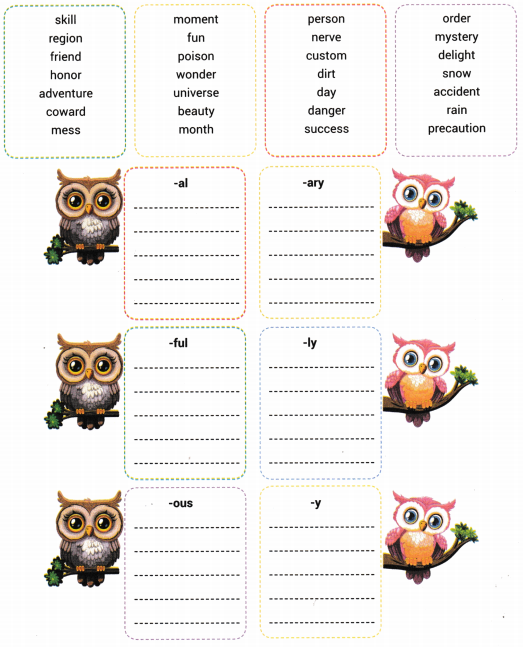
II. There are some words that look similar in meaning but have different uses. A list of such words with their uses are given in the box.
| Word 1 | Word 2 | Difference in Use |
| Say | Tell | ’’Say” is usually followed by what was said; “Tell” is followed by a person, (e.g., He said “hello.” vs. He told me a story.) |
| Speak | Talk | “Speak” is more formal and often one-way; “Talk” is informal and two-way. (e.g., He spoke to the audience, vs. They talked for hours.) |
| See | Watch | “See” is passive noticing, “Watch” is active observing, (e.g., 1 saw a bird. vs. 1 watched a movie.) |
| Listen | Hear | “Hear” is passive; “Listen” is active, (e.g., 1 heard a noise, vs. 1 listened to music.) |
| Look | Watch | “Look” is a quick glance, “Watch” involves attention over time, (e.g., Look at that cloud! vs. Watch the show.) |
| Big | Large | Often interchangeable, but “large” is more formal or technical, (e.g., a big problem vs. a large quantity) |
| Job | Work | “Job” is a specific position; “Work” is the general activity, (e.g., She has a job at the bank. vs. She goes to work every day.) |
| Trip | Journey | “Trip” is short or specific; “Journey” is long or symbolic, (e.g., a business trip vs. a spiritual journey) |
| House | Home | “House” is the building; “Home” is the place where one lives emotionally, (e.g.. They bought a new house, vs. 1 miss my home.) |
1. Fill in the blanks with suitable words from the sets of words given in the box above.
Yesterday, I had a (i) __________ interview for a (ii) __________ at a company near my (iii) __________ On the way there, I saw a street performer who made people laugh-he was really funny! I stopped to (iv) __________ him for a moment, then continued walking because I didn’t want to be late for (v) __________ At the interview, the manager (vi) __________ me about the position and (vii) __________ that he was looking for someone with experience. We (viii) __________ for a while, and he also (ix) __________ about the company’s goals. I tried to (x) __________ carefully, though I could also (xi) __________ other people chatting nearby. After the interview, I went home and went for a short (xii) __________ to the park. It wasn’t a long (xiii) __________ but it gave me time to think. When I returned (xiv) __________ I felt hopeful.
The experience was both challenging and exciting, and I know it was a step on my personal (xv) __________ toward success.
III. Present Perfect Continuous Tense Structure:
Subject + has/have + been + present participle (verb + ing)
Usage:
We use the present perfect continuous tense to show:
1. An action that started in the past and is still continuing.
2. An action that recently stopped, with visible results or effects now.
3. Emphasis on duration (how long the action has been happening).
Examples:
1. I have been studying for three hours.
(The action started in the past and is still happening.)
2. She has been working with that company since 2020.
(Emphasizes duration up to now.)
1. Fill in the blanks using the verbs given in brackets in present continuous or present perfect continuous tense:
Mary (i) __________ (prepare) for the party all morning, while her parents (ii) __________ (make) sure everything is perfect. The guests (iii) __________ (arrive) one by one, and Mary (iv) __________ (greet) them with a rehearsed smile. She (v) __________ (try) to use polite phrases that her mother taught her. Her mother (vi) __________ (watch) her carefully and (vii) __________ (correct) her with gentle signs. Meanwhile, the children (viii) __________ (wait) for their turn to perform. The guests (ix) __________ (enjoy) Mary’s innocent mistakes and (x) __________ (laugh) softly.
IV. Kinds of Sentences
| Sentence Types | Function | Punctuation | Examples |
| Declarative | Statement or fact | Period (.) | She has been working since 2020. |
| Interrogative | Asks a question | Question (?) | Have you been studying for the exam? |
| Imperative | Command or request | Period (.) | Please listen carefully. |
| Exclamatory | Strong feeling or emotion | Exclamation (!) | Wow, you have scored 100 marks, out of 100 marks! |
1. Identify the kind of sentence and punctuate them appropriately.
1. what did you say to mrs shaw
2. mary is trying to remember her lines
3. please sit down and make yourself comfortable
4. how rude of mary to say that
5. have the guests arrived yet
6. the children are standing near the door
7. don’t interrupt the conversation
8. what a strange thing to say in front of the guests
9. is she doing this on purpose
10. listen carefully to what your mother told you
Let us listen
I. Request your brother/sister/classmate to read out the conversation between Ria and her father. Listen to it carefully and then answer the following questions. (Transcript Page 121)
1. Fill in the blanks by selecting the correct option
1. Ria didn’t __________ Mr. and Mrs. Mehta when they came.
(i) greet
(b) leave
(c) ignore
2. Ria felt __________ when the guests arrived.
(i) excited
(b) tired
(c) nervous
3. Her father told her that saying ” __________.” is always appreciated.
(i) Go away
(b) Good evening
(c) Whatever
4. When someone gives us something, we should say” __________.”
(i) No
(b) Thank you
(c) Later
5. Ria said ” __________.” when asked about the gift.
(i) Thank you
(b) It’s okay, I guess
(c) I love it
6. Her father reminded her that it is good to say kind things even when we feel __________.
(i) angry
(b) bored
(c) shy
2. Select the true statements.
1. Ria’s father uses the guest visit to teach her good manners.
2. Ria thanked Mrs. Mehta as soon as she got the gift.
3. Her father says that nervousness is not a reason to be impolite.
4. Ria thinks it’s unnecessary to greet guests.
5. Her father says that kind words help us grow confident.
6. Ria interrupted the guest while she was talking.
7. The father says, “It’s okay to ignore politeness in private places. ”
8. Ria is not interested in learning polite behaviour.
9. Saying “Please” and “Sorry” are considered polite actions.
10. The conversation ends with Ria wanting to improve herself.
Let us Speak
Intonation: Intonation is the rise and fall of the pitch of tone while speaking.
I. Speak the given declarative sentences aloud with appropriate intonation and stress the highlighted words.
1. The dog barked loudly at the stranger.
2. I visited my grandparents last weekend.
3. The teacher explained the lesson very clearly.
4. They moved to a new house last month.
5. The weather was beautiful yesterday.
6. I found my lost keys under the table.
7. She cooked dinner for everyone last night.
8. We completed the project ahead of schedule.
9. The baby slept through the night without waking up.
10. He ran a marathon last year.
II. Work in pairs and speak the following sentences aloud, applying stress and appropriate intonation. Match the sentences with their meanings from the list below.
Sentences:
1. I didn’t see him yesterday.
2. She didn’t finish the assignment
3. 1 met them at the mall.
4. He didn’t call me.
5. They haven’t arrived yet.
6. I’ve been to the museum.
7. She called me last night.
8. We finished the work on time.
9. I saw him earlier today.
10. He didn’t attend the meeting.
Meanings:
(i) A meeting at the mall took place.
(ii) The call took place the night before.
(iii) The person was not seen on the mentioned day.
(iv) The expected arrival has not happened.
(v) He missed the meeting.
(vi) The task was completed successfully.
(vii) The assignment was left incomplete.
Let us Write
Read the following story carefully.
The Unexpected Gift
The old woman, Elara, sat by the window, her gaze fixed on the bustling market square below, A young boy, no older than seven, cautiously approached her stall, a small, dusty box clutched in his hands.
“Good afternoon, little one,” Elara greeted him, her voice soft with age.
The boy, looking nervous, shifted his weight and stammered, “I… I have a gift for you.”
Elara smiled warmly, a hint of mischief twinkling in her eyes. “A gift? What a delightful surprise!” He opened the box, revealing a single, perfectly ripe strawberry.
“It’s… a strawberry,” he said, his voice barely a whisper. “My grandmother said it’s the best strawberry in all the kingdom”
Elara chuckled, a warm, comforting sound. “A fine gift indeed, my boy. Thank you.”
She took the strawberry, her fingers gently tracing the smooth skin. “Tell me, what’s your name?” “Theo,” he replied, a small smile finally gracing his face.
Elara looked at the boy, then back at the strawberry. “And what a name for such a generous gift,” she said, her heart filled with warmth. “Here, Theo,” she said, and handed him a coin. “Go buy yourself some sweets with this. You deserve them.”
Theo’s eyes widened in surprise. “Thank you,” he said, his voice now brimming with happiness.
Elara watched him as he skipped away, the bright strawberry still safely in his hand. The unexpected gift had brought a smile to her face and a spark of joy to her day.
Now rewrite the above story in your own words.
- Ensure that the story captures the main events, character’s emotions and humorous moments effectively.
- Use paragraphs to organize your story.
Let us explore
I. Enacting a Play
1. Work in groups. Enact your favourite part of a play.
Points to remember
- Allot a specific role to each member in the group, such as director, narrator, and characters.
- Include actions and expressions as indicated in the play (e.g., gestures, facial expressions).
II. Greeting Guests in Different Languages
1. Find out how people greet guests who visit their homes in different languages. Share it with your classmates and the teacher.