Our subject specific Class 8 Social Science Worksheet and Class 8 SST Chapter 2 Reshaping India’s Political Map Worksheet with Answers Pdf are aligned with latest patterns.
Reshaping India’s Political Map Worksheet Class 8
Class 8 Reshaping India’s Political Map Worksheet
Worksheet On Reshaping India’s Political Map Class 8 – Reshaping India’s Political Map Worksheet
Multiple Choice Questions
Question 1.
What was the economic system used by the Delhi Sultanate to assign land to nobles?
(a) Iqta system
(b) Zamindari
(c) Ryotwari
(d) Jagirdari
Answer:
(a) Iqta system
Question 2.
What was the main aim of Timur’s invasion of Delhi?
(a) To build temples
(b) To help Indian rulers
(c) To plunder wealth and fight “infidels”
(d) To join the Mughal Empire
Answer:
(c) To plunder wealth and fight “infidels”
Question 3.
Name the ruler who established the Mughal Empire in India.
(a) Akbar
(b) Sher Shah
(c) Babur
(d) Humayun
Answer:
(c) Babur
Question 4.
Why did Babur stayed in India instead of returning to Central Asia?
(a) He wanted to visit temples
(b) He found India’s climate, wealth, and skilled artisans impressive
(c) He disliked Central Asia
(d) He lost his army
Answer:
(b) He found India’s climate, wealth, and skilled artisans impressive
Question 5.
Name the powerful queen of the Garha kingdom who fought against Akbar’s army,
(a) Rani Lakshmibai
(b) Rani Padmavati
(c) Rani Durgavati
(d) Rani Ahilyabai Holkar
Answer:
(c) Rani Durgavati

Question 6.
State the name of the tax on non-Muslims that Akbar abolished.
(a) Zakat
(b) Khums
(c) Jizya
(d) Lagaan
Answer:
(c) Jizya
Question 7.
Mention the Rajput ruler who fought the Battle of Haldighati.
(a) Rana Sanga
(b) Maharana Pratap
(c) Rana Kumbha
(d) Durga Das Rathore
Answer:
(b) Maharana Pratap
Question 8.
The Battle of Haldighati was fought in which year?
(a) 1526
(b) 1576
(c) 1610
(d) 1658
Answer:
(b) 1576
Question 9.
State the group that supported Maharana Pratap in guerrilla warfare.
(a) Rajputs
(b) Bhils
(c) Mughals
(d) Sikhs
Answer:
(b) Bhils
Question 10.
What type of warfare did the Ahoms and Rajputs use against powerful armies?
(a) Naval warfare
(b) Guerrilla warfare
(c) Traditional warfare
(d) Trench warfare
Answer:
(b) Guerrilla warfare
Question 11.
Name the Sikh Guru, who was executed for refusing to convert to Islam under Aurangzeb.
(a) Guru Tegh Bahadur
(b) Guru Nanak
(c) Guru Hargobind
(d) Guru Arjan
Answer:
(a) Guru Tegh Bahadur
Question 12.
Which Mughal ruler banned music and dance in his court?
(a) Akbar
(b) Aurangzeb
(c) Jahangir
(d) Shahjahan
Answer:
(b) Aurangzeb
Question 13.
During whose reign did the Mughal Empire reach its greatest territorial extent?
(a) Akbar
(b) Jahangir
(c) Aurangzeb
(d) Shahjahan
Answer:
(c) Aurangzeb
Question 14.
According to the Ain-i-Akbari as recorded by Abul Fazl, who was incharge of finances under Akbar?
(a) Mir Bakhshi
(b) Diwan
(c) Khan-i-Saman
(d) Sadr
Answer:
(b) Diwan
Question 15.
Identify the system that allowed merchants to transfer funds without carrying currency physically,
(a) Jagir system.
(b) Hundi system
(c) Iqta system
(d) Mansabdari system
Answer:
(b) Hundi system
Fill in the Blanks
Fill in the blanks with the help of words in the box given below.
| Iqtidars, Lodi, Aurangzeb, Poetry, Akbar, Vijayanagara, Todar Mai, Paiks, Hampi, Haldighati |
1. The capital city of the Vijayanagara Empire was ________, architecture and trade.
Answer:
Hampi
2. The ________ dynasty ruled over Delhi before the rise of the Mughal Empire.
Answer:
Lodi
3. Guru Tegh Bahadur opposed the forced conversion policy of ________, the Mughal emperor.
Answer:
Aurangzeb
4. The Battle of Talikota in 1565 led to the downfall of the ________ Empire.
Answer:
Vijayanagara
5. Maharana Pratap continued to resist the Mughals even after the Battle of ________.
Answer:
Haldighati
6. The Ahoms divided their land into administrative units called ________ for better governance.
Answer:
Paiks
7. During medieval times, Sufi saints spread their teachings through ________ and spiritual songs.
Answer:
Poetry
8. ________ was the Mughal emperor who abolished not only the Jizya tax but also expanded the empire significantly.
Answer:
Akbar
9. Under the Iqta system, territories were assigned to nobles called ________ to collect taxes for the Sultan.
Answer:
Iqtadars
10. Akbar’s Finance Minister ________ introduced an efficient revenue system and carried out a systematic land survey.
Answer:
Todar Mai
True or False
Write ‘T’ for True or ‘F’ for False statements.
1. The Mughal Empire was established in India by Babur after defeating Ibrahim Lodi at the Battle of Haldighati.
Answer:
False
2. The Ahoms defeated the Mughals in the Battle of Saraighat.
Answer:
True
3. Akbar’s policy of Sulh-i-Kul encouraged peaceful coexistence among people of different religions.
Answer:
True
4. Todar Mai, Akbar’s Finance Minister, introduced an efficient revenue system.
Answer:
True
5. The Mansabdari system under the Mughals was meant only for religious leaders and scholars.
Answer:
False
6. Krishnadevarqya is remembered as a weak ruler who depended entirely on his ministers.
Answer:
False
7. The Battle of Talikota resulted in the decline of the Delhi Sultanate.
Answer:
False
8. Rajput queen Rani Durgavati surrendered peacefully to Akbar’s army.
Answer:
False
9. The Bhakti movement was against idol worship and only followed strict rituals.
Answer:
False
Match the Columns
Question 1.
Match the term in column A with their description in column B.
| Column A | Column B |
| A. Babur | 1. Fierce battle between Mughals and Rajputs |
| B. Krishnadevaraya | 2. Founder of the Mughal Empire |
| C. Battle of Haldighati | 3. Patron of art, literature and temples |
| D. Aurangzeb | 4. Expanded Mughal Empire to its largest extent |
Answer:
| Column A | Column B |
| A. Babur | 2. Founder of the Mughal Empire |
| B. Krishnadevaraya | 3. Patron of art, literature and temples |
| C. Battle of Haldighati | 1. Fierce battle between Mughals and Rajputs |
| D. Aurangzeb | 4. Expanded Mughal Empire to its largest extent |
Question 2.
Match the term in column A with their description in column B
| Column A | Column B |
| A. Muhammad bin Tughlaq | 1. Introduced a token currency |
| B. Timur | 2. Invaded Delhi in 1398 |
| C. Ahoms | 3. Managed a strong tribal military |
| D. Akbar | 4. Introduced the Mansabdari system |
Answer:
| Column A | Column B |
| A. Muhammad bin Tughlaq | 4. Introduced the Mansabdari system |
| B. Timur | 2. Invaded Delhi in 1398 |
| C. Ahoms | 3. Managed a strong tribal military |
| D. Akbar | 1. Introduced a token currency |
Question 3.
Match the image in column A with their description in column B.

Answer:
A-4, B-2, C-3, D-1
Assertion-Reason Questions and Answers
Given below are two statements marked as Assertion (A) and Reason(R). Read the statements and answer the questions according to the codes given below.
Codes
(a) Both A and R are true and R is the correct explanation of A.
(b) Both A and R are true, but R is not the correct explanation of A.
(c) A is true, but R is false.
(d) A is false, but R is true.
Question 1.
Assertion (A) The Delhi Sultanate controlled all of Southern India.
Reason (R) The Delhi Sultanate maintained a strong army and efficient administrative and military structure.
Answer:
(d) A is false, but R is true.
Question 2.
Assertion (A) Timur’s invasion caused destruction in Delhi.
Reason (R) Timur came to establish a permanent empire in India.
Answer:
(c) A is true, but R is false.
Question 3.
Assertion (A) Akbar encouraged debates among scholars of different religions.
Reason (R) He built the Ibadat Khana at Fatehpur Sikri.
Answer:
(a) Both A and R are true and R is the correct explanation of A.
Question 4.
Assertion (A) The Rajputs easily gave up their kingdoms to the Mughals.
Reason (R) Akbar expanded and stabilised his empire, even gaining the support of many Rajputs.
Answer:
(d) A is false, but R is true.
Question 5.
Assertion (A) The Ahoms successfully defended their land from Mughal attacks.
Reason (R) The Ahoms used guerrilla warfare and had strong unity.
Answer:
(a) Both A and R are true and R is the correct explanation of A.
Question 6.
Assertion (A) Akbar’s Mansabdari system helped him organise his administration.
Reason (R) Mansabdars were paid through jagirs and were loyal to the emperor.
Answer:
(a) Both A and R are true and R is the correct explanation of A.
Question 7.
Assertion (A) Indian merchants relied heavily on the physical transport of currency for trade.
Reason (R) The hundi system allowed transferring funds across political boundaries without moving currency physically.
Answer:
(d) A is false, but R is true.
Jumbled Words
Rearrange the words to form a correct word.
1. Famous battle between Mughals and Rajputs in 1576.
AHLIDAGTHI ______________
Answer:
HALDIGHATI
2. The Mughal general who defeated Rana Pratap at Haldi Ghati.
AMNGHSIN ______________
Answer:
MAN SINGH
3. A powerful kingdom in Assam that resisted the Mughals.
OHMAS ______________
Answer:
AHOMS
4. The kingdom in Rajasthan.
PURTAJ ______________
Answer:
RAJPUT
5. A strong fortress of the Rajputs.
HRKUMLGAHBA ______________
Answer:
KUMBHALGARH
6. A system used by Akbar to rank officials.
BSSAANDARM ______________
Answer:
MANSABDARS
7. Kingdom in the Deccan resisting Mughals.
IPURBJA ______________
Answer:
BIJAPUR
8. The Mughal province division system.
BHASU ______________
Answer:
SUBHA
9. The maritime city is important for trade in Gujarat.
TRASU ______________
Answer:
SURAT
Very Short Answer Type Questions
Question 1.
Name the Rajput king who showed unmatched bravery in the Battle of Haldighati.
Answer:
____________________________________________
____________________________________________
Question 2.
Identify the South Indian empire that flourished under Krishnadevaraya leadership.
Answer:
____________________________________________
____________________________________________
Question 3.
Which Mughal emperor reimposed Jizya and pilgrimage taxes?
Answer:
____________________________________________
____________________________________________
Question 4.
Write the name of the region where the Ahoms strongly resisted Mughal expansion.
Answer:
____________________________________________
____________________________________________
Question 5.
Mention the architectural wonder built by Shah Jahan in memory of his wife.
Answer:
____________________________________________
____________________________________________
Question 6.
Identify the Mughal emperor who created Din-i Ilahi, a new religion..
Answer:
____________________________________________
____________________________________________
Question 7.
What happened to the Mughal treasury during Aurangzeb’s Deccan campaigns?
Answer:
____________________________________________
____________________________________________
Question 8.
How did the Ahoms maintain their army without a permanent force?
Answer:
____________________________________________
____________________________________________
Question 9.
Name and explain one major rebellion that weakened the Mughals.
Answer:
____________________________________________
____________________________________________
Short Answer Type Questions
Question 1.
Describe the effects of Timur’s invasion on Delhi.
Answer:
____________________________________________
____________________________________________
Question 2.
State how Babur laid the foundation of the Mughal Empire.
Answer:
____________________________________________
____________________________________________
Question 3.
How did Aurangzeb’s religious beliefs influence his rule?
Answer:
____________________________________________
____________________________________________
Question 4.
Why is the Battle of Haldighati important in Indian history?
Answer:
____________________________________________
____________________________________________
Question 5.
What role did the Rajputs play in resisting Mughal expansion?
Answer:
____________________________________________
____________________________________________
Question 6.
How did the Ahoms protect Assam from Mughal invasions?
Answer:
____________________________________________
____________________________________________
Question 7.
What were Krishnadevaraya’s contributions to culture and literature?
Answer:
____________________________________________
____________________________________________
Long Answer Type Questions
Question 1.
Explain how the Vijayanagara Empire became a cultural and political center in South India.
Answer:
____________________________________________
____________________________________________
Question 2.
How did regional kingdoms contribute to reshaping India’s political map during the medieval period?
Answer:
____________________________________________
____________________________________________
Question 3.
State the importance of religious tolerance in the Mughal administration under Akbar.
Answer:
____________________________________________
____________________________________________
Question 4.
Compare the policies of Akbar and Aurangzeb regarding religion, administration and military expansion. How did their approaches affect the empire’s stability?
Answer:
____________________________________________
____________________________________________
Source-Based Questions
Read the source given below and answer the questions that follow.
Question 1.
“In the 16th century, the Vijayanagara Empire reached its peak under its celebrated ruler, Krishnadevaraya, who expanded and secured the empire’s dominance over the Deccan. Under his rule, the empire achieved both military power and cultural renaissance. He patronised poets and scholars in Sanskrit, Telugu and Kannada; he himself composed an epic poem in Telugu, Amuktamalyada, on the story of the Tamil poet-saint Andal; one section of the work is a Rajaniti (royal policy) where he expounded his ideas of good governance. Krishnadevaraya provided grants to many temples, including Tirupati in Andhra Pradesh and the Vitthala temple in his own capital Vijayanagara, which displayed many grand temples, palaces and other buildings.”
(i) What does Krishnadevaraya’s choice to write Amuktamalyada in Telugu suggest about his rule?
(a) He preferred only Telugu over other languages
(b) Telugu was the official court language
(c) He valued regional languages and connected with local culture
(d) Tamil was not allowed in his empire
(ii) Krishnadevaraya’s interest in the Tamil saint Andal’s story shows
(a) his desire to spread Tamil language
(b) political alliances with northern India
(c) appreciation of religious devotion across regional boundaries
(d) focus only on South Indian legends
(iii) What might the grants to temples like Vitthala and Tirupati indicate about Krishnadevaraya’s governance?
(a) He used temples to hide wealth
(b) He supported temples to gain both religious merit and public loyalty
(c) He wanted to become a religious leader
(d) He opposed other religious practices
(iv) The presence of poets and scholars in multiple languages at his court suggests
(a) the empire had poor communication
(b) he wanted to replace all local languages with Persian
(c) a culturally diverse and intellectually rich atmosphere
(d) there were no official languages in the empire
Question 2.
“The Delhi Sultanate was formed after the defeat in 1192 of King Bcittwiraj Chauhan, who ruled over parts of North-Western India. This Sultanate saw the rule of five successive foreign dynasties of Turkic-Afghan origin — the Mamluks (or ‘Slave dynasty’), the Khiljis (or Khaljis), the Tughlaqs, the Sayyids, and the Lodis (or Lodhis). While certain parts of northern India came under the control of the Delhi Sultanate, neighbouring kingdoms, such as the Eastern Gangas in the East and the Hoysalas in the South resisted its advance and also emerged as thriving centres of art, culture, and administration. The city of Delhi also assumed a bigger role in the political landscape of northern India.”
(i) Why is the Delhi Sultanate said to be ruled by foreign dynasties?
____________________________________________
____________________________________________
(ii) How did Eastern Gangas and Hoysalas respond to the Delhi Sultanate?
____________________________________________
____________________________________________
(iii) Why did Delhi become politically important during the Sultanate period?
____________________________________________
____________________________________________
Picture-Based Questions
Question 1.
Observe the picture given below and answer the following questions.

(i) State the historical significance of this monument in the-context of the Delhi Sultanate.
____________________________________________
(ii) Mention the two rulers associated with the construction of this tower and describe their contributions.
____________________________________________
Question 2.
Observe the picture given below and answer the following questions.
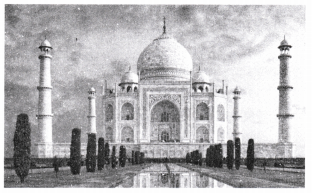
(i) State how the architectural style of the Taj Mahal reflects the culture of the Mughal Empire.
____________________________________________
(ii) Mention one reason why Shah Jahan built this monument and describe how it reflects Mughal values.
____________________________________________
Map-Based Questions
Question 1.
Instructions On a blank political map of India, mark and label the following important medieval cities/empires.
(a) Delhi (Capital of Delhi Sultanate)
(b) Agra (Mughal Capital)
(c) Hampi (Capital of Vijayanagara Empire)
(d) Mewar

Activities
Question 1.
Solve the crossword
ACROSS
3. The title used by rulers of the Delhi Sultanate
4. The invader whose attack led to Delhi’s destruction in 1398 CE
6. City known as the capital of the Vijayanagara Empire
DOWN
1. Famous battle fought between Akbar and Maharana Pratap in 1576
2. The river along which the Delhi Sultanate often expanded
5. The emperor known for his policy of religious tolerance and Din-i Ilahi

Answer:
ACROSS
3. SULTAN
4. TIMUR
6. HAMPI
DOWN
1. HALDIGHATI
2. YAMUNA
5. AKBAR
Question 2.
Monuments of Medieval India.
