Climate Class 9 Important Questions Social Science Geography Chapter 4
Important Questions for Class 9 Social Science Geography Chapter 4 Climate
Climate Class 9 Important Questions Very Short Answer Type Questions
Question 1.
What is climate? [CBSE 2014]
Answer:
The climate refers to the sum total of weather conditions and variations over a large area for a long period of time.
Question 2.
What is weather?
Answer:
‘Weather’ refers to the state of the atmosphere over an area at any point of time.
Question 3.
Name the. elements of weather and climate.
Answer:
Temperature, atmospheric pressure, wind, humidity and precipitation.
Question 4.
What does ‘monsoon’ imply? [CBSE 2015]
Answer:
The word, ‘monsoon’ comes from the Arabic word’ mausim’ which means season. It implies a seasonal reversal in the wind direction throughout the year.
Question 5.
Which are the rainest months of India?
Answer:
June to September
Question 6.
Name the month in which the withdrawl of monsoon begins.
Answer:
September
Question 7.
Which region of India receives most of its rainfall in winter?
Answer:
Tamil Nadu coast.
Question 8.
Name the two branches of the monsoon.
Answer:
- The Arabian Sea branch.
- The Bay of Bengal branch.
Question 9.
What is burst of monsoon? [CBSE 2015]
Answer:
Around the time of its arrival, the normal rainfall increases suddenly and continues constantly for several days. This is known as the ‘burst’ of the monsoon.
Question 10.
What me the ‘retreating monsoons’? [CBSE 2014]
Answer:
During the months of October and November, the temperature in the Northern plains begins to decrease, and because of low temperature, the pressure starts rising and the low pressure is no longer strong enough to attract the monsoon winds. This results in the retreat of the monsoon.
Question 11.
With reference to the ‘Cold weather season in India, answer the following questions.
(i) What is its time period?
(ii) Name the winds which prevail over the country during this season.
Answer:
(i) Mid November to February.
(ii) North-East trade winds.
Question 12.
Name the winds from which the Tamil Nadu coast receive winter rainfall?
Answer.
North-East monsoons which reach there after passing over the Bay of Bengal, and picking moisture from there. .
Question 13.
Name two coldest areas in India.
Answer:
Dras and Kargil (Temperature – 40°C)
Question 14.
Which is the wettest place in India?
Answer:
Mawsynram in the southern ranges of the Khasi hills.
Question 15.
What is a jet stream?
Answer:
A jet stream is a fast blowing wind blowing in a narrow zone in the upper atmosphere.
Question 16.
‘The peninsular region does not have a well defined cold season.’ Give reason.
Answer:
Due to the moderating influence of the sea, the peninsular region does not have a well defined cold season.
Question 17.
Name two states where mango showers are common. [CBSE 2000(B)]
Answer:
Kerala and Karnataka.
Question 18.
Name two states on the eastern coast which are frequently struck by the tropical cyclones.
Answer:
Andhra Pradesh and Tamil Nadu.
Question 19.
What is meant by breaking of monsoon or burst of the monsoon?
Answer:
The rain bearing monsoons are extremely strong and violent. Their approach is accompanied by thunder and lightning. This is known as the Wreaking of monsoon.
Question 20.
What is the name given to the climate of India?
Answer:
The Monsoon climate.
Question 21.
What is loo?
Answer:
It is a local wind which is hot and dry.
Question 22.
Name the wind which prevails over India in winter season.[CBSE 2013]
Answer:
North-East trade winds.
Question 23.
Two stations with most equable climate.
Answer:
Mumbai and Chennai.
Question 24.
Two stations with most extreme climate.
Answer:
Leh and Jodhpur.
Question 25.
Name any two regions which receive over 400 cm of rainfall.
Answer:
The Western coast and the North-eastern India receive over 400 cm of rainfall.
Question 26.
Name two stations influenced by the retreating and the North-East monsoons.
Answer:
Chennai and Bengaluru.
Question 27.
Two stations receiving winter showers from the western disturbances.
Answer:
Amritsar and Delhi.
Question 28.
State two chief characteristics of the Western Disturbances? [CBSE1995,2013]
Answer:
- These originate over the east Mediterranean sea.
- These cause rain in North India.
Climate Class 9 Important Questions Short Answer Type Questions
Question 1.
“ Despite an overall unity in the gen¬eral pattern of climate of India,there are perceptible regional variations in climatic conditions within the country.” Justify.
Or
“India has diverse climatic conditions”Support this statement by giving examples, each of tempera¬ture and precipitation.
Answer:
- The mercury occasionally touches 50°C in the western deserts, and it drops down to as low as -45°C in winter around Leh.
- The annual precipitation is less than 10 cm in the north-west Himalayas and the western desert. It exceeds 400 cm in Meghalaya.
- Most parts of the country receive rainfall from June to September, but some parts like the Tamil Nadu coast get most of its rain during October and November.
Question 2.
Explain the factors affecting India’s climate. [CBSE 2015]
Answer:
- Latitude : The Tropic of Cancer passes through the middle of the country from the Rann of Kuchchh in the west to Mizoram in the east. Almost half of the country, lying south of the Tropic of Cancer, belongs to the tropical area. All the remaining area, north of the Tropic, lies in the sub-tropic. Therefore, India’s climate has characteristics of tropical as well as subtropical climates.
- Altitude: India has mountains to the north which have an average height of about 6,000 metres. India also has a.vast coastal area where the maximum elevation i% about 30 metres. The Himalayas prevent the cold winds from Central AsiafrQm entering the subcontinent. It is because of these mountains that this subcontinent experiences comparatively milder winters as compared to central Asia.
- Pressure and Winds: The pressure and wind conditions over India are unique. During winter, there is a high-pressure area north of the Himalayas. Cold dry winds blow from this region to the low-pressure areas over the oceans to the south. In summer, a low-pressure area develops over interior Asia as well as over northwestern India. This causes a complete reversal of the direction of winds during summer. Air moves from the high-pressure area over the southern Indian Ocean, in a south¬easterly direction, crosses the equator, and turns right towards the low-pressure areas over the Indian subcontinent. These are known as the Southwest Monsoon winds. These winds blow over the warm oceans, gather moisture and bring widespread rainfall over the mainland of India.
Question 3.
Mention any three characteristics of the Monsoon’.[CBSE 2011,12,14 ]
Answer:
- The Monsoons are pulsating in nature.
- These are affected by different atmospheric conditions prevailing in the region.
- The duration of the monsoon is between 100 – 120 days.
Question 4.
What is “October Heat”?
Answer:
The months of October-November form a period of transition from a hot rainy season to dry winter conditions. The retreat of monsoons is marked by clear skies, and rise in temperature. The land is still moist. Owing to the condition of high temperature and humidity, the weather becomes rather oppressive. This is commonly known as ‘October Heat’.
Question 5.
Explain development of Monsoon Trough and its influence over rainfall distribution. [CBSE 2014]
Answer:
- It is a region of low atmospheric pressure which develops because of excessive heat.
- It brings a remarkable change in rainfall pattern.
- It is responsible for diy and wet spells of monsoon.
Questions.6.
Give reasons as to why:
(i) Seasonal reversal of wind direction takes place over the Indian subcontinent.
(ii) The bulk rainfall in India is concentrated over a few months.
(iii) The Tamil Nadu coast receives winter rainfall.
(iv) The delta region of the eastern coast is frequently struck by cyclones.
(v) Parts of Rajasthan, Gujarat and the leeward side of the Western Ghats are drought prone.
Answer:
(i)
- During winter, there is a high pressure area over north of the . Himalayas. Whereas, there is low pressure area over the ocean to the south. So cold and dry winds blow from the Himalayan region towards the ocean.
- During summer, a low pressure area develops over the interior , Asia as well %is over the Northwestern India. This causes a complete reversal of the direction of winds during summer.
(ii)
- Most parts of India receive rainfall from the south-west monsoons which blow in India only between June to September.
- Only the eastern coast of India receives some rainfall from the North-East trade winds during the cold weather season.
- It is because Tamil Nadu gets rain from the north-east monsoons which reach there after passing over the Bay of Bengal, after picking moisture from there.
(iv)
- In the mid-October, the mercury
begins to fall at a rapid speed in Northern India. - The low pressure conditions of the North shifts to the Bay of Bengal by November. This shift causes cyclonic depressions in the Andaman Sea.
- These cyclonic depressions give rise to tropical cyclones which cause heavy and widespread rains in the deltas of the Godavari, the Krishna and the Kaveri.
(v)
- Rajasthan does not receive much rain because the Aravalli Range which lies parallel to the direction of the winds and hence condensation does not occur.
- Gujrat receives less rainfall because there are no hills and mountain ranges.
The leeward side of the Western Ghats receives less rainfall because when air descends, it gets warmed up. Due to its rising temperature, the relative, humidity of air decreases, and the air turns from a saturated state to an unsaturated state. Due to his fact, no rainfall occurs on the leeward side.
Climate Class 9 Important Questions Long Answer Type Questions
Questions.1.
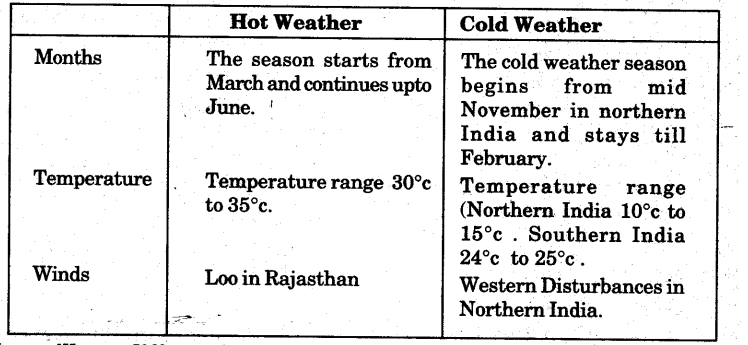
Compare the hot weather season of India with that of cold weather season.
Answer:
Questions.2.
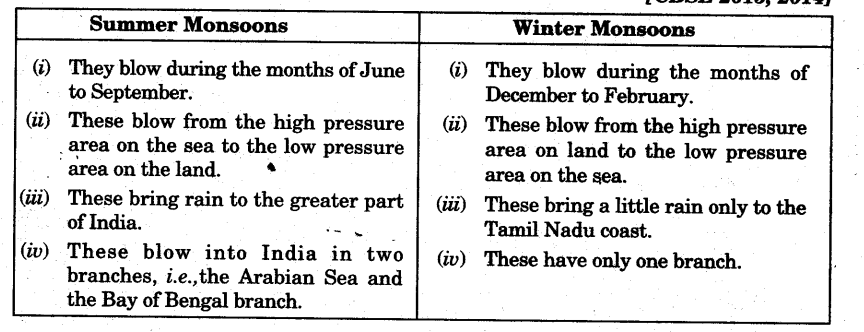
How will you differentiate between the summer and winter monsoons?
Or
Differentiate between South-West and North-East trade winds.
Answer:
Climate Class 9 Important Questions Higher Order Thinking Skills (Huts) Questions
Questions. 1.
Give reason for the following:
(i) Thiruvananthapuram has the year equable climate.
(ii) Delhi has extreme climate.
(iii) The Tamil Nadu coast receives winter rainfall.
(iv) Leh has moderate precipitation almost through-out the year.
(v) The delta region of the eastern coast is frequently struck by cyclones.
Answer:
(i) It has equable climate due to proximity to sea. Sea has moderating influence over its climate.
(ii) Because Delhi is far away from sea. As the distance from the sea increases,its moderating influence decreases.
(iii) Tamil Nadu receives rainfall from North-east trade winds.
(iv) Leh is at a very high altitude. During the cold weather season, the ‘Western Disturbances’ contribute to heavy snowfall in this region. Both south-west and south¬east monsoons also cause precipitation in this part.
(ii) (a) In the mid October, the mercury begins to fall at a rapid speed in Northern India.
(b)The low pressure conditions of the North shifts to the Bay of the Godavari, the Krishna and the Kaveri.
Questions.2.
Carefully study the given rainfall and temperature graphs and answer the following of questions:
(i) Which station receives more rainfall?
Answer:
Shillong.
(ii) Which is the rainiest month of Shillong?
Answer:
June
(iii) Which is the coldest month in Leh?
Answer:
January
(iv) Compare the climatic conditions of both the stations with reference to rainfall and temperature.
Answer:
- Leh receives very low rainfall whereas Shillong receives very high rainfall.
- Temperature in Leh remains very low throughout the year whereas temperature in Shillong remains between 10°C to 20°C.
Bengal by November. This shift causes cyclonic depressions in the Andaman Sea. - These cyclonic depressions give rise to tropical cyclones which cause heavy and widespread rains in the deltas
Questions.3.
Study the climatic data given below and answer the questions that follow: [CBSE2014]
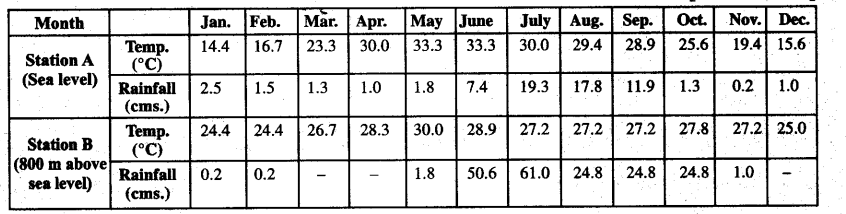
(i) Calculate the annual range of temperature of Station A. Why is the range of . temperature very low?
(ii) Which of the two Stations has the lower temperature? Why?
(iii) Calculate the annual rainfall of Station B.
Answer:
(i) 5.6 Because the station is near the sea.
(ii) Station B. Because of high altitude.
(iii) Annual rainfall of station B is 31.8 cm.
Questions.4.
Given below is the climate data – mean monthly temperatures and mean monthly rainfall for stations A, B and C from India. Study the data carefully and answer the following questions:
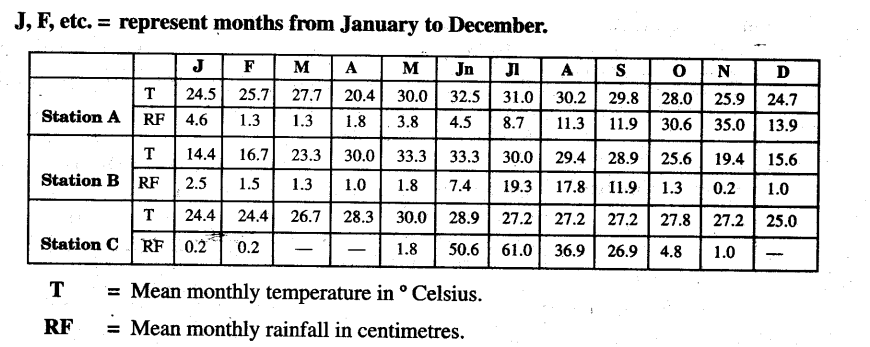
(i) What is the annual range of temperature in Station A?
Answer:
The annual range of temperature in Station A (32.5°C — 24.5°C) = 8°C
(ii) What is the annual rainfall experienced by the Station A?
Answer.
4.6+1.3+ 1.3 = 128.7 cm.
(iii) Name the wettest month in Station A.
Answer.
November.
(iv) Calculate the annual rainfall of Station C.
Answer.
The annual rainfall of Station C is 183.4 cm. (0.2 + 0.2 + 1.8 + 50.6..)
Climate Class 9 Important Questions Value Based Questions
Questions.1.
Which moral values the monsoon teaches us? Mention any two.
Answer:
- Monsoon acts as a unifying bond.
- Monsoon are responsible for unity in diversity.
Questions.2.
Why the people of India eagerly awaits the arrival of the monsoon?
Answer:
These monsoon winds binds the whole country by providing water to set the agricultural activities in motion.
Questions.3.
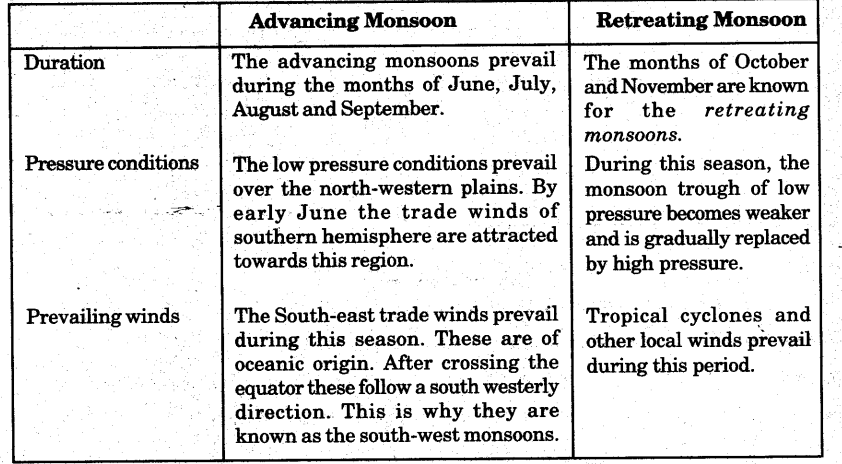
Compare he retreating monsoon with advancing monsoon.
Or
Mention any three features of retreating monsoon.
Or
Mention any four features of advancing monsoon.
Answer:
Questions.2.
“Monsoon acts as a unifying bond”. Explain. [CBSE March 2013,15]
Answer:
- The seasonal alteration of the wind systems and the associated weather conditions provide a rhythmic cycle of seasons. Even the uncertainties of rain and uneven distribution are very much typical of the monsoons.
- The Indian landscape, its animal and plant life, its entire agricultural calendar arid the life of the people, including their festivities, revolve around this phenomenon. Year after year, people of India from north to south and from east to west, eagerly await the arrival of the monsoon.
- These monsoon winds bind the whole country by providing water to set the agricultural activities in motion. The river valleys which carry this water also unite as a single river valley unit.