Students can find accurate Class 7 English Extra Questions and Class 7 English Chapter 12 Conquering the Summit Extra Questions and Answers for better understanding.
Conquering the Summit Extra Question Answer Class 7 English Chapter 12
Conquering the Summit Very Short Questions and Answers
Question 1.
Which tragedy changed Arunima’s life?
Answer:
The train accident on the fateful night of 11 April, 2011, changed Arunima’s life.
Question 2.
Why Arunima wanted to join paramilitary forces?
Answer:
Arunima wanted to join paramilitary forces to secure a regular income and continue pursuing her passion for sports.

Question 3.
How was Arunima able to survive after the horrible train accident?
Answer:
Arunima was able to survive after the horrible train accident with her extraordinary will to live.
Question 4.
Who inspired Arunima to climb Mount Everest?
Answer:
An article about Mount Everest that she read inspired her to climb Mount Everest.
Question 5.
What does the story of Arunima narrates?
Answer:
The story of Arunima narrates the triumph of will, courage, determination and dedication.
Question 6.
Arunima’s historic achievement on 21st May, 2013 was celebrated across the nation. What made this achievement extraordinary?
Answer:
Arunima became the first female amputee to climb Mount Everest.
Question 7.
At the summit, Arunima left behind a token of her inspiration. Whose photograph did she place there, and what might it have symbolised for her?
Answer:
Arunima placed a photograph of Swami Vivekananda, symbolising strength, courage and spiritual inspiration.
Question 8.
Through which autobiography did Arunima share her powerful journey of struggle and success with the world?
Answer:
Through her autobiography called “Born Again on the Mountain: A Story of Losing Everything and Finding It Back” Arunima shared her powerful journey of struggle and success with the world.
Question 9.
By January 2019, Arunima had accomplished an extraordinary mountaineering feat. What record did she complete?
Answer:
Arunima climbed all Seven Summits, conquering the highest peaks of all seven continents.
Question 10.
Recognising her indomitable spirit, Arunima was honoured with a prestigious award in 2015. Identify the award and what it represents.
Answer:
Arunima was awarded the Padma Shri, one of India’s highest civilian honours, recognising her courage and achievements.
Conquering the Summit Short Questions and Answers
Question 1.
Why did Arunima approach Bachendri Pal?
Answer:
Arunima approached Bachendri Pal for guidance and training in mountaineering, as she aspired to climb Mount Everest despite losing her leg in a tragic train accident.
Question 2.
How does Arunima’s journey from a tragic accident to conquering Mount Everest inspire others?
Answer:
Arunima’s journey from the horrific train accident to scaling Mount Everest, the world’s highest peak, stands as a beacon of hope and resilience. Others get inspired after hearing her story and are motivated with her achievements.
Question 3.
How did Arunima feel at the top of the world?
Answer:
At the top of the world, Arunima felt a mix of emotions-overwhelmed with joy, pride and a deep sense of accomplishment. She reflected on her incredible journey, from surviving a tragic accident to achieving her dream of conquering Mount Everest. The moment was both emotional and inspiring, as she proved that determination and resilience could overcome any obstacle.
Question 4.
What did Bachendri Pal say to Arunima when she approached her?
Answer:
When Arunima approached Bachendri Pal for guidance, she encouraged her to stay determined and work hard towards her goal. Bachendri Pal recognised Arunima’s resilience and supported her dream of climbing Mount Everest, providing her with necessary training and motivation to achieve this extraordinary feat. Bachendri Pal said “My child you decided to climb Mount Everest in these situations with a prosthetic leg – you have conquered the Everest with in you, the world will realise later.”
Question 5.
How did Arunima’s accident change the course of her life?
Answer:
Arunima’s accident changed the course of her life as she lost her leg due to it. However, instead of giving up, Arunima set a new goal to climb Mount Everest, transforming her pain into a journey of purpose and inspiration.
Question 6.
Why did Arunima choose to climb Mount Everest in particular?
Answer:
Inspired by an article she read in hospital, she saw Everest as the ultimate test of will and decided to prove that she could achieve the impossible despite her disability.
Question 7.
How did Arunima prepare herself physically for the expedition?
Answer:
Arunima prepared herself by completing a basic mountaineering course at the Nehru Institute of Mountaineering and underwent 18 months of intense physical training.
Question 8.
What role did Bachendri Pal play in Arunima’s success?
Answer:
Bachendri Pal mentored and motivated Arunima, offering her confidence and emotional support, reminding her that true victory lies in overcoming inner fears.
Question 9.
What does the phrase ‘Everest within you’ mean in the context of this chapter?
Answer:
The phrase “Everest within you’ refers to the personal, emotional and psychological battles a person must win before achieving any external goal.
Conquering the Summit Long Questions and Answers
Question 1.
How does Arunima’s autobiography inspire readers around the world?
Answer:
Arunima wrote her autobiography “Born Again on the Mountain: A Story of Losing Everything and Finding it Back”, where she shared her struggles and triumphs. Her story encourages people to believe in themselves, work hard, and never give up, no matter how tough the situation is. Her book has inspired countless readers worldwide to face life’s difficulties with courage and determination.
Question 2.
How do Arunima’s achievements go beyond just physical endurance?
Answer:
Arunima’s success is not just about physical strength but also about mental resilience and determination. Despite her accident, she refused to give up and showed immense courage. Her story is an example of how a strong mindset and will power can help overcome any challenge, making her achievements inspirational on a global level.
Question 3.
Did Arunima’s mountaineering journey end with scaling Mount Everest? Explain.
Answer:
No, Arunima’s mountaineering journey did not end with scaling Mount Everest. After conquering Everest, she set her sights on scaling the highest peaks on all seven continents. Her determination and resilience led her to become the world’s first female amputee to achieve this incredible feat, proving that no obstacle is too great to overcome.
Question 4.
Describe Arunima’s transformation from a sportsperson to a mountaineer.
Answer:
Arunima began as a national-level volleyball player. After a horrific train accident in 2011, she lost her leg and faced emotional and physical trauma. However, instead of giving up, she resolved to do something extraordinary-climb Mount Everest.
With a prosthetic leg and indomitable spirit, she trained rigorously for over a year and became the first Indian female amputee to scale Everest in 2013.
Her journey from a hospital bed to the world’s highest peak is a remarkable transformation of purpose and perseverance.
Question 5.
Explain how Arunima’s life story reflects the theme of ‘conquering inner fears’.
Answer:
The ‘Everest within’ mentioned by Bachendri Pal refers to internal struggles like fear, self-doubt and despair. Arunima battled through pain, public doubt and personal grief. Her victory wasn’t just about reaching a mountain summit; it was about defeating the doubts in her mind. Her courage in the face of adversity shows how true conquests are those made over one’s own limitations.
Question 6.
How did Arunima redefine the idea of success after her accident?
Answer:
Arunima shifted from societal definitions of successwealth or recognition-to a deeply personal goal: climbing Mount Everest as an amputee. By pursuing this audacious dream, she redefined success as the ability to transform setbacks into stepping stones, inspiring countless others to set and chase meaningful goals.
Question 7.
Discuss the challenges faced by Arunima during her preparation and expedition.
Answer:
Arunima’s challenges were multifaceted. Physically, she had to adapt to life with a prosthetic leg. Emotionally, she had to overcome trauma and grief. She underwent strenuous mountaineering training, faced altitude sickness, fatigue and mental exhaustion during her Everest climb, yet she remained committed throughout the 52-day expedition.
Question 8.
What role did Arunima’s family background play in her resilience?
Answer:
Coming from a disciplined family-her father was an army engineer and her mother a health supervisorArunima grew up valuing strength, independence and commitment.
This foundation, along with her involvement in sports, helped build her physical and emotional resilience, shaping her ability to face life’s harshest trials.
Conquering the Summit Competency Based Questions
Question 1.
What message do you get from the story of Arunima Sinha?
Answer:
The story of Arunima Sinha teaches us the importance of determination, resilience and a never-give-up attitude. Despite losing her leg in a tragic accident, she refused to let her disability define her. Instead, she pursued her dream with courage and climbed Mount Everest. Her journey inspires us to overcome obstacles, stay strong in adversity and believe in our potential to achieve greatness.
Question 2.
Imagine you are part of an interview panel. Frame two questions you would ask Arunima Sinha about her mindset during the Everest expedition and explain why you chose those questions.
Answer:
(i) “What kept you going during the most difficult moments of the climb?”
(ii) “How did you mentally prepare to face uncertainty and isolation on Everest?”
These questions probe into her mental strength, decision-making under stress and the resilience that sustained her through extreme challenges, giving insights that can inspire others.
Question 3.
Think of a situation where you or someone you know faced a major obstacle. How would Arunima’s story help in dealing with it?
Answer:
Arunima’s story teaches that obstacles are part of the journey, not the end. If I or someone faced failure in exams or a personal setback, remembering her courage can help shift focus to setting new goals, not giving up, and working steadily towards recovery and success.
Conquering the Summit Extract Based Questions and Answers
I. Read the following extracts and answer the questions that follow choosing the best option from among the given ones.
This is a story that narrates the triumph of will, courage, determination, and dedication. Arunima Sinha’s journey from a devastating accident to scaling the highest peak in the world stands as a beacon of hope and resilience. In 2011 , at the age of 24 , Arunima Sinha, a national-level volleyball player, faced a life-altering event. It challenged her in ways she could never have imagined. (Page 167 )
Question 1.
What-qualities of Arunima Sinha are highlighted in this passage?
Answer:
The passage highlights Arunima’s willpower, courage, determination and dedication.
Question 2.
Why is Arunima’s journey considered aspiring?
Answer:
Her journey is inspiring because she overcame a terrible accident and still managed to climb the highest mountain in the world.
Question 3.
What does the phrase beacon of hope and resilience’ mean in this passage?
Answer:
It means that Arunima’s story serves as a source of inspiration and strength for others facing difficulties.
Question 4.
How did Arunima’s Hife change at the age of 24?
Answer:
At 24, she had a tragic accident that led to the loss of her leg, changing her life for ever.
II. On the fateful night of 11 April 2011, she met with a train accident. The hours that followed were harrowing. She never imagined she would survive that night, but survive she did, miraculously, displaying an extraordinary will to live. (Page 167 )
Question 1.
When did Arunima’s accident take place?
(a) 21 May 2013
(b) 11 April 2011
(c) In 2015
(d) In July 2016
Answer:
(b) 11 April 2011
Question 2.
What does the passage say about Arunima’s willpower?
Answer:
The passage shows that she had an extraordinary will to live despite the terrible accident.
Question 3.
What does the word ‘harrowing’ mean in this context?
Answer:
It means extremely disturbing and painful.
Question 4.
Did Arunima expect to survive the accident?
Answer:
No, she never imagined she would survive, but, she did miraculously.
III. To pursue her ambition, Arunima Sinha completed a basic mountaineering course at the Nehru Institute of Mountaineering in Uttarkashi, followed by eighteen months of rigorous training. Arunima approached Bachendri Pal, the first Indian woman to summit Everest, to guide her in the endeavour. (Pages 167-168).
Question 1.
Where did Arunima complete her mountaineering course?
Answer:
She completed her mountaineering course at the Nehru Institute of Mountaineering in Uttarkashi.
Question 2.
Who was Bachendri Pal?
Answer:
Bachendri Pal was the first Indian woman to climb Mount Everest.
Question 3.
How long did Arunima train for climbing Everest?
Answer:
She trained for eighteen months.
Question 4.
What does the word ‘rigorous’ mean in this passage?
Answer:
It means very strict and challenging.
IV. On 21 May 2013, after 52 exhausting days, Arunima Sinha reached the summit of Mount Everest. Standing at the top of the world, she felt a surge of emotions-pride, relief, and an overwhelming sense of achievement. She displayed the Indian flag at the summit and left behind a photograph of her idol, Swami Vivekananda, whose teachings had inspired her throughout her journey. (Page 168)
Question 1.
When did Arunima reach the top of Mount Everest?
Answer:
She reached the summit on 21 May 2013.
Question 2.
How many days did it take for Arunima to climb Mount Everest?
Answer:
It took her 52 days to climb Mount Everest.
Question 3.
What emotions did Arunima feel at the top?
Answer:
She felt pride, relief and a great sense of achievement.
Question 4.
Whose photograph leave at the summit?
Answer:
She left a photograph of Swami Vivekananda.
Grammar and Writing :
A. Fill in the blanks with suitable articles.
Passage
Arunima Sinha’s story is not just about climbing (1) …………. mountain; it is about climbing (2) …………. emotional peak that lies within. She had (3) …………. leg amputated after (4) …………. tragic accident, but she refused to let that stop her. Many people might have given up hope, but not Arunima. She underwent some training sessions and pushed herself harder than any athlete. There was no doubt in her mind-she would make it to the summit. And she did, planting (5) …………. Indian flag with pride. She is truly (6) …………. inspiration for everyone.
Answer:
1. a, 2. the, 3. a, 4. a, 5. the, 6. an
B. Complete the following table suitably.
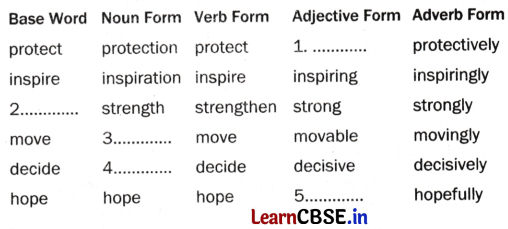
Answer:
1. protective
2. strong
3. move
4. decision
5. hopeful
C. After reading this chapter, you feel inspired by Dr. Arunima Sinha. Write an application to the Principal requesting to invite Arunima Sinha for a motivational session.
Answer:
To
The Principal
Sunrise Academy
New Delhi
26th April, 20XX
Subject Request to Invite Dr. Arunima Sinha for a
Motivational Talk
Respected Madam/Sir,
I am a student of Class 7, [Your Section].
I would like to request you to kindly invite Dr. Arunima
Sinha to our school for a motivational session.
Dr. Arunima Sinha’s journey of courage and strength is truly inspiring for young students like us. Listening to her story in person would encourage us to work hard, stay determined and never give up on our dreams. It would be a great honour for all the students to learn from her experiences.
I hope you will consider my request and make the necessary arrangements to invite her to our school.
Thank you.
Yours sincerely, XYZ
Class 7
Conquering the Summit Extra Questions for Practice
Multiple Choice Questions
1. How old was Arunima Sinha when she met with a train accident?
(a) 21
(b) 23
(c) 24
(d) 25
2. When was Arunima awarded Padma Shri?
(a) in 2011
(b) in 2013
(c) in 2015
(d) in 2019
3. Whose teachings inspired Arunima during her journey to the summit of Mount Everest?
(a) Bachendri Pal
(b) Her Coach
(c) Swami Dayanand
(d) Swami Vivekananda
4. The antonym of endurance is:
(a) frailty
(b) persistence
(c) perseverance
(d) tenacity
5. The phrase ‘Everest within you’ most likely refers to
(a) the imaginary dream Arunima had
(b) the obstacles she faced internally
(c) her physical strength
(d) the real mountain she climbed
6. The image of Swami Vivekananda at the summit symbolises
(a) national pride
(b) religious devotion
(c) guidance and inner inspiration
(d) celebration of Indian heroes
7. Arunima’s journey challenges the notion that
(a) sports are not for women
(b) physical disability limits one’s dreams
(c) mountaineering is a dangerous sport
(d) recovery is only physical
8. Arunima chose to approach Bachendri Pal mainly because she
(a) was a sports celebrity
(b) had resources for funding
(c) had experienced Everest herself
(d) was a mountaineering institute head
9. The use of the word ‘conferred’ in the chapter conveys that Arunima was
(a) gifted a title without merit
(b) officially recognised and honoured
(c) secretly awarded for her courage
(d) congratulated by her family
Fill in the Blanks
1. Throughout her journey Arunima has faced ………… numerous challenges and setbacks.
2. Highest mountain of Europe is …………
3. Arunima Sinha was a ………… headed lady.
4. Bachendri Pal ………… confidence in Arunima Sinha.
5. Arunima Sinha was awarded the …………. for her outstanding achievements in adventure sports.
6. The prosthetic leg Arunima used was a symbol of both limitation and …………. .
7. Arunima’s inspiration to climb Everest came from …………. .
8. Arunima completed her mountaineering training at the …………. Institute of Mountaineering.
9. She left behind a photograph of …………. at the summit.
State Whether True or False
1. Arunima climbed the seventh peak on Antarctica and became world’s first female amputee to climb Mount Vinson.
2. To scale Mount Everest was Arunima Sinha’s childhood dream.
3. Arunima’s parents wanted her to choose mountaineering her career.
4. Arunima and her family had a natural inclination towards athletics.
5. Arunima completed her climb in under two weeks.
6. Arunima waved the Indian flag at the summit.
7. Arunima’s story is only about physical strength.
8. Bachendri Pal discouraged Arunima from climbing Everest.
9. She was the first female amputee in the world to climb Mount Vinson.
Assertion and Reason Question
Two statements are given-Assertion (A) and Reason (R). Read them carefully and choose the correct option.
1. Assertion (A): Arunima was awarded Padma Shri in 2015.
Reason ( R ): She received the award for her exemplary bravery.
Codes:
(a) Both (A) and (R) are true, and (R) is the correct explanation of (A).
(b) Both (A) and (R) are true, but (R) is not the correct explanation of (A).
(c) (A) is true, but (R) is false.
(d) (A) is false, but ( R ) is true.
Extract-Based Questions
Read the extracts given below and answer the questions that follow.
A. “Standing at the top of the world, she felt a surge of emotions-pride, relief, and an overwhelming sense of achievement.”
1. Complete the sentence.
Arunima’s feelings at the summit reflected ………. .
2. State whether the following sentence is True or False.
The phrase ‘surge of emotions’ refers only to joy.
3. What word in the extract means ‘strong wave or rush’?
4. Which of the following best describes her state of mind?
(a) Confused
(b) Exhausted and indifferent
(c) Emotional and accomplished
(d) Nervous and regretful
B. “Failure is not when we fall short of achieving our goals. It is when we don’t have goals worthy enough.”
1. Complete the sentence.
According to Arunima, true failure occurs when …………. .
2. State whether the following sentence is True or False.
This quote suggests that effort is more important than result.
3. What value does this statement reflect?
4. Choose the correct interpretation of this quote.
(a) Goals are always easy to reach
(b) Failure is unavoidable
(c) Dreaming big is more important than succeeding easily
(d) Avoid challenges to escape failure
Very Short Answer Type Questions
1. Why was Arunima’s leg amputated?
2. Why did Arunima want to join the paramilitary forces even though she had a degree in law?
3. Who guided Arunima in achieving her dream?
4. Where is Arunima Sinha from?
5. What sport did Arunima play before her accident?
6. What happened to Arunima on the night of 11th April, 2011?
7. What kind of leg did Arunima get after her accident?
8. Which mountaineer mentored Arunima?
Short Answer Type Questions
1. Why did Arunima choose to climb Mount Everest instead of pursuing her passion for sports?
2. What were the worst and best days of Arunima’s life?
3. Why did Arunima carry a photo of Swami Vivekananda?
4. What message does Arunima give about failure?
5. How is Arunima’s story a source of motivation for others?
6. What awards did Arunima receive for her achievements?
7. How does Arunima represent the power of the human spirit?
Long Answer Type Questions
1. What would Arunima have done after her accident if she had not read the article on Mount Everest?
2. What qualities did Arunima possess that enabled her to climb the highest peak in the world despite being handicapped?
3. How did Arunima’s journey influence perceptions about disability in society?
4. In what ways is Arunima’s journey an example of women empowerment?
5. Why is Arunima’s autobiography titled ‘Born Again on the Mountain’?
6. How does Arunima’s example guide young readers in goal setting and perseverance?
7. Compare Arunima’s definition of failure with society’s usual understanding.
Competency Based Question
1. What makes Arunima different from other physically challenged individuals who could not achieve what she did and set such an example?