These Class 7 Poorvi Worksheet and Class 7 English Chapter 4 Animals Birds and Dr Dolittle Worksheet with Answers Pdf are perfect for home study.
Class 7 English Chapter 4 Animals Birds and Dr Dolittle Worksheet with Answers
Class 7 English Animals Birds and Dr Dolittle Worksheet
Class 7 English Chapter 4 Worksheet – Class 7 Animals Birds and Dr Dolittle Worksheet
Multiple Choice Questions
Question 1.
What prompted Polynesia to insist that Dr. Dolittle should focus exclusively on treating animals, rather than humans?
(a) Her personal dislike for humans and their noises
(b) Dolittle’s natural talents and empathy were better suited to animal care than human interaction
(c) She believed animals were plagued by more diseases than humans
(d) She wished to be his assistant on a full-time basis
Answer:
(b) Dolittle’s natural talents and empathy were better suited to animal care than human interaction
Question 2.
After donning his green spectacles, what did the plough horse express?
(a) He swore he would never need another doctor again
(b) He began advising fellow horses to disregard human doctors
(c) He acknowledged Dolittle’s wisdom, asserting animals, too, deserve intelligent healthcare
(d) He pranced around the field, thanking the parrot for his newfound vision
Answer:
(c) He acknowledged Dolittle’s wisdom, asserting animals, too, deserve intelligent healthcare
Question 3.
The Cat’s-food-Man’s proposal became particularly significant to Dr. Dolittle
(a) he offered to provide free food for Dolittle’s parrot
(b) despite being illiterate, he admired Dolittle’s book on cats
(c) he pledged to refer more animal patients to Dolittle’s practice
(d) he suggested writing a collaborative book on parrots with Dolittle
Answer:
(b) Despite being illiterate, he admired Dolittle’s book on cats.
Question 4.
Dr. Dolittle’s growing success as an animal doctor was evidenced by
(a) the improved health and longer lifespans of the animals under his care
(b) his opening of a new, larger hospital for exotic pets
(c) the increasing arrival of animals from far-flung regions due to word-of-mouth
(d) the conversion of his house into a royal zoo
Answer:
(c) the increasing arrival of animals from far-flung regions due to word-of-mouth
Question 5.
Why were special doors and tunnels constructed at Dr. Dolittle’s house?
(a) To prevent the mixing of animal and human patients
(b) To facilitate organised and efficient treatment based on species-specific needs
(c) To create entertaining mazes for the animals to enjoy
(d) Because Dolittle was conducting a study on animal traffic patterns
Answer:
(b) To facilitate organised and efficient treatment based on species-specific needs

Question 6.
The realisation that dogs use their noses to ask questions came about when
(a) Dolittle stumbled upon a research paper by Polynesia.
(b) he observed their behaviour and how they interacted with other animals.
(c) Polynesia interpreted their nose gestures as forms of communication.
(d) he overheard a dog speak in fluent English.
Answer:
(c) Polynesia interpreted their nose gestures as forms of communication
Question 7.
Unlike other clinics, Dolittle’s practice stood out because
(a) He used the internet to diagnose animal illnesses
(b) He combined food and medicine as part of his treatment for animals
(c) His unique ability to communicate directly with animals allowed him to understand their needs perfectly
(d) He had the latest diagnostic equipment, including high-tech X-ray machines
Answer:
(c) his unique ability to communicate directly with animals allowed him to understand their needs perfectly.
Fill in the blanks
(i) The _________ was the first to suggest that Dolittle should focus on treating animals, not humans. (Cat’s-food-Man / farmer / parrot)
Answer:
Cat’s-food-Man
(ii) The parrot, _________, could speak and understand multiple animal languages. (Polynesia / Theodosia / Olivia)
Answer:
Polynesia
(iii) The plough horse said he needed _________ not medicines, because he was going blind, (a new doctor / sunlight / spectacles)
Answer:
spectacles
(iv) Dolittle’s house was later divided into doors marked ‘horses’, ‘cows’, and even a tunnel for _________. (mice / cats / bats)
Answer:
mice
(v) According to the story, animals preferred Dolittle because he could _________ their actual problems, (examine / predict / understand)
Answer:
understand
(vi) The doctor stopped treating people and dedicated himself to animals after learning their _________, (diseases / behaviour / language)
Answer:
language
(vii) The farm animals wearing spectacles became a _________ sight in Puddleby. (new / seasonal / common)
Answer:
common
State True or False
(i) Polynesia only began speaking the animal language once Dolittle could understand it.
Answer:
True
(ii) The Cat’s-food-Man could not read but still admired Dolittle’s book.
Answer:
True
(iii) Dolittle wrote his first book on dog behaviour which impressed his neighbours.
Answer:
False
(iv) The plough horse thought human doctors were smarter because they didn’t listen to animals.
Answer:
False
(v) After the spectacle treatment, all horses stopped coming to Dolittle.
Answer:
False
(vi) Animals from other countries got to know about Dolittle through migrating birds.
Answer:
True
(vii) Dolittle’s clinic was well-known only in Puddleby and nowhere else.
Answer:
False
Answer the following Questions
(i) Why did Polynesia wait before speaking in bird language to Dr. Dolittle?
Answer:
Polynesia knew that Dolittle wouldn’t understand her earlier, so she didn’t use bird language until he learned it.
(ii) How did the plough horse prove that animal doctors needed more intelligence than human doctors?
Answer:
The plough horse, after being treated with green spectacles, remarked that animal doctors need to be twice as clever as human doctors because animals cannot talk.
This meant that diagnosing and treating animals requires more intelligence, as doctors must understand their problems without spoken language-relying instead on observation, empathy and deeper insight.
(iii) How did the construction of special doors in Dolittle’s house help him?
Answer:
The construction of special doors in Dr. Dolittle’s house helped him manage his animal patients more efficiently. These doors and tunnels were designed for different kinds of animals, allowing them to enter and exit easily without confusion or crowding.
(iv) What made Dolittle an extraordinary animal doctor?
Answer:
Dr. Dolittle was an extraordinary animal doctor because he could understand and speak the languages of animals, thanks to his parrot Polynesia. Unlike regular doctors, he didn’t have to guess what was wrong-animals could tell him directly.
He also treated them with kindness, patience and respect, creating a clinic specially designed for their comfort.
(v) How did Dolittle’s fame spread beyond his locality?
Answer:
Dolittle’s fame spread beyond his locality through word of mouth among animals. After he successfully treated many creatures, they began telling others about him. Animals from far-off places started coming to his clinic, sharing stories of his kindness and skill.
Extract Based Questions
I. “Then the Cat’s-food-Man came Oto see him. He was a big red-faced man, very proud of the animals he sold. ‘Doctor’, he said, ‘I have read your book on cats. It’s a wonderful book. If you are going to stick to animals, why don’t you become an animal doctor?'”
(i) What does the word ‘proud’ in the extract mean in the given context?
Answer:
Here, ‘proud’ means feeling pleased or satisfied with what one has or does-in this case, the man feels proud of the animals he sells.
(ii) The Cat’s-food-man encouraged Dr. Dolittle to become an animal doctor because he _________
Answer:
admired his book on cats and believed he understood animals well.
(iii) Why did the Cat’s-food-Man suggest a new career path to Dr. Dolittle?
(a) Because Dolittle was not a good human doctor
(b) Because he admired Dolittle’s writing on cats and trusted his knowledge
(c) Because he wanted to sell more animals
(d) Because he disliked human doctors
Answer:
(b) Because he admired Dolittle’s writing on cats and trusted his knowledge
(iv) What does this extract reveal about how Dolittle’s reputation began to grow?
Answer:
It reveals that Dolittle’s deep understanding of animals, reflected in his book on cats, was noticed by others, leading them to recognise his potential as an animal doctor.
II. “As soon as they found that he could talk their language, they told him where the pain was and how they felt. And he cured the lame horses, the sick dogs, and the worried cows. And they all got well.”
(i) What does the word ‘cured’ mean in this context?
Answer:
‘Cured’ means to heal or make someone well again; here, it refers to Dolittle successfully treating the animals.
(ii) What made Dr. Dolittle different from other vets in this extract?
(a) He used better medicines
(b) He charged less
(c) He could speak the animals’ language and understand their problems directly
(d) He read animal books
Answer:
(c) He could speak the animals’ language and understand their problems directly
(iii) How did the animals react when they realised Dr. Dolittle could talk to them?
Answer:
They told him where they were hurt and how they felt, showing trust and hope that he could help them.
(iv) What kinds of animals did Dr. Dolittle help in this extract?
Answer:
He helped lame horses, sick dogs and worried cows.
Working with Language!
Match the characters in column A to their specifications in column B.
| Column A | Column B |
| (i) Dr. Dolittle | (a) became full of animal patients |
| (ii) Polynesia | (b) suggested Dolittle become animal doctor |
| (iii) The Cat’s-food-Man | (c) stopped visiting once he chose animals |
| (iv) Lame horses and sick dogs | (d) helped Dolittle learn animal speech |
| (v) People of Puddleby | (e) were treated by Dolittle successfully |
| (vi) Dolittle’s garden | (f) spoke the language of animals |
Answer:
| Column A | Column B |
| (i) Dr. Dolittle | (f) spoke the language of animals |
| (ii) Polynesia | (d) helped Dolittle learn animal speech |
| (iii) The Cat’s-food-Man | (b) suggested Dolittle become animal doctor |
| (iv) Lame horses and sick dogs | (e) were treated by Dolittle successfully |
| (v) People of Puddleby | (c) stopped visiting once he chose animals |
| (vi) Dolittle’s garden | (a) became full of animal patients |
Use the words given in the box correctly to complete the paragraph.
| mice, animals, spectacles, green, visit, horse, bird, language, Polynesia, badgers, people |
Dr. Dolittle was once a doctor for (i) _________, but soon turned to treating (ii) _________. With the help of (iii) _________, a parrot, he learned (iv) _________. Animals began to (v) _________ him from near and far. One day, a plough (vi) _________ came and asked for (vii) _________ glasses. The doctor provided green (viii) _________ Eventually, animals like (ix) _________ and (x) _________ also arrived at his clinic.
Answer:
(i) people
(ii) animals
(iii) Polynesia
(iv) bird language
(v) visit
(vi) horse
(vii) green
(viii) spectacles
(ix) badgers
(x) mice
Rearrange the following sentences to form a meaningful paragraph.
(i) Doctor Dolittle became very popular as an animal doctor because he could understand the language of animals and treat them correctly.
(ii) The Cat’s-food-Man advised Doctor Dolittle to stop treating people and start treating animals instead.
(iii) With Polynesia’s help, Doctor Dolittle began learning how animals speak, using gestures and sounds.
(iv) Animals from far and wide came to his house, and he even had separate doors made for each type of animal.
(v) One day, a horse complained that a vet had been giving him pills when all he really needed was a pair of green spectacles.
(vi) At first, Doctor Dolittle was unsure about the idea, but Polynesia strongly encouraged him to make the change.
Answer:
(ii) → (vi) → (iii) → (i) → (v) → (iv)
Let us Learn!
From the box below, sort the words into the correct types of compound words.
(One has been done for you)
| birdcage, doctor-fish, jungle gym, moonlight, self-care, animal lover, doghouse |
| Hyphenated Words | Open Compound Words | Closed Compound Words |
| self-care | birdcage | |
Answer:
| Hyphenated Words | Open Compound Words | Closed Compound Words |
| self-care | jungle gym | birdcage |
| doctor-fish | animal lover | moonlight |
| doghouse |
Match the compound words in column A with their meanings in column B.
| Column A | Column B |
| (i) Birdsong | (a) A type of care one gives to oneself |
| (ii) Treehouse | (b) A cage where birds are kept |
| (iii) Self-care | (c) A house built on the branches of a tree |
| (iv) Birdcage | (d) The pleasant sound birds make in nature |
| (v) Animal-lover | (e) A person who cares deeply for animals |
Answer:
| Column A | Column B |
| (i) Birdsong | (d) The pleasant sound birds make in nature |
| (ii) Treehouse | (c) A house built on the branches of a tree |
| (iii) Self-care | (a) A type of care one gives to oneself |
| (iv) Birdcage | (b) A cage where birds are kept |
| (v) Animal-lover | (e) A person who cares deeply for animals |
Let’s Recall
A palindrome is a word, phrase or sentence that reads the same backward as forward, ignoring spaces, punctuation and capitalisation.
Examples
- Madam
- A man, a plan, a canal, Panama
Look at the following sentences. Write ‘Yes’ if the sentence is a palindrome and ‘No’ if it is not.
(i) A nut for a jar of tuna. _________
(ii) The dog barked at the mailman. _________
(iii) Eva, can I see bees in a cave? _________
(iv) Step on no pets. _________
(v) Was it a car or a cat I saw? _________
Answer:
(i) Yes
(ii) No
(iii) Yes
(iv) Yes
(v) Yes
Rewrite the sentences in the tense mentioned in brackets.
(i) Dr. Dolittle treated animals yesterday. (Change to Simple Present Tense)
(ii) The birds will be chirping in the morning. (Change to Present Continuous Tense)
(iii) He rescued a sick fox last week. (Change to Present Perfect Tense)
(iv) They are building a treehouse. (Change to Simple Present Tense)
(v) The dog has barked at strangers before. (Change to Present Continuous Tense)
Answer:
(i) Dr. Dolittle treats animals.
(ii) The birds are chirping in the morning.
(iii) He has rescued a sick fox.
(iv) They build a treehouse.
(v) The dog is barking at strangers.
Let us Write!
Question 1.
Imagine you’re an animal who just visited Dr. Dolittle. Write a diary entry describing your visit.
______________________________________________________________________
______________________________________________________________________
______________________________________________________________________
______________________________________________________________________
______________________________________________________________________
Question 2.
You are the head of the ‘Animal Care Club’ in your school. Inspired by Dr. Dolittle’s compassion towards animals, your club is organising a ‘Pet Care Awareness Camp’ for students. Write a notice informing students about the event. Include details such as the date, time, venue, purpose of the camp, and what students need to bring if they wish to participate. Write the notice in about 50 words, using proper format.
______________________________________________________________________
______________________________________________________________________
______________________________________________________________________
______________________________________________________________________
______________________________________________________________________
Let us Explore!
Question 1.
Visit or research about a real animal shelter. Compare it with Dr. Dolittle’s clinic.
______________________________________________________________________
______________________________________________________________________
______________________________________________________________________
______________________________________________________________________
______________________________________________________________________
Question 2.
What are some kind and safe ways we can help stray or abandoned animals in our neighbourhood?
______________________________________________________________________
______________________________________________________________________
______________________________________________________________________
______________________________________________________________________
______________________________________________________________________
Animals Birds and Dr Dolittle Class 7 Worksheet
Let us Discuss
I. Answer as per the instructions.
1. The cat’s food-Man had visited Dr Dolittle because ____________
(a) he had pain in his stomach.
(b) he wanted to see Dr Dolittle.
(c) his friend was in pain.
(d) his pet was sick.
2. Fill in the blanks by choosing the suitable option given in the brackets.
The parrot wanted to suggest Doctor Dolitttle that being a human being he has got ____________ (sense/memory) and he should become an animal doctor and be the ____________ (best/strict) doctor in the world.
3. State whether the following sentence is true or false.
When the dog asks a question, he twitches up one side of his nose, as the parrot teaches Doctor Dolittle.
4. Do you think the parrot taught Doctor Dolittle the language of animals? If yes, how?
________________________________________________________________
5. Why did the plough horse think that anyone can treat animals?
(a) they recover fast.
(b) they undergo easy treatment.
(c) they make no complaints.
(d) anyone can become an animal doctor.
II. Do you think Doctor Dolittle had become famous as a real doctor among animals?
________________________________________________________________
III. Arrange the following events in correct order according to the story. First and last have been done for you.
| 1. Polynesia clarified Dolittle that a parrot can talk in people’s language and bird language. | |
| 2. As the time rolled by, Dolittle was able to learn the language of animals, talk to them and understand whatever they said. | |
| 3. Polynesia sitting in the window, was watching the rain and singing. She at once stopped signing and started listening. | 1 |
| 4. The doctor first learnt the bird’s A, B, C, and then, the language of animals. | |
| 5. The plough horse got green spectacles from the doctor and soon it became a fashion to wear spectacles by the farm animals in the countryside. | 10 |
| 6. In Polynesia’s view Dolittle should apply his brain and try to become the best animal doctor, as he knew the way the animals think. | |
| 7. The cat’s-food-Man spread the news that Dolittle was becoming an animal doctor. | |
| 8. The animals don’t always speak with their mouths. They use their ears, feet tails or everything to speak. | |
| 9. The Cat’s-food-man was open to suggest Doctor Dolittle to become an animal doctor, as his knowledge was better than a vet. | |
| 10. The plough horse needed spectacles, otherwise he would become blind in one eye. | |
| 1. Polynesia clarified Dolittle that a parrot can talk in people’s language and bird language. |
Think beyond
I. Read the extracts given below and answer the questions that follow.
1. When the Cat’s-food-Man had gone, the parrot flew off the window on to the Doctor’s table and said,” That man’s got sense. That’s what you ought to do. Be an animal doctor. Give the silly people up—if they haven’t brains enough to see you’re the best doctor in the world. Take care of animals instead-they’ll soon find it out. Be an animal doctor.” “Oh, there are plenty of animal doctors,” said John Dolittle putting the flowerpots outside on the windowsill to get the rain.
” Yes, there are plenty,” said Polynesia.” But none of them are any good at all. Now listen, Doctor, and I’ II tell you something. Did you know that animals can talk?”
(i) Complete the sentence by choosing the correct option.
In the line, “Yes, there are plenty,” said Polynesia. Here Polynesia means that ____________
(a) there are many doctors.
(b) there are many animal doctors,
(c) Doctor Dolittle is correct.
(d) everything will become right.
(ii) Why did Doctor Dolittle not try to become an animal doctor earlier?
________________________________________________________________
(iii) Identify whether the following statement is true or false.
Polynesia was sure that Doctor Dolittle would become the best animal doctor in the world.
(iv) What do you think Doctor Dolittle would have felt after hearing Polynesia that animals can talk?
(a) Surprised
(b) Angry
(c) Happy
(d) Envious
2. And so it was with all the other animals that were brought to him. As soon as they found that he could talk their language, they told him where the pain was and how they felt, and of course it was easy for him to cure them.
Now, all these animals went back and told their brothers and friends that there was a doctor in the little house with the big garden, who really was a doctor. And whenever any creature got sick—not only horses and cows and dogs-but all the little things of the fields, like harvest mice, badgers, and bats, all came at once to his house on the edge of the town, so that his big garden was nearly always crowded with animals trying to get in to see him.
(i) Choose a word from the extract to complete the analogy.
Back beating: hurt:: ____________ : felt
(ii) Choose the correct word to complete the sentence.
The animals’ attitude as revealed in the extract is
(a) misunderstanding
(b) surprising
(c) respectful
(d) jealous
(iii) Complete the sentence with an appropriate reason.
All the animals assembled in the big garden of Doctor Dolittle to see him because ____________
(iv) Do you agree with the concluding sentence of the extract? Why/why not?
________________________________________________________________
II. Answer the following questions.
1. Why do you think the Cat’s-food-Man addressed his wife as a scholar in the extract?
________________________________________________________________
2. Do you think Polynesia, the parrot, had the right attitude in suggesting Doctor Dolittle to become an animal doctor? If yes, then how?
________________________________________________________________
3. Did the Doctor have correct learning attitude? How does this quality help the new learners? Give evidence from the text.
________________________________________________________________
4. How did the neighbours show their respect to Doctor Dolittle when they heard about him?
________________________________________________________________
5. Do you think human beings could possibly learn the language of birds and animals? If possible, what difficulties they might face?
________________________________________________________________
Let us learn
Compound words are formed by combining two words of different parts of speech to create a new word that has an entirely new meaning. They are of three types-hyphenated (Cat’s-food-Man), open compound words (bird language) and closed compound words (flowerpots).
I. Complete the following table correctly by choosing words from the box given below. One has been done for you.
| Stomach-ache, animal doctor, sailor-song, classroom, football, one-footed, Fast-acting, flowerpots, bird, language, understood, side door, well-known |
| Hyphenated Words | Open Compound Words | Closed Compound Words |
| Stomach-ache |
II. Create compound words from the table given below.
| A | B |
| 1. living | (i) chair |
| 2. high | (ii) dried |
| 3. ice | (iii) room |
| 4. back | (iv) handed |
| 5. arm | (v) cream |
| 6. sun | (vi) space |
| 7. left | (vii) school |
III. Now, complete the sentences with suitable compound words from the table. One has been done for you.
1. When I visited Ravi’s residence, I found his living room neat and clean.
2. The students who have attended ____________ in the rural areas have greater degree of concentration.
3. While walking through the garden near our house, we arrived at an ____________ parlour and purchased two milk bars.
4. Mr. Sharma has sufficient ____________ in his kitchen garden, where he has decided to grow some grapevines.
5. After retirement, my father used to sit on an ____________ and read newspapers.
6. Earlier the village women used to cook food while using ____________ cow dungs as fuel.
7: Gaurav eats ____________ but does everything else with his right hand.
IV. Read the sentences given below and the clues in brackets. Guess the animals.
1. I have crazy hibernation periods. I can snooze for periods of up to three years, a survival instinct for when I feel the need to self-preserve. (Reptile) ____________
2. I have the insane ability to swivel my head in almost a full circle, due to my flexibility and the head being connected to one socket pivot. (Bird) ____________
3. I produce intense vasoconstriction. If you’re stung by one, it can cause shock, paralysis, malaise, nausea and vomiting, sweating, delirium, pyrexia, cardiogenic shock, respiratory distress, and even death if it’s not treated within a few hours by anti-venom. (Animal) ____________
4. I can jump over 27 feet in one bound. I can accomplish this due to my small front legs and a long, strong tail that helps keep me balanced while jumping. (Animal) ____________
5. I may be small, but I cause millions of deaths every year around the world, according to the World Health Organization. This is because I carry and transmit a number of viruses and diseases, from malaria to dengue to yellow fever. (Insect) ____________
Palindrome
A word, phrase, or sentence that reads the same backwards as forwards is a palindrome.
V. Read the sentences below and identify the palindrome words and sentences.
1. Some students have defied the established rules of school.
2. The engineers installed rotator to check the wind.
3. The captain produced several deed in his favour.
4. Don’t try to peep into his room.
5. Wow! The dress is very nice.
6. He came at noon.
7. A new civic centre is built in our town.
8. The radar controls the direction of aeroplanes.
9. All three teams are level on points.
10. Our principal is a madam.
VI. Underline the verbs and identify the tense form in the following sentences from the text.
1. You know all about animals ____________
2. See, he’s talking to you ____________
3. Animals don’t always speak with their mouths ____________
4. I’m ploughing the field ____________
5. It takes a much cleverer man to be a really good animal doctor. ____________
VII. Fill in the blanks using the (present perfect) form of verbs given within brackets.
Doctor Dolittle (i) ____________ (learn) how to communicate with birds and animals from the parrot, Polynesia. She (ii) ____________ (teach) him everything about the bird and animal language. Being a good listener, the doctor (iii) ____________ (always request) the parrot to speak slowly, so that he could note down whatever she teaches him. Gradually, the doctor (iv) ____________ (develop) ability to understand and communicate with animals. Now, he (v) ____________ (make) his little house an animal hospital where countless animals frequently visit with their problems. The doctor (vi) ____________ (treat) hundreds of sick animals, (vii) ____________ (make) them well and (viii) ____________ (win) their trust. His popularity among the animals is growing everyday.
Now, the doctor lives happily in the company of birds and animals.
Let us Listen
I. Request your friend/sister/brother/ to read out an announcement given at the end of this workbook. As you listen, state whether the following statement is true or false.
(Transcript Page 121)
The ploughing horse is very excited to see Doctor Dolittle, as he is a real doctor in his view.
II. Request him/her to read out the announcement again. As you listen, complete the details given below, with one or two exact words you hear.
1. Doctor Dolittle has turned his little house into a ____________
2. The big garden will serve the animals as ____________
3. The ploughing horse has special reason to visit the doctor, as he is going to become ____________
4. The ____________ for the ploughing horse that the doctor has made, is liked by all the animals.
5. The doctor gives preference to the ____________ of animals instead of his fees.
6. Doctor Dolittle is a real animal doctor because he can ____________ with animals in their own language.
7. The horse wearing spectacles has become a common ____________ in the countryside.
8. Doctor Dolittle is not a professional doctor because his fees are ____________
Let us write
I. A cultural festival is being organised in your school. Write a Notice to inform the students about the event. Complete the draft of the notice by using the words and phrases given in the box below.
| Cultural events, Wednesday and Thursday, school pass, inform, entry, 9:00 am to 1:00 pm, school premises |
Let us explore
I. Goshala is a place where stray cows are looked after with proper care. You can also buy milk from the goshala. Plan a visit with your parents to some goshala and find out how the cows live there. If you find any fault with the system, you may make a complaint to the manager of the goshala also.
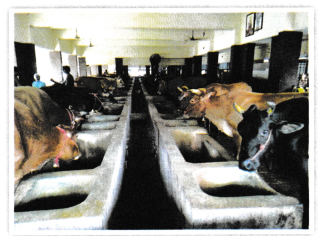
II. Do you think the best way to take care of stray animals is to provide them with food and water, take them to some animal shelter or adopt them? Take help from your parents or friends and express your view before the class.