Students often review Class 7 Maths MCQ and Class 7 Maths Chapter 7 A Tale of Three Intersecting Lines MCQ Questions Online Test with Answers for quick revisions before tests.
MCQ on A Tale of Three Intersecting Lines Class 7
A Tale of Three Intersecting Lines MCQ Class 7
Class 7 Maths MCQ Chapter 7 A Tale of Three Intersecting Lines
Question 1.
A triangle is not possible if the measures of the angles are
(a) 40°, 65°, 75°
(b) 56°, 50°, 74°
(c) 72°, 63°, 45°
(d) 67°, 42°, 81°
Answer:
(d) 67°, 42°, 81°
Question 2.
Which of the following represents the altitude of the triangle ABC?
(a) AM
(b) AL
(c) AP
(d) AN
Answer:
(b) AL
Question 3.
The value of the unknown exterior angle x in the given triangle is :
(a) 70°
(b) 110°
(c) 40°
(d) 90°
Answer:
(a) 70°
Question 4.
If a, b and c are the three sides of a triangle, then
(a) a + b = c
(b) a + b < c
(c) a + b > c
(d) a – b > c
Answer:
(c) a + b > c

Question 5.
In a △ABC, AD is the perpendicular on BC. Then, altitude of a triangle is
(a) AD
(b) AB
(c) AC
(d) BC
Answer:
(a) AD
Question 6.
If the exterior angle of a triangle is 130°, then sum of two interior angles opposite to the exterior angle of a triangle is equal to
(a) 50°
(b) 60°
(c) 180°
(d) 130°
Answer:
(d) 130°
Question 7.
In the following figure, ∠A = 20° and ∠B = 20°, then ∠ACD is equal to

(a) 30°
(b) 40°
(c) 60°
(d) 80°
Answer:
(b) 40°
Question 8.
In a △ABC, if ∠A = 60° and ∠B = 30°, then the exterior angle formed by producing B C is equal to
(a) 180°
(b) 99°
(c) 90°
(d) 105°
Answer:
(c) 90°
Question 9.
The measures of ∠x and ∠y in the given figure are respectively

(a) 30°, 60°
(b) 40°, 40°
(c) 70°, 70°
(d) 70°, 60°
Answer:
(d) 70°, 60°
Question 10.
In the given figure, find the value of x.

(a) 75°
(b) 90°
(c) 120°
(d) 60°
Answer:
(c) 120°
Question 11.
Which of the following cannot be the length of the third side of a triangle, whose two sides measure 10 cm and 5 cm ?
(a) 12 cm
(b) 16 cm
(c) 14 cm
(d) 13 cm
Answer:
(b) 16 cm
Question 12.
The sum of the three angles of a triangle is equal to
(a) 60°
(b) 180°
(c) 90°
(d) 360°
Answer:
(b) 180°
Question 13.
The two angles of any triangle are 60° and 40°. Then, the value of third angle is
(a) 40°
(b) 60°
(c) 80°
(d) 50°
Answer:
(c) 80°
Question 14.
If the three sides of a triangle are equal, then the triangle is known as
(a) scalene
(b) isosceles
(c) equilateral
(d) acute angled
Answer:
(c) equilateral
Question 15.
The third angle of a △ whose two angles are 100° and 79° is :
(a) 1°
(b) 2°
(c) 10°
(d) 21°
Answer:
(a) 1°
Question 16.
Two sides of a △ are 5 cm and 7 cm. Third side of this ∆ must be greater than :
(a) 5 cm
(b) 2 cm
(c) 7 cm
(d) 12 cm
Answer:
(b) 2 cm
Question 17.
Two sides of ∆ are 4 cm and 2 cm. Third side must be smaller than :
(a) 4 cm
(b) 2 cm
(c) 6 cm
(d) 1 cm
Answer:
(c) 6 cm
Question 18.
An isosceles ABC has A=30° and ∠B =75°. ∠C =
(a) 30°
(b) 75°
(c) 105°
(d) 45°
Answer:
(b) 75°
Question 19.
Possible side lengths for an isosceles ∆ can be :
(a) 4 cm, 4 cm, 8 cm
(b) 6 cm, 6 cm, 13 cm
(c) 3 cm, 3 cm, 5 cm
(d) 1 cm, 1 cm, 2 cm
Answer:
(c) 3 cm, 3 cm, 5 cm
A Tale of Three Intersecting Lines Class 7 Assertion and Reason Questions
Question 1.
Assertion (A): If two internal opposite angles of a triangle are equal and the external angle is 110°, then each internal angle is 50°.
Reason (R): A triangle with one of its angles as 110° is called an obtuse-angled triangle.
In the given question, a statement of Assertion is followed by a statement of Reason. Choose the correct option as:
(a) Both assertion and reason are true and the reason is the correct explanation of assertion.
(b) Both assertion and reason are true but the reason is not the correct explanation of the assertion.
(c) Assertion is true and the reason is false.
(d) Assertion is false and the reason is true.
Answer:
(d) Assertion is false and the reason is true.
Question 2.
Assertion (A) ABC is an equilateral triangle such that AB = BC = CA and ∠A = ∠B = ∠C = 60°.
Reason (R) Equilateral triangle has all its sides equal and each angle measure 30°.
(a) Both Assertion and Reason are true and Reason is the correct explanation of Assertion.
(b) Both Assertion and Reason are true but Reason is not the correct explanation of Assertion.
(c) Assertion is true but Reason is false.
(d) Assertion is false but Reason is true.
Answer:
(c) Assertion is true but Reason is false.
Question 3.
Assertion (A) Two sides of a triangle are of lengths 5 cm and 1.5 cm . The length of the third side of the triangle cannot be 3.4.
Reason (R) The difference between the two sides of a triangle should be less than the third side.
(a) Both Assertion and Reason are true and Reason is the correct explanation of Assertion.
(b) Both Assertion and Reason are true but Reason is not the correct explanation of Assertion.
(c) Assertion is true but Reason is false.
(d) Assertion is false but Reason is true.
Answer:
(a) Both Assertion and Reason are true and Reason is the correct explanation of Assertion.
Question 4.
In the questions given below, there are two statements marked as Assertion (A) and Reason (R). Read the statements and choose the correct option.
(a) Both (A) and (R) are true and R is the correct explanation of (A).
(b) Both (A) and (R) true but (R) is not the correct explanation of (A).
(c) (A) is true but (R) is false.
(d) (A) is false but (R) is true.
1. Assertion (A): AB=6 cm, BC=8 cm and AC =14 cm can be the sides of a Δ.
Reason (R) : AB+AC>BC.
Answer:
(d) (A) is false but (R) is true.
2. Assertion (A) : A ΔABC with ∠A=70° and ∠B=120° can not be constructed.
Reason (R) : For a Δ ABC, ∠ A+∠ B+∠ C= 180°
Answer:
(a) Both (A) and (R) are true and R is the correct explanation of (A).
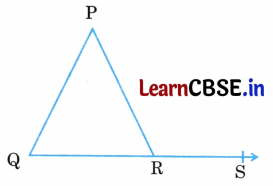
3. Assertion (A) : In the following figure ∠PRS is called an exterior angle.
Reason (R) : An exterior angle is formed if any side of a Δ is extended.
Answer:
(a) Both (A) and (R) are true and R is the correct explanation of (A).
A Tale of Three Intersecting Lines Class 7 Fill in the blanks
1. In the given figure,

(i) ∠B = ___
(ii) ∠C = ___
Answer:
(i) ∠B = 55°
(ii) ∠C = 55°
2. In the given figure,

(i) ∠PQR = ___
(ii) ∠PRS = ___
(iii) ∠PRQ = ___
Answer:
(i) ∠PQR = 80°
(ii) ∠PRS = 130°
(iii) ∠PRQ = 50°
3. The length of the third side of a triangle whose two sides are 5 cm and 6 cm must be less than (i) ___ and greater than (ii) ___
Answer:
(i) 11 cm
(ii) 1 cm
4. A triangle can have atmost _____ obtuse angle.
Answer:
One
5. Altitude is also called _____ of a triangle.
Answer:
height
6. A triangle with one angle equal to 90° is called a _____ triangle.
Answer:
height angled
7. In an isosceles triangle, _____ sides are equal.
Answer:
2
8. The sum of the interior angles of a triangle is always _____ degrees.
Answer:
180
A Tale of Three Intersecting Lines Class 7 True or False
1. An equilateral triangle can be a right triangle.
Answer:
False
2. The sum of the two sides of a triangle is greater than or equal to the third side.
Answer:
False
3. A triangle can have all three angles with measures less than 60°.
Answer:
False
4. The altitude of a triangle always lies outside the triangle.
Answer:
False
5. A triangle can have two obtuse and one acute angle.
Answer:
False
6. Sum of the measures of three angles of a triangle is greater than 180°.
Answer:
False
7. It is possible to have a triangle in which each angle is less than 60°.
Answer:
False
8. It is possible to have a right angled equilateral triangle.
Answer:
False
9. The difference between the length of any two sides of a triangle is smaller than the length of third side.
Answer:
True
10. In the following figure, the value of x is equal to 12 cm.

Answer:
False
A Tale of Three Intersecting Lines Class 7 Match the Following
Question 1.
Match the Column I to Column II.
| Column I | Column II |
| (i) Sum of all three angles in a triangle is | (a) 60° |
| (ii) Sum of interior opposite angles is equal to | (b) 90° |
| (iii) Equilateral triangle have each angle equals to | (c) exterior angle |
| (iv) In a right angled triangle, atleast one angle should be | (d) 180° |
Answer:
| Column I | Column II |
| (i) Sum of all three angles in a triangle is | (d) 180° |
| (ii) Sum of interior opposite angles is equal to | (c) exterior angle |
| (iii) Equilateral triangle have each angle equals to | (a) 60° |
| (iv) In a right angled triangle, atleast one angle should be | (b) 90° |
Question 2.
Match the Column I to Column II.
| Column I | Column II |
| (i) In a ∠ABC, ∠A = 120°, ∠B = 30°. The measure of ∠C is | (a) 35° |
| (ii) If an exterior angle of a triangle is 120°, then its adjacent interior angle is | (b) 65° |
| (iii) Sum of two angles of a triangle is 1 45°. The measure of third angle is | (c) 30° |
| (iv) In a right angled triangle, one of the acute angle is 25°. The measure of the other acute angle is | (d) 60° |
Answer:
| Column I | Column II |
| (i) In a ∠ABC, ∠A = 120°, ∠B = 30°. The measure of ∠C is | (c) 30° |
| (ii) If an exterior angle of a triangle is 120°, then its adjacent interior angle is | (d) 60° |
| (iii) Sum of two angles of a triangle is 1 45°. The measure of third angle is | (a) 35° |
| (iv) In a right angled triangle, one of the acute angle is 25°. The measure of the other acute angle is | (b) 65° |
Case Study Based Question
Question 1.
Ravi is making a photo frame in the shape of a triangle. He measures the angles and fiads them to be 60° each. He also finds that all the sides are of equal length.
(i) What type of triangle is Ravi’s photo frame?
Answer:
Since, all the angles of photo frame are equal i.e. 60° and each side is equal.
∴ Ravi’s photo frame is the type of equilateral triangle.
(ii) What is the sum of the interior angles of Ravi’s photo frame?
Answer:
Since, the angles of Ravi’s photo frame are 60°, 60° and 60°.
So, sum of all angles of Ravi’s photo frame
= 60° + 60° + 60° = 180°
(iii) Will the triangle remain the same type if all angles are 70° ? Why or why not?
Answer:
No, triangle is not possible when all angles are 70°.
So, 70° + 70° + 70° = 210° > 180°
Therefore, triangle is not possible.
Fun Activity
Question 1.
Complete the crossword puzzle using the given directions:

Directions:
Across
2. The Angle Sum Property states that the of all three angles of a triangle is 180°.
4. A triangle with two sides of equal length is called ___ triangle.
6. A perpendicular line from the vertex of a triangle to its opposite side is called ___.
7. Triangles that have sides of three different length.
Down
1. A triangle with all sides of equal length is called triangle.
3. A triangle that has all acute angles is called ___ angled triangle.
5. A triangle that has one right angle is angled triangle.
Answer:

Answer the following
Question 9.
Construct a triangle with side lengths 4 cm, 5 cm, and 7 cm.
Answer:
Do it Yourself.
Question 10.
For each of the following, give at least 5 possible values for the third length so there exists a triangle having these as sidelengths (decimal values could also be chosen):
(a) 2 and 8
(b) 7 and 12
Answer:
(a) 6.5, 7, 8, 9, 9.5
(b) 6, 10, 13.5, 15, 18,
Question 11.
Construct triangles for the following measurements:
(a) 45°, 5 cm, and 60°
(b) 30°, 5 cm, and 50°
Answer:
Do it yourself.