Students can find accurate Class 7 English Extra Questions and Class 7 English Chapter 5 A Funny Man Extra Questions and Answers for better understanding.
A Funny Man Extra Question Answer Class 7 English Chapter 5
A Funny Man Very Short Questions and Answers
Question 1.
What did the funny man wear on his feet?
Answer:
The funny man wore hats on his feet.
Question 2.
How did the funny man travel home?
Answer:
The funny man hopped on his head to travel home.

Question 3.
What object did the funny man pretend was a rose?
Answer:
The funny man pretended a currant bun as a rose.
Question 4.
Identify one poetic device used in the phrase “funny sounding sight”.
Answer:
Alliteration.
Question 5.
How did the man behave when he met the speaker?
Answer:
The man behaved politely and smiled at the speaker.
Question 6.
How did the speaker react to the offered bun?
Answer:
The speaker staggered back in surprise and made a witty comment.
Question 7.
What did the man do after singing a song?
Answer:
The man sat on the ground and sang in a funny voice.
Question 8.
Find out the literary device used in the phrase ‘funny looking smell’.
Answer:
The literary device used here is synaesthesia, which means the mixing of senses.
Question 9.
Why does the poet ‘stagger’ rather than step back?
Answer:
The poet ‘stagger’ rather than step back as it implies physical and emotional shock from absurdity.
Question 10.
Identify the man’s tone in the term ‘Your Highness’.
Answer:
The man’s tone is mock-formal, contrasting with the bun gesture.
A Funny Man Short Questions and Answers
Question 1.
Why did the poet stagger back when offered the “rose”?
Answer:
She was surprised by the currant bun being offered as a rose.
Question 2.
How does the poem show that the funny man had good manners?
Answer:
He smiled and used polite words like “Allow me to present.”
Question 3.
What effect does the AABB rhyme scheme create in the poem?
Answer:
It creates a musical, playful rhythm.
Question 4.
Explain the meaning of “hopped home on his head” in your own words.
Answer:
It means he jumped upside-down, using his head like a foot.
Question 5.
How does the poet create humour through the man’s appearance?
Answer:
The poet describes the man wearing a shoe on his head and hats on his feet, which is the opposite of what people usually do. This strange reversal creates a funny image that amuses readers.
Question 6.
Why did the speaker say, “I never saw a rose with such a funny looking smell”?
Answer:
The speaker made this remark after the man offered a currant bun as a rose. The unusual situation led to this witty and sarcastic comment.
Question 7.
What role does politeness play in the man’s behaviour?
Answer:
Despite his odd appearance and actions, the man behaves very politely. His respectful tone makes the situation even funnier because it contrasts with his silly actions.
Question 8.
How is imagination used in the poem?
Answer:
Imagination is used to show a character doing absurd things in a normal world. The poet blends polite manners with strange actions, making the poem feel like a silly dream.
Question 9.
What does the poet want readers to feel after reading the poem?
Answer:
The poet wants readers to enjoy the humour and strangeness of the funny man. The playful tone invites us to laugh and not take everything too seriously.
A Funny Man Long Questions and Answers
Question 1.
Analyse how the poet creates humour through the funny man’s illogical actions. Support your answer with three examples from the poem.
Answer:
The humour comes through absurd actions: wearing shoes on his head (illogical dressing), offering food as a flower (unexpected substitution), and hopping on his head (physical impossibility). These exaggerations create comedy.
Question 2.
Discuss the importance of repetition in the poem, focusing on how the word “funny” contributes to its overall tone and message.
Answer:
Repetition of “funny” emphasises the poem’s light-hearted tone and reinforces the theme of finding joy in nonsense.
Question 3.
Compare the funny man’s behaviour to modern-day clowns or comedians. What similarities do you zotice in their methods of creating laughter?
Answer:
Like clowns, the funny man uses visual gags (wrong clothing), props (bun as rose), and physical comedy (hopping) to entertain, showing humour transcends time.
Question 4.
Describe the appearance and behaviour of the funny man in the poem.
Answer:
The funny man wore a shoe on his head and hats on his feet, which made him look very strange. He behaved in a polite and respectful manner, even though his actions were very odd. He offered a currant bun to the speaker, calling it a rose and held it to the speaker’s nose.
He also sang a funny song and sat down on the ground. Instead of answering questions properly, he turned around and hopped home on his head.
His entire behaviour was unpredictable and silly, which made the poem entertaining. The contrast between his politeness and his strange actions added to the humour.
Question 5.
How does the poet create humour through actions and language in the poem?
Answer:
The poet creates humour by showing a man who does everything in a silly and unexpected way. Wearing shoes on the head and hats on the feet is already a funny image. When the man offers a bun as a rose, the speaker reacts with a clever line, saying it had a ‘funny looking smell.’ Even the man’s singing is described as a ‘funny feeling sound’, which adds to the laughter.
The language is simple but full of imagination and playfulness. These surprising actions and clever expressions make the poem both humorous and memorable.
Question 6.
What do you learn from the speaker’s response to the funny man?
Answer:
The speaker stays calm and polite throughout the poem, even though the man behaves in a strange way. This shows that the speaker does not make fun of him or treat him rudely. Instead, the speaker responds with curiosity, humour and light sarcasm.
This teaches us that it is possible to enjoy someone’s silliness without being disrespectful.
The speaker’s attitude helps readers laugh along with the poem rather than at someone. It also shows how one can respond to absurd situations with kindness and wit.
A Funny Man Competency Based Questions
Question 1.
Imagine you meet someone behaving like the funny man in your neighbourhood. How would you react, and what would this reveal about your personality?
Answer:
I would laugh and join the fun, showing I appreciate creativity. This reveals I value humour over strict rules and enjoy playful surprises in daily life.
Question 2.
Create a humorous 4-line verse in the style of the poem, using an absurd image (like “socks on hands” or “umbrellas underground”). Ensure it follows the AABB rhyme scheme.
Answer:
There once was a cat from Spain, Who used a cloud as a cane.
When the sun came out, It gave a loud shout, And danced in the pouring rain!
Question 3.
If the speaker had laughed or made fun of the man, how would the poem feel different?
Answer:
If the speaker had laughed at the man, the poem would feel unkind or mocking. The gentle humour comes from observing, not teasing. The poem stays light-hearted because the speaker responds with wonder, not meanness.
Question 4.
Think of a saying or proverb that matches the poem’s message. Explain it.
Answer:
The saying ‘Don’t judge a book by its cover’ fits this poem well. The man looks funny but has good manners. The poem shows that what is outside doesn’t always reflect what is inside.
Even though the man was being funny, he made sure he did not disrespect anyone while doing so. Hence, we should not judge people by their appearance just like the saying goes ‘Don’t judge a book by its cover’.
Question 5.
What does this poem suggest about how we should respond to things we don’t understand?
Answer:
The poem suggests we should respond with curiosity, patience and kindness when something confuses us. The speaker doesn’t make fun of the man, even when he behaves oddly. This respectful response helps keep the tone fun and friendly.
A Funny Man Extract Based Questions and Answers
Read the following extracts and answer the questions that follow:
I. One day a funny kind of man
Came walking down this street
He wore a shoe upon his head
And hats upon his feet. (Page 60)
Question 1.
The man wore shoes on his feet and a hat on his head. (True/False)
Answer:
False (The man wore hat on his feet and shoes on his head).
Question 2.
The funny man walked down the ______
Answer:
street
Question 3.
Where did the man wear his shoe?
Answer:
on his head
Question 4.
What was unusual about the man’s clothing?
(a) He wore no shoes
(b) He wore hats upon his feet
(c) He wore a crown
(d) He wore shoes without socks
Answer:
(b) He wore hats upon his feet
II. He raised the shoe and smiled at me,
His manners were polite;
But never had I seen before
Such a funny sounding sight. (Page 60)
Question 1.
The man was rude to the poet. (True/False)
Answer:
False (The man was polite in behaviour)
Question 2.
The man’s manners were ______
Answer:
polite
Question 3.
How did the man greet the poet?
Answer:
Smiled at her
Question 4.
Why was the sight “funny sounding”?
(a) The man was singing
(b) His appearance seemed to create sound-like amusement
(c) The poet heard laughter
(d) The man was singing in a typical tone
Answer:
(b) His appearance seemed to create sound-like amusement
III. He said, “Allow me to present
Your Highness with a rose.”
And taking out a currant bun
He feld it to my nose. (Page 60)
Question 1.
The man gave the poet a real rose. (True/False)
Answer:
False (The man gave a currant bun)
Question 2.
The man addressed the poet as “Your ______”
Answer:
Highness
Question 3.
What did the man actually offer?
Answer:
A currant bun
Question 4.
Why did the poet call him “funny”?
(a) He offered food instead of a flower
(b) He wore a red coat
(c) He danced
(d) He made funny faces
Answer:
(a) He offered food instead of a flower
IV. I staggered back against the wall
And then I answered, “Well!
I never saw a rose with such
A funny looking smell.“(Page 60)
Question 1.
The poet liked the smell of the currant bun. (True/False)
Answer:
False (The poet didn’t like the smell)
Question 2.
The poet _____ back against the wall.
Answer:
staggered
Question 3.
How did the poet react to the “rose”?
Answer:
Surprised
Question 4.
Why did the poet stagger?
(a) She was scared
(b) She was surprised by the man’s action
(c) She felt dizzy
(d) She was hungry
Answer:
(b) She was surprised by the man’s action
V. He then began to sing a song,
And sat down on the ground;
You never heard in all your life
Such a funny feeling sound. (Page 60)
Question 1.
The man stood while singing. (True/False)
Answer:
False (The man sat down on the ground)
Question 2.
The sound gave a _____ feeling.
Answer:
funny
Question 3.
Where did the man sit?
Answer:
On the ground
Question 4.
What made the song funny?
(a) Its loud volume
(b) Its unusual tone or effect
(c) It was in a foreign language
(d) Its style of writing
Answer:
(b) Its unusual tone or effect
VI “My friend, why do you wear two hats
Upon your feet?” I said.
He turned the other way about,
And hopped home on his head. (Page 60)
Question 1.
The man walked home normally. (True/False)
Answer:
False (The man hopped to his home on his head)
Question 2.
The man hopped home on his _____
Answer:
head
Question 3.
How many hats did the man wear on his feet?
Answer:
Two
Question 4.
What shows the man’s absurd behaviour?
(a) Wearing hats on feet
(b) Hopping on his head
(c) Both (a) and (b)
(d) None of the above
Answer:
(c) Both (a) and (b)
Grammar and Writing :
A. Match the verbs in Column A with the correct words from Column B to form phrasal verbs. Write the completed phrasal verbs in Column (c). Then, use them in sentences (Part B).
Part A: Match and Form Phrasal Verbs
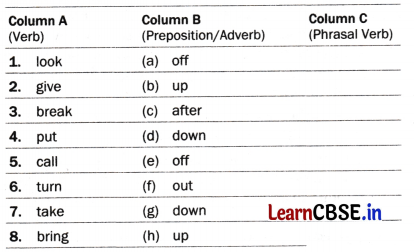
Answer:
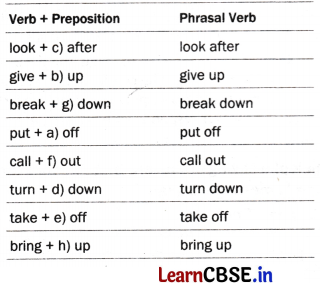
Part B: Use the Phrasal Verbs in Sentences (Fill in the blanks with the correct phrasal verb you formed above.)
1. Please ………. your little sister while I go shopping.
Answer: look after
2. He didn’t ………. even after failing twice.
Answer: give up
3. The old car ………. on the way to school.
Answer:
broke down ……….
4. We had to ………. the match due to heavy rain
Answer: put off
5. The teacher ………. the boy for misbehaving in class.
Answer: called out
6. The manager ………. her idea as it was too expensive.
Answer: turned down
7. The flight will ………. in ten minutes.
Answer: take off
8. Grandma helped to ………. the children with good values.
Answer: bring up
B. Writing a Limerick
A. Let us revise what is a limerick?
A limerick is a short, funny poem with five lines.
- Lines 1, 2, and 5 rhyme with each other.
- Lines 3 and 4 are shorter and rhyme with each other.
Rhyme Scheme: AABBA
B. Write your own limerick.
Use the box below to plan and then write your poem.
Line Number
Start Writing Your Line
1 There once was a ……….
2 ……….
3 ……….
4 ……….
5 ……….
Answer:
There once was a man from the hill, Who danced with a cat on the sill. They twirled through the night, What a funny sight! Till morning, they danced with great skill.
A Funny Man Extra Questions for Practice
Multiple Choice Questions
1. What body part did the funny man use to hop home?
(a) Hands
(b) Head
(c) Feet
(d) Knees
2. What did the funny man hold to the poet’s nose?
(a) A real rose
(b) A currant bun
(c) His hat
(d) His shoe
3. How many times does the word ‘funny’ appear in the poem?
(a) Two
(b) Three
(c) Four
(d) Five
4. Which phrase from the poem is an example of alliteration?
(a) “funny kind of man”
(b) “walking down this street”
(c) “funny sounding sight”
(d) “he held it to my nose”
5. The poet describes funny man’s manners were:
(a) funny
(b) mischievous
(c) polite
(d) rude
6. What emotion is most present when the man begins to sing?
(a) Fear
(b) Amusement
(c) Annoyance
(d) Disgust
7. What can we infer about the speaker’s tone throughout the poem?
(a) Jealous and rude
(b) Curious and confused
(c) Annoyed and serious
(d) Proud and angry
8. What does the speaker mean by “funny looking smell”?
(a) The rose looked funny
(b) The smell didn’t match the appearance
(c) The bun had no smell
(d) The rose was fake
9. What does the ending show when the man “hopped home on his head’?
(a) He was embarrassed
(b) He continued to act in a silly way
(c) He wanted attention
(d) He was angry at the speaker
Fill in the Blanks
1. The funny man wore a shoe upon his …………
2. The object offered as a rose was actually a …………
3. The funny presented the rose to the …………
4. The rose had a ………… looking smell.
5. The man didn’t reply to the question; he simply ………. away.
6. The speaker sarcastically said the bun had a ‘funny looking ……….’.
7. At the end, the man hopped home on his ………. .
State Whether True or False
1. The funny man wore shoes on both his hands and feet. …………
2. The poet immediately recognised the currant bun wasn’t a real rose. …………
3. The funny man spoke rudely to the poet. …………
4. The poem maintains a serious tone throughout. …………
5. The currant bun was presented as a gift, not food.
6. The man sat on the ground and began singing.
7. The speaker describes the song as beautiful and melodic.
8. The poem ends with the man explaining his actions.
Assertion and Reason Question
Two statements are given- Assertion (A) and Reason (R). Read them carefully and choose the correct option.
1. Assertion (A): The funny man’s behaviour is deliberately illogical.
Reason ( R ): He wants to challenge societal norms through humour.
Codes:
(a) Both (A) and (R) are true, and (R) is the correct explanation of (A).
(b) Both (A) and (R) are true, but (R) is not the correct explanation of (A).
(c) (A) is true, but (R) is false.
(d) (A) is false, but (R) is true.
Extract Based Questions
Read the extracts given below and answer the questions the follow.
A. I staggered back against the wall
And then I answered, “Well!
I never saw a rose with such
A funny looking smell.”
1. Complete the sentence.
The speaker’s reaction shows both ………. and ………. .
2. State whether the following sentence is True or False.
The speaker was scared of the funny man.
3. What does the line ‘funny looking smell’ mean?
4. What emotion does the speaker express most clearly?
(a) Fright
(b) Anger
(c) Disgust
(d) Surprise
B. “My friend, why do you wear two hats Upon your feet?” I said.
He turned the other way about, And hopped home on his head.
1. Complete the sentence.
When questioned, the man ………. instead of replying.
2. State whether the following sentence is True or False.
The man explained his strange dressing before leaving.
3. What effect does the poet create by ending the poem with ‘hopped home on his head’?
4. What tone is best reflected in this ending?
(a) Tragic
(b) Playful
(c) Serious
(d) Sad
Very Short Answer Type Questions
1. Name two items the funny man wore incorrectly.
2. What did the funny man do after singing his song?
3. Identify one instance of polite behaviour from the funny man.
4. Which sense does the phrase “funny looking smell” appeal to?
5. What question did the speaker ask the funny man?
6. How did the man leave at the end of the poem?
7. Which part of the man’s behaviour surprised the speaker the most?
8. Why is the poem called ‘A Funny Man’?
Short Answer Type Questions
1. Explain why the poet describes the sight as “funny sounding”.
2. How does the poem maintain its humorous tone through rhyme?
3. What does the funny man’s response to the poet’s question reveal about his character?
4. Describe how the poet reacts to the funny man’s behaviour overall.
5. How does the funny man defy normal expectations?
6. What does the poem teach us about enjoying life?
7. What is the most amusing part of the poem and why?
Long Answer Type Questions
1. Analyse how the poet uses three different poetic devices to create humour in the poem. Support your answer with examples.
2. Compare the funny man’s behaviour to that of a modern-day street performer. What similarities and differences do you notice in their methods of entertainment?
3. Describe the mood and setting of the poem. What effect does it create for the readers? Explain.
4. If you were in the place of the speaker, how would you react to the man’s actions? Describe.
5. Rewrite the poem ‘A Funny Man’ as a short story.
Competency Based Question
1. Imagine you encounter someone behaving as unusually as the funny man in a public place. Describe how you would respond and what your reaction might reveal about your personality. (Write in about 100 words)